|
1930
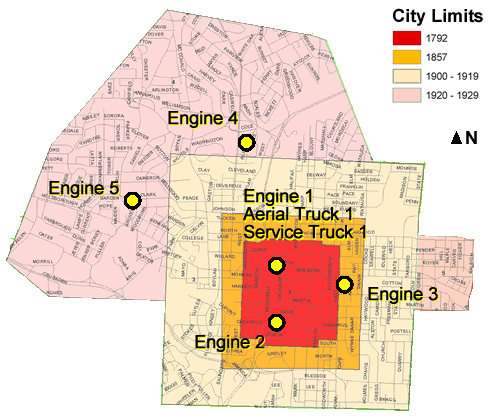
Five stations protecting 7.3 square miles and 37,379 residents.
Two-story brick cafe at 230 Fayetteville Street burned. The 4:30 a.m. alarm
was transmitted from Box 21. Four lines and 1,100 feet of hose were used. (May 24, 1930)rfd
Commercial building at 215 S. Wilmington Street burned. The 7:01 p.m. alarm
was received by telephone. Three lines and 1,200 feet of hose were used on the two-story, brick building. (July 15, 1930)rfd
Barber shop at 219 S. Wilmington Street burned. The 6:20 a.m. alarm
was transmitted from box 216. Three lines and 1,800 feet of hose were used on the two-story, brick building. (July 25, 1930)rfd
Residence at 230 E. Morgan Street burned. The
4:00 p.m. alarm was transmitted by telephone. Three lines and 1,350 feet of hose
were used at the two-story, frame building. (July 31, 1930)rfd
City Auditorium at 1-19 E. Davie Street burned.
Building was adjacent to City Hall. Many municipal papers destroyed, included Fire Department records. The 11:58 alarm
was received by telephone. Seven lines and 3,200 feet of hose were used on the three-story, brick structure. Total loss
was $84,600.
[MF] (October 24, 1930)rfd
Holloway Cabinet Shop at 514 Fayetteville Street burned. The 3:45 a.m. alarm
was transmitted from box 342. Three lines and 2,700 feet of hose were used at the two- story, brick building. (December 6, 1930)rfd
Mulligan Furniture Company at 112 W. Hargett Street burned. The 1:30 a.m. alarm
was transmitted from box 361. Three lines and 1,650 feet of hose were used on the two-story, brick structure. (December 14, 1930)rfd
Hill's city directory dated 1930 summarized department as:
- Headquarters - 110-112 W. Morgan - tel 414
- Chief - W. Ernest Holland
- Assistant Chief - Earlie B. Smith
- Second Assistant Chief - R. D. Upchurch
- Engine Company No. 1, 110 W. Morgan - F. S. Solomon, Captain
- Truck Company No. 1, 110 W. Morgan - E. D. King, Captain
- Engine Company No. 2, 412 S. Salisbury - Grady W. Higgins, Captain
- Engine Company No. 3, 135 E. Hargett - W. L. Choplin, Captain
- Engine Company No. 4, 505 Jefferson - Alvin B. Lloyd, Captain
- Engine Company No. 5, 1914 Park Dr. - Edward G. McGhee, Captain.
1931
Residence at 218 Linden Avenue burned. The 9:40 a.m. alarm
was received by telephone. Three lines and 1,200 feet of hose were used on the one-story, frame structure. (January 17, 1931)rfd
Two-story brick building at Hargett and Wilmington Streets burned. The 3:00 a.m. alarm
was transmitted from box 216. Three lines and 1,000 feet of hose were used. (February 19, 1931)rfd
House and garage at Fayetteville and South Streets burned. The 1:25 a.m. alarm
was transmitted from box ___. Three lines and 850 feet of hose were used on the two-story frame building and garage. (July 11, 1931)rfd
Carolina Hotel at corner of Dawson and Hargett Streets burned. The 3:40 a.m. alarm
was transmitted from box 323. Three lines and 1,500 feet of hose were used on the nine (?)story, brick hotel. (July 17, 1931)rfd
National Board of Fire Underwriters produced report on Raleigh's fire
protection capabilities. Read entire report. (August 1931)
Salvation Army Relief Headquarters at old Raleigh
Junior High School at 109
W. Morgan Street burned. The 2:10 a.m. alarm was verbal. Four lines and 2,200 feet of hose
were used on the three-story, brick structure. (November 10, 1931)rfd
B& N Motor Company at 110 E. Morgan Street burned. The 9:00 a.m. alarm
was transmitted from box 235. Seven lines and 3,450 feet of hose were used on the two-story, brick structure.
[MF] (November 27, 1931)rfd
Sanders Motor Company at 321 S. Blount Street burned. The 7:25 p.m. alarm
was transmitted from box 261. Nine lines and 3,800 feet of hose were used on the three-story, brick garage.
[MF] (December 17, 1931)rfd
Salvation Army Relief Headquarters in auditorium of old
Raleigh Junior High School at 109
W. Morgan Street burned. Roof was destroyed by fire discovered shortly
after 9:00 p.m. Cause of fire was undetermined. The building was located directly
across the street from Fire Station 1 on W. Morgan Street. The 9:20 p.m. alarm
was verbal. Five lines and 2,600 feet of hose were used on the three-story, brick
school. [MF] (December 26, 1931)no27dec31, rfd
Hill's city directory dated 1931 summarized department as:
- Headquarters - 110-112 W. Morgan - tel 414
- Chief - W. Ernest Holland
- First Assistant Chief - Earlie B. Smith
- Second Assistant Chief - Ralph D. Upchurch
- Engine Company No. 1, 110 W. Morgan - F. Sidney Solomon, Captain
- Aerial Truck Company No. 1, 110 W. Morgan - Ellis D. King, Captain
- Engine Company No. 2, 412 S. Salisbury - Grady W. Higgins, Captain
- Engine Company No. 3, 135 E. Hargett - W. Leonard Choplin, Captain
- Engine Company No. 4, 505 Jefferson - Alvin B. Lloyd, Captain
- Engine Company No. 5, 1914 Park Dr. - Edward G. McGhee, Captain.
1932
Apartment house on Wilmington Street burned. The 4:10 p.m. alarm
was transmitted from box 17. Three lines and 1,500 feet of hose were used on the two-story, frame building. (March 15, 1932)rfd
Capital Jewelry Company at 18 E. Hargett Streets burned. The 10:20 p.m. alarm
was transmitted from box 216. Three lines and 750 feet of hose were used on the two-story, brick store. (March 18, 1932)rfd
Fire occurred on Lenoir Street. The 3:37 a.m. alarm
was transmitted from box 332. Three lines and 1,000 feet of hose were used. (April 10, 1932)rfd
Two-story, frame apartment building at 321 E. Morgan Street burned. The 9:34 a.m. alarm
was received by telephone. Five lines and 3,150 feet of hose were used. Adjacent two-story frame residence at 323 E. Morgan Street also burned.
[MF] (April 22, 1932)rfd
Railroad roundhouse at 201 W. Johnson Street burned. The 8:54 p.m. alarm
was received from box 421. Six lines and 3,800 feet of hose were used. The blaze destroyed the machine shop building and badly damaged the roundhouse at the Seaboard Air Line Railway Company yards. Eight locomotives
were also damaged in addition to the wooden frame structures. A total of 22 engines
were stored in the 50-year-old roundhouse at the time. Every fire engine in the city except one responded and water
was pumped for three and four blocks away. Firefighters battled the difficult blaze by climbing on top of the unburned portion of the roundhouse and pouring water into the burning part. Hundreds of spectators
were attracted to the blaze that brilliantly lighted the skies.
[MF] (June 15, 1932)rfd, no16jun32
Station 2 moves to Memorial Auditorium. City retained ownership of
the old station at 412
S. Salisbury Street. Photos and more information.
(After August 14, 1932)yb84, no, rt
Hill's city directory dated 1932 summarized department as:
- Headquarters - 110-112 W. Morgan - tel 414
- Chief - W. Ernest Holland
- First Assistant Chief - Earlie B. Smith
- Second Assistant Chief - Ralph D. Upchurch
- Engine Company No. 1, 110 W. Morgan - F. Sidney Solomon, Captain
- Aerial Truck Company No. 1 & Truck Company No. 1, 110 W. Morgan - Ellis D. King, Captain
- Engine Company No. 2, E. Worth corner Fayetteville - Grady W. Higgins, Captain
- Engine Company No. 3, 135 E. Hargett - W. Leonard Choplin, Captain
- Engine Company No. 4, 505 Jefferson - Alvin B. Lloyd, Captain
- Engine Company No. 5, 1914 Park Dr. - Edward G. McGhee, Captain.
1933
Dairy Barn at State College burned. The 10:45 p.m. alarm
was received by telephone. Three lines and 1,400 feet of hose were used on the one-story, frame building. (April 6, 1933)rfd
Freight train derailed in Morrisville. The Southern Railway train derailed at 4:30 a.m. in the center of town. No crew members
were injured, but a search was made for a missing hobo. Flames broke out in a tank car filled with gasoline and spread to nine box cars piled three-high along the highway. Firefighters from both Raleigh and Durham extinguished the flames before the post office and other buildings across the highway
were endangered. Morrisville was located 13.59 miles from Station 1.
[MA] [RA] (April 28, 1933)rt23apr33
Legislation proposed to provide civil service
projection to Raleigh firemen. They would be employed and regulated by
Civil Service Board, after bill introduced in State Senate by Wake County
Senator John W. Hinsdale. The three-member board would have the power to
discharge any fireman convicted of performing any political function other than
voting. No candidate would be eligible for appointment to Fire Chief unless they
have been a member of the department for the previous five years, and would be
chosen by the Commissioner of Public Safety with approval of the Mayor and
Commissioner of Public Works. The Civil Service Board would be named within 30
days after ratification of the act. Competitive examinations for employment
would be open, as needs arise, to "all white persons possessing the rights of
suffrage and meeting requirements prescribed by the board." Notices of
examinations would have to be published two weeks prior. Firefighters "liable to
dismissal" would have the opportunity of a public hearing the before the board
at least 10 days after notice of such charges. (April 6, 1933)no07apr33
Three-story, frame residence on E. Edenton Street burned. The 4:48 a.m. alarm
was transmitted from Box 15. Three lines and 1,300 feet of hose were used. (December 5, 1933)rfd
Hill's city directory dated 1933 summarized department as:
- Headquarters - 110-112 W. Morgan - tel 414
- Chief - W. Ernest Holland
- First Assistant Chief - Earlie B. Smith
- Second Assistant Chief - Ellis B. King
- Engine Company No. 1, 110 W. Morgan - W. Ralph Butts, Captain
- Aerial Truck Company No. 1 & Truck Company No. 1, 110 W. Morgan - John G. Harrison, Captain
- Engine Company No. 2, 412 E Worth corner Fayetteville - R. Lee Matthews, Captain
- Engine Company No. 3, 135 E. Hargett - W. Leonard Choplin, Captain
- Engine Company No. 4, 505 Jefferson - Alvin B. Lloyd, Captain
- Engine Company No. 5, 1914 Park Dr. - Edward G. McGhee, Captain.
1934
Residence at 824 Brooklyn (?) burned. The 1:36 a.m. alarm
was received by telephone. Three lines and 950 feet of hose were used. (July 23, 1934)rfd
Residence at 505 E. Davie Street burned. The 11:10 p.m. alarm
was transmitted from box 212. Four lines and 1,800 feet of hose were used. (October 29, 1934)rfd
Hill's city directory dated 1934 summarized department as:
- Headquarters - 110-112 W. Morgan - tel 414
- Chief - W. Ernest Holland
- First Assistant Chief - Earlie B. Smith
- Second Assistant Chief - Ellis B. King
- Engine Company No. 1, 110 W. Morgan - W. Ralph Butts, Captain
- Aerial Truck Company No. 1 & Truck Company No. 1, 110 W. Morgan - John G. Harrison, Captain
- Engine Company No. 2, 412 E Worth corner Fayetteville - R. Lee Matthews, Captain
- Engine Company No. 3, 135 E. Hargett - W. Leonard Choplin, Captain
- Engine Company No. 4, 505 Jefferson - Alvin B. Lloyd, Captain
- Engine Company No. 5, 1914 Park Dr. - Edward G. McGhee, Captain.
1935
Civil Service Protection granted to Raleigh firemen. General Assembly passed a law creating a civil service commission
for the city's firefighters and police officers. This ended the practice of
patronage hiring, such as when candidates for City Commissioner rewarded
campaign supporters with jobs or promotions in the fire department. The old
system also resulted in the firing of firemen who supported losing candidates in
municipal elections. The bill was titled "An Act to Create a Civil Service Commission for the Fire
Department and Police Department of the City of Raleigh and to Provide the
Necessary Machinery and Rules for the Organization and Operation of Said Civil
Service Commission and [ Fire and Police ] Departments." It required creation of a five-member Civil Service Commission. They
were granted full charge of hiring and dismissing members of the fire
department. Competitive examinations were now required for employment.
Promotions would be made by the Fire Chief, with approval of the commission.
Appointments to Fire Chief would be made by the Public Safety Commissioner, also
with approval of the commission. Dismissals required cause, and included the
opportunity for an open hearing to defend the charges. Political activity, other
than exercising the right to vote, was prohibited. (March 1, 1935)yb12
Efird's Department at 210 Fayetteville Street burned. Largest fire since City Auditorium blaze. Several people injured. Damage of approximately $250,000. Fire apparently
started in basement storeroom near Salisbury Street entrance and directly beneath the office. About 75 customers and 60 clerks
were in the store at the time the fire was discovered. Firefighters directed their initial efforts toward rescue, raising ladders and carrying down clerks who fled to the office on the mezzanine floor on the Salisbury Street side. Nearly thirty minutes
were required to make entrance at a garbage elevator shaft leading from the Salisbury Street sidewalk to the basement, as firefighters battered the doors. Hose lines numbered a dozen, at times carried atop the Grant store building and which
was protected from the flames by a heavy fire wall. The 4:30 p.m. fire attracted thousands of spectators from the business district. All policemen on duty
were called to the scene, to help with crowd control. Traffic was stopped, too, on Fayetteville and Salisbury Streets. Four former Fire Chiefs assisted, John W. Mangum, Charles D. Farmer, Sherwood Brockwell, and Hubert H. Horton. Volunteers also helped and even Reverend J. Randall Farris, of the Hillyer Memorial Church,
was seen dragging a line of hose. The 4:55 p.m. alarm was received by telephone. Eight lines and 4,950 feet of hose
were used on the three-story, brick building.
[MF] (March 25, 1935)rfd
Dixie Building at 420 Fayetteville Street burned. The 3:00 a.m. alarm
was received by telephone. Four lines and 2,200 feet of hose were used on the three-story, brick building. (May 13, 1935)rfd
Cameron park Apartments at 1213 Hillsboro Street burned. The 10:30 a.m. alarm
was transmitted from box 341. Four lines and 2,100 feet of hose were used on the three-story, brick building. (May 31, 1935)rfd
Two-story, frame residence at 305 W. Jones Street burned. The 12:45 a.m. alarm
was transmitted from box 422. Four lines and 1,600 feet of hose were used. (June 9, 1935)rfd
Mattress factory at Central Prison at 835 W. Morgan
Street destroyed by fire.
Fire was discovered about 3:30 p.m. at the one-story, frame building located
several hundred feet from the main building. Destroyed were a quantity of wheat
straw, five bales of mattress material, and 120 mattresses. Total damages amounted
to less than $1,000. Male prisoners gather to watch and some assist Raleigh
firefighters. The 3:35 p.m. alarm was received y telephone. Three lines and 750
feet of hose were used. (August 1, 1935)no02aug35, rfd
Crosby-Garfield School at 568 E. Lenoir Street burned. The 3:18 p.m. alarm
was transmitted from box 242. Five lines and 3,150 feet of hose were used on the two-story, brick school.
[MF] (November 22, 1935)rfd
One-story frame residence at 728 Nash Drive burned. The 8:45 a.m. alarm
was received by telephone. Three lines and 1,800 feet of hose were used. (December 20, 1935)rfd
Just after Christmas, on account of several days of sub-freezing
temperature, the City Commissioners agreed to permit ice skating on Lake Howell
at Pullen Park, with police supervision. Years later, former Fire Chief Jack Keeter recalled that the temperature dropped below zero and stayed there. The
ice wasn't thick but it provided a base. The fire department... dumped an inch
of water over the thin coating of ice; it froze solid overnight and they
repeated the process two or three times until there was a safe depth of ice over
the entire lake. Hundreds of people ice-skated; onlookers made bonfires out of
railroad crossties near the lake. (December, 1935)pph
Hill's city directory dated 1935 summarized department as:
- Headquarters - 110-112 W. Morgan - tel 414
- Chief - W. Ernest Holland
- First Assistant Chief - Earlie B. Smith
- Second Assistant Chief - Ellis B. King
- Engine Company No. 1, 110 W. Morgan - W. Ralph Butts, Captain
- Aerial Truck Company No. 1 & Truck Company No. 1, 110 W. Morgan - John G. Harrison, Captain
- Engine Company No. 2, 412 E Worth corner Fayetteville - R. Lee Matthews, Captain
- Engine Company No. 3, 135 E. Hargett - W. Leonard Choplin, Captain
- Engine Company No. 4, 505 Jefferson - Alvin B. Lloyd, Captain
- Engine Company No. 5, 1914 Park Dr. - Edward G. McGhee, Captain.
1936
Staudt's Bakery at 1205 Harrison Avenue burned. The 10:11 p.m. alarm
was transmitted from box 341. Three lines and 1,150 feet of hose were used on the two-story, brick
building. (February 20, 1936)rfd
Apparatus delivered: 1936 American LaFrance 400 Series pumper,
1000/100. Delivered by August 7, 1936. Placed in service as Engine 1. Photos and more information. (August 1936)alf,
no07aug36
Motor Service Company burned. The 8:05 a.m. alarm
was transmitted from box 312. Seven lines and 3,500 feet of hose were used on the
three-story, cement building.[MF] (July 20, 1936)rfd
Fire department hosted 49th annual convention of North Carolina
State Firemen's Association. The four-day program opened at Memorial Auditorium and concluded with a motorized apparatus tournament on Oberlin Road at Fire Station 5. Chief W. Ernest Holland
was elected President of the association and was the first Raleigh firefighter to hold the title. (August 10, 1936)no09aug32, no10aug32, no11aug32, no12aug32
Seaboard Air Line Railway shop at 201 W. Johnson Street burned. Early
morning blaze destroyed old roundhouse after discovery about 4:30 a.m. Building
was called the back shop since its abandonment years ago as a roundhouse. Lost
machinery and equipment was estimated at least $10,000. Four lines and 2,000 feet
of hose were used on the one-story, brick structure. The 4:35 a.m. alarm was transmitted from box 421. (December 8, 1936)no09dec36, rfd
Hill's city directory dated 1936 summarized department as:
- Headquarters - 110-112 W. Morgan - tel 414
- Chief - W. Ernest Holland
- First Assistant Chief - Earlie B. Smith
- Second Assistant Chief - Ellis D.. King
- Engine Company No. 1, 110 W. Morgan -R. Lee Matthews, Captain
- Aerial Truck Company No. 1 & Truck Company No. 1, 110 W. Morgan - W. Ralph Butts, Captain
- Engine Company No. 2, E Worth corner Fayetteville - John G. Harrison, Captain
- Engine Company No. 3, 135 E. Hargett - W. Leonard Choplin, Captain
- Engine Company No. 4, 505 Jefferson - Alvin B. Lloyd, Captain
- Engine Company No. 5, 1914 Park Dr. - Edward G. McGhee, Captain.
1937
The Gateway on Highway 15-A, two miles south of Raleigh destroyed by fire.
Alarm received at 12:15 a.m. for the Carolina Pines roadhouse. All occupants
escaped and a dog was rescued later by firefighters and police officers. Raleigh
fire truck responded but was unable to pump water from a pond near the fire. The
building burned to the ground by 2:00 a.m. Scores of couples attending a dance at
Memorial Auditorium ending at midnight were also attracted to the scene as the
sky was brilliantly lighted by the scene and visible for several miles. (January
30, 1937)no31jan37
Residence on Ridge Road near Meredith College campus burned to ground.
The morning alarm was answered from a fire station three miles
away. Fire was confined to basement. The absence of hydrants prevented
firefighters from doing more than helping to remove furniture from the home and
throwing chemicals on a nearby residence to prevent it from catching fire.
(March 17, 1938)no18mar38
Booster pumping used for first time after fire destroyed residence just outside city limits.
Home of George W. Mordecai on Wake Forest Road had second-story destroyed. First
floor saved after two-hour fight. The blaze was discovered shortly before 3 p.m.
Fire Chief W.E. Holland arrived with two companies after the first alarm was
telephoned in. The home was located at the intersection of Wake Forest and
Whitaker Mill roads, approximately one mile from the city limits. Because of
lacking water supply, firemen ran one two-inch hose from an oil plant 300 yards
away, utilizing booster pumps at both ends of the line. One pumper was parked at
the oil plant, another was parked at the house. Members of the Mordecai family
and their servants were home when the fire was discovered. (June 3, 1937)no
Carolina Tractor at 733 W. Hargett Street burned. Four lines and 2,500 feet of hose
were used on the one-story, brick building. The 9:47 a.m. alarm was received by telephone. (December 9, 1937)rfd
Hill's city directory dated 1937 summarized department as:
- Headquarters - 110-112 W. Morgan - tel 414
- Chief - W. Ernest Holland
- First Assistant Chief - Earlie B. Smith
- Second Assistant Chief - Ellis D.. King
- Engine Company No. 1, 110 W. Morgan -R. Lee Matthews, Captain
- Aerial Truck Company No. 1 & Truck Company No. 1, 110 W. Morgan - W. Ralph Butts, Captain
- Engine Company No. 2, E Worth corner Fayetteville - John G. Harrison, Captain
- Engine Company No. 3, 135 E. Hargett - W. Leonard Choplin, Captain
- Engine Company No. 4, 505 Jefferson - Alvin B. Lloyd, Captain
- Engine Company No. 5, 1914 Park Dr. - Edward G. McGhee, Captain.
1938
Fire Chief's report for January: Forty-one alarms answered with total damages of $1,510. Buildings and contents at risk valued at $25,975 with total insurance on same $17,650. Out of the 41 alarms, 16 were false and 7 unnecessary. Two of the calls requested aid outside of the city limits. Twenty-two alarms came by telephone and 19 from alarm boxes. Fires were extinguished using 72 feet of ladders and 2,270 feet of hose. Pumps were operated for 40 minutes. rt01feb38
Paper warehouse on Concord Street destroyed by fire.
Early morning fire attracted several thousand spectators shortly before midnight.
Hundreds of bales of waste paper were still burning in the morning. Raleigh
firefighters answered the call and laid two lines, though the warehouse was located
over a half-mile from the City limits. Despite availability of water lines
serving nearby residences, building burned to ground. Blazing warehouse was within
a few yards of the Atlantic Refining Company's storage plant, but a strong
northeast wind fanned flames away from the tanks and the gasoline was never in
danger. (February 1, 1938)no02feb38, rt02feb38
International Association of Fire Fighters (IAFF) local chapter 548 chartered.
At the time of application, dated February 4, the Temporary President was K.
J. Smith and the Temporary Secretary was R. G. Davis. They soon elected the
first officers: President, Vice President, Recording Secretary,
Secretary-Treasurer, and Chaplain. The first president was Robert Glenn
Davis. There were twenty-one charter members:
- J. M. Burnette
- E. L. Knight
- K. J. Smith
- V. G. Mims
- W. R. Butts
- J. G. Harrison
- O. K. Ellen
- J. B. Ledbetter
- R. G. Wiggs
- D. E. Caudle
- U. N. Ennis
|
- C. D. Mills
- T. M. Poole
- R. T. Bray
- J. T. White
- R. G. Davis
- J. R. Marshall
- P. E. Nordon
- P. L. Abevette
- E. G. McGee
- J. R. King.
|
The charter fee was $10.00 and dues were $1.00 per month for active members. (by May 1, 1938)rpffa records,
chb
Tower at Station 1 demolished. For years the city
had wanted to demolish the combination bell, hose, and training tower, which
was several inches off-center. Considered cost-prohibitive, the demolition finally proceeded during construction of an addition to the adjacent Revenue Building.
Because contractor H. L. Coble couldn't get his trucks through the seven-foot alley between the buildings, the wrecking job
was performed for free. (March, 1938)no04mar38
Sir Walter Shoe Shop downtown burned. Fire
spread to basement of Capitol Restaurant next door. Flames also made their way
upward and through the walls to the "cleaning establishment of Gus Russo."
(Monday of or before April 4, 1938)rt04apr38
Three-story frame building at 422 S. Dawson Street burned. The 1:12 p.m. alarm
was received by telephone. Three lines and 550 feet of hose were used. (April 7, 1938).rfd
Washington High School For Negroes at 1000 Fayetteville
Road damaged by fire. Raleigh's largest school was unoccupied at the time of the fire, "discovered at 9 p.m." Fire swept across a major portion of the roof, sections of which
had collapsed by the time the fire was brought under control "shortly before 11 o'clock." Cause of fire
was unknown and apparently started "on the top floor of the three-story building." Fire Chief W. E. Holland suffered a "dangerous cut on his right wrist" and
was taken to Rex Hospital where he received "three stitches" before returning to the fire. "Great billows of black smoke rose as the tar burned furiously" and "smoke hung low, and, swept by a light easterly breeze, settled over nearby State Highway 15-A, endangering traffic." Four pumpers poured "thousands of gallons of water" into the burning structure. Firemen experienced "considerable trouble with bursting hose." One hose
split that was located "near a group of Negro spectators, knocking one woman to the ground and drenching about a dozen others." The 4:05 p.m. (?)alarm
was received by telephone. Four lines and 4,060 feet of hose were used in the
three-story, brick structure. (November 3, 1938)no04nov38, rfd
Barbee Bonded Warehouse building at northeast corner of Wilmington and
Lenoir streets burned. Fire started about 11:45 p.m. and the roof collapses
before firemen can "train a hose on it." The entire contents of the warehouse
were destroyed, "about 180 bales of cotton belonging to Parker Brothers and
Company." The fire was brought under control "shortly before 1 o'clock." Four
fire trucks responded to the 11:49 p.m. alarm, which was transmitted from box 27.
Three lines and 2,050 feet of hose were used. (November 12, 1938)no13nov38, rfd
News & Observer article dated February 15 noted "city has eight motorized units, the latest one purchased two years ago at a cost of $13,500"
Hill's city directory dated 1938 summarized department as:
- Headquarters - 110-112 W. Morgan - tel 414
- Chief - W. Ernest Holland
- First Assistant Chief - Earlie B. Smith
- Second Assistant Chief - Ellis D.. King
- Engine Company No. 1, 110 W. Morgan -R. Lee Matthews, Captain
- Aerial Truck Company No. 1 & Truck Company No. 1, 110 W. Morgan - W. Ralph Butts, Captain
- Engine Company No. 2, E Worth corner Fayetteville - John G. Harrison, Captain
- Engine Company No. 3, 135 E. Hargett - W. Leonard Choplin, Captain
- Engine Company No. 4, 505 Jefferson - Alvin B. Lloyd, Captain
- Engine Company No. 5, 1914 Park Dr. - Edward G. McGhee, Captain.
1939
Ammon's Clothing Store at 235 Fayetteville Street burns, a one-story brick building. The 6:46 p.m. alarm
was received by telephone. Nine lines and 450 feet of hose were used.
[MF] (March 23, 1939).rfd
Fire Chief W. E. Holland removed from duties, after "confined by illness."
Second Assistant Chief Ellis D. King assumed duties. (Spring 1939)no08apr39
Florist shop at Polk and Watauga Streets burned. The 7:20 p.m. alarm
was received by telephone. Three lines and 1,800 feet of hose were used. (April 2, 1939)rfd
Ellis D. King appointed sixth Fire Chief,
serves 1939-1941. King joined the fire department in 1921. He succeeded
Chief Holland. (May 4 or 11, 1939)cm
Norfolk-Southern Railroad maintenance shop in Glenwood Yards
on Sunrise Avenue destroyed by fire. Fire broke out at 11:45 a.m. but
was under control by 12:15 p.m. Raleigh's biggest fire in months, fueled by burning oil and grease, produces tall columns of smoke,
attracted hundreds of residents to the Roanoke Park section of the city. Three locomotives
were damaged. Total damage was estimated at $31,000. The 11:47 a.m. alarm was received by telephone. Three lines and 2,000 feet of hose
were used. (May 18, 1939)
Raleigh Burlap Bag Company building at 420 S. Salisbury Street burned. Three people, "trapped by flames and smoke in their second-story apartment,"
were rescued.. Lieutenant K. G. Smith "from Station No. 1" mounted a ladder erected "as the fire truck arrived" and assisted Miss Dorothy Gottlieb, 18, her father, Joseph M. Gottlieb, 44, and maid, Hattie Dixon, down the ladder. Screams of the two women "awakened a number of guests in the Sir Walter Hotel, half a block away." Blaze
was discovered at 2:35 a.m. Damage to the building was estimated at $400. The 2:18 a.m. (?)alarm
was received by telephone. Three lines and 1,250 feet of hose were used at the
two-story, brick building. (May 24, 1939)no24may04, rfd
Apartment building at Hillsboro and St. Mary's street burns, a three-story, brick building. The 3:30 a.m. alarm
was transmitted from box 38. Three lines and 1,800 feet of hose were used. (June 7, 1939).rfd
Apartments at 322 S. Blount street burns, a two-story, brick building. The 1:25 p.m. alarm
was transmitted from box 215. Three lines and 1,450 feet of hose were used. (June 24, 1939)rfd
Neiman's Jewelry Store burned. Alarm was received 7:45 p.m. during torrential downpour that disrupts traffic and
telephone service. Damage was between $1,000 and $2,000. Can of benzene
cleaning fluid stored under the store was apparently ignited by small welding
torched used that day (July 20, 1939)no21jul39
News & Observer article dated July 19 noted motor vehicle inventory of
city included "five fire trucks" and "three other pieces of firefighting equipment (including one fire truck that won't work)" (July 19, 1939)
Seaboard Railroad commissary at 201 W. Johnson Street destroyed by fire.
Blaze started while employees were "firing a stove" in the cafe. Three
railroad employees tried "vainly to put out the blaze with hand
extinguishers." Damage estimated at around $15,000. Building also contained
general merchandise sold to railroad workers and district offices for the
commissary company. Firefighters kept the flames from spreading to the
roundhouse and other buildings. The fire was extinguished after two hours.
The 1:57 a.m. alarm was received by telephone. Three lines and 1,150 feet of
hose were used. (November 29, 1939)rfd
Apparatus delivered: 1939 American LaFrance Series
500 tractor with rebuilt 1916 American LaFrance Type 17 aerial ladder.
Contract for the $9,000 rebuilding was awarded on September 8, 1939. Photos and more information. (by December 16, 1939)ccm,
no09sep39
Hill's city directory dated 1939 summarized department as:
- Headquarters - 110-112 W. Morgan - dial 6514
- Chief - Ellis D.. King
- First Assistant Chief - W. Ralph Butts
- Second Assistant Chief - Alvin B. Lloyd
- Engine Company No. 1, 110 W. Morgan - Kenneth J. Smith, Captain
- Aerial Truck Company No. 1 & Truck Company No. 1, 110 W. Morgan - Chas L Hayes, Captain
- Engine Company No. 2, E Worth corner Fayetteville - R. Lee Matthews, Captain
- Engine Company No. 3, 135 E. Hargett - W. Leonard Choplin, Captain
- Engine Company No. 4, 505 Jefferson - John G. Harrison,, Captain
- Engine Company No. 5, 1914 Park Dr. - Edward G. McGhee, Captain.
Abbreviations
|
[AA] |
|
Aircraft accident |
| [AI] |
|
Apparatus incident |
| [EF] |
|
Early fire |
|
[HM] |
|
Haz-mat incident |
|
[MA] |
|
Mutual Aid |
|
[MF] |
|
Major fire |
|
[RA |
|
Railway accident |
| [TF] |
|
Tanker fire |
| [TR] |
|
Technical rescue |
| [UD] |
|
USAR deployment |
|
[UF]
|
|
Unusual fire |
|
[UI] |
|
Unusual incident |
|
[WE] |
|
Weather event |
Sources
| ar |
|
City of Raleigh Annual Report |
| bd |
|
City of Raleigh budget documents |
| cvh |
|
Cameron Village: A History 1949-1999,
Nan Hutchins, Sprit Press, 2001 |
| cad |
|
City of Raleigh Auditor's Office |
| ccm / cm |
|
City Council Minutes / City Minutes |
| ccor |
|
1792-1892, The Centennial Celebration of
Raleigh, NC, Kemp D. Battle, Edwards and Broughton, 1893 |
| cer |
|
Chief Engineer's Report |
| dah |
|
North Carolina Department of Archives and
History |
| dahni |
|
North Carolina Department of Archives and
History News and Observer index |
| fp |
|
City of Raleigh Fire Protection Study |
| hr |
|
Historical Raleigh with Sketches of Wake
County and its Important Towns, Moss N. Amis, 1912 |
| oh |
|
Oral History |
| mjlr |
|
Mike Legeros records. |
| mp |
|
Morning Post |
| nc |
|
North Carolinian |
| no |
|
News and Observer |
| noi |
|
News and Observer
Index |
| pb |
|
Peter Brock |
| pph |
|
Pullen Park History |
| rla |
|
Raleigh Fire Department Ladies Auxiliary
scrapbooks |
| rpu |
|
Raleigh Fire Department Photo Unit records |
| rr |
|
Raleigh Register |
| rt |
|
Raleigh Times |
| ruh |
|
Raleigh: An Unorthodox History |
| yb84 |
|
Raleigh Fire Department 1984,
Raleigh Fire Department, Taylor Publishing, 1984 |
| yb02+ |
|
Raleigh Fire and Rescue: 1984-2002,
Raleigh Fire Department, Taylor Publishing, 2002, plus additional
historical information also compiled by the Raleigh Fire Department
around 2002. |
| wch |
|
Wake: Capital County of North Carolina -
Volume 1, Prehistory Through Centennial, Elizabeth Reid Murray,
Capital County Publishing, 1983 |
Copyright 2023 by Michael J. Legeros
|