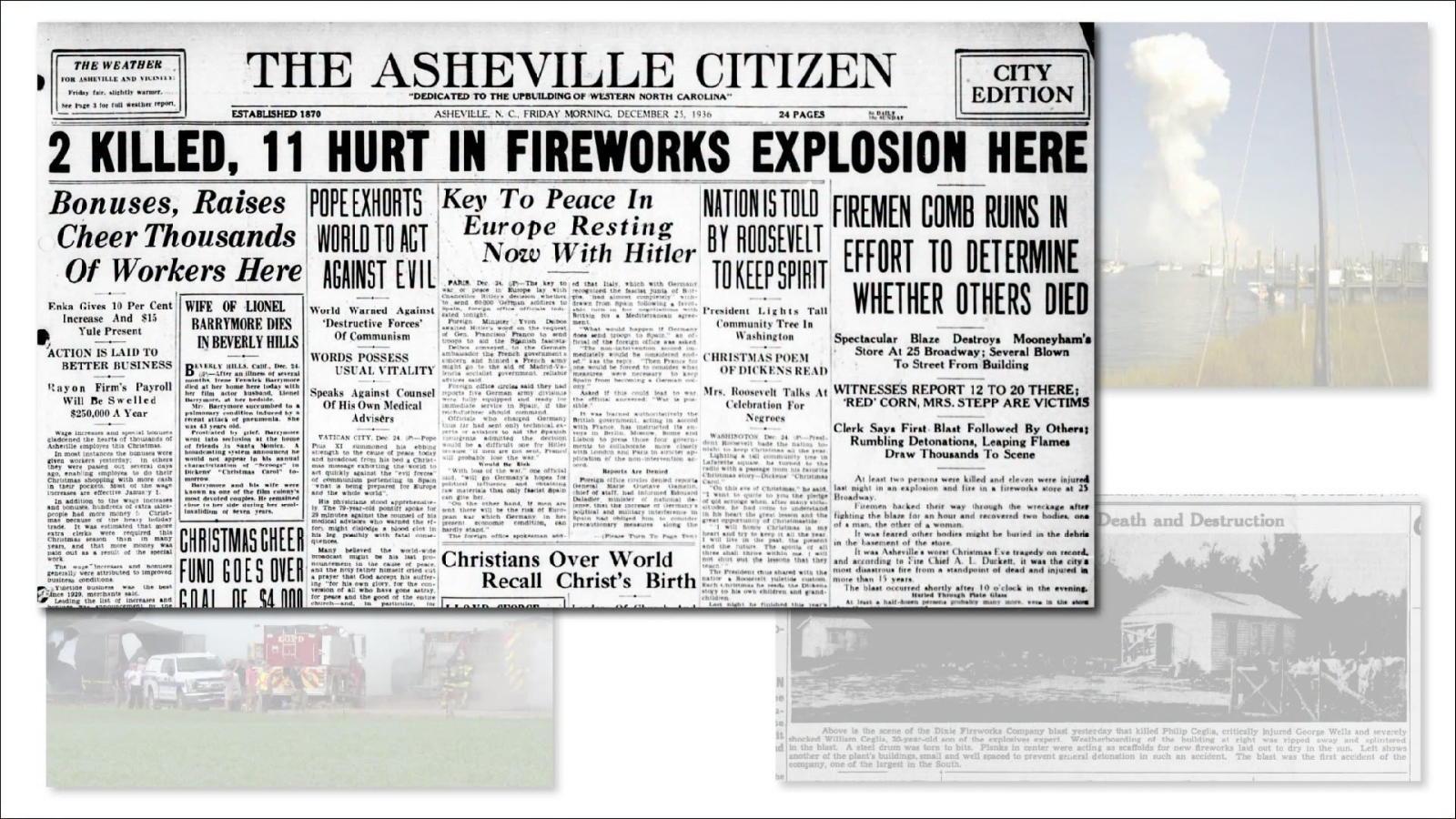
This is part two of a multi-part series about fireworks incidents and disasters in North Carolina. Read others: Part 1 | Part 3
Part 2 – Asheville Fireworks Store Explosion – December 24, 1936
See source materials in this Google Drive folder.
Asheville Fireworks Store Explosion
December 24, 1936
On Christmas Eve, 1936, around 10:13 p.m., a fireworks store at 25 Broadway Street in downtown Asheville exploded. Two people were killed and 11 others were injured. It occurred in a retail area that was busy with shoppers finishing their holiday shopping.
The explosion was followed by a series of smaller blasts that continued for several minutes, reported the next day’s Asheville Citizen. The first explosion “blew several persons in the store out into the street.” Those outside the building said the blast “almost knocked them to their feet.”
The Asheville Fire Department received the first alarm at 10:13 p.m. A general alarm followed, with seven of the city’s eight fire companies responding to the scene. They included the units from Station 1, just up the block at Pack Square.
“Scores of volunteers assisted the firemen with their work,” reported the next day’s newspapers. The explosion “demolished” the two-story business.
Killed were a 30 year-old male employee of the store and a 38 year-old woman (customer?).
The injured people ranged in ages from 12 to 29, with injuries ranging from burns, cuts and bruises, and eardrum damage.
The most seriously injured victim was the brother of the store owner, who was transported and admitted to Mission Hospital. The other ten were discharged after receiving attention at the hospital.
The owner later asked authorities to investigate if the store was “dynamited,” believing vandals caused the explosion.
From Sanborn Maps in 1917 and 1956, the building was a two-story brick business, mid-block between Walnut and College. It adjoined other two-story buildings on either side.
List of Victims
Killed
- Tam Francise Corn, 30, store employee, killed. Death certificate listed “sudden death” as caused by “burning and incineration of entire body.”
- Maude Stepp, 38, killed. Death certificate listed “sudden death” as caused by “burning and incineration of entire body.”
Injured
- Dave Mooneyham, store owner, cuts and bruises.
- Paul De Bruhl, 18, Woodfin, injury to eardrum.
- Walter Knight, 29, Woodfin, burns and cut on right hand.
- Willard Hobbs, 12, Greensboro, injury to legs.
- James Moore, 16, Woodfin, burns and cut on right hand.
- James P. Bradley, 22, Mars Hill, cuts and bruises.
- W. C. Wallen, 32, Oak Park road, bruises on leg, cuts on head and hands.
- Lawrence Stepp, 15, cuts and bruises. Son of the woman who was killed.
- W. H. Redmon, Marshall, shock.
- Winifred Corn, Woodfin, cuts and bruises.
- E. Simmington, 13, cuts and bruises.
Then What Happened?
The store owner, the property owner, and the city of Asheville were sued in county court by one of the injured victims, stating that the store owner was negligent because he had a defective “gasoline stove in close proximity to an open charcoal fire,” and which apparently cited the cause of the explosion.
It also noted that the store owner permitted “the firing of firecrackers in the store”[!] and allowed “employees to smoke and strike matches in the store” [!!].
The incident compelled the general assembly in February 1937 to enact legislation providing the sale or discharge of fireworks in Buncombe County. However, supervised displays at public parks and public celebrations were permitted. [1937 N.C. Public-Local Laws ch. 68 (H.B. 39), ratified Feb. 15, 1937.]
Noted state fire marshal Sherwood Brockwell in a newspaper article in December 1937, every city in North Carolina with a population over 10,000 banned both the “sale and shooting of pyrotechnical products.”
Reported the Asheville Times on September 10, 1937, three suits against the store owner and the property owner were settled in county court.
They were filed by (a.) the wife of the store employee who was killed, (b.) the owner of a jewelry repair store in the same building, whose equipment was damaged, and (c.) the juvenile son of the woman who was killed.
Also, “several other actions” had been brought against the defendants. Unsure if those also proceeded.
What Happened After That?
A statewide ban was ratified on March 27, 1947. Named “An Act to Regulate the Manufacture, Sale, Use and Display of Pyrotechnics”. Below is the summary.[1]
- Section 1 — Made it unlawful throughout North Carolina to manufacture, purchase, sell, deal in, transport, possess, receive, advertise, use, handle, exhibit, or discharge pyrotechnics except as authorized by the act.
- Section 2 — Authorized common carriers to transport fireworks in the ordinary course of business.
- Section 3 — Required permits for public fireworks exhibitions.
- Section 4 — Assigned authority to county commissioners (or other designated local authorities) to issue permits for fairs, carnivals, shows, and public celebrations after determining the display could be conducted safely.
- Section 5 — Defined “pyrotechnics” broadly to include fireworks used for amusement or exhibition while exempting industrial explosives, signaling flares, and firearm ammunition.
- Section 6 — Made violations a misdemeanor.
- Section 7 — Repealed conflicting laws.
- Section 8 — Made the act effective upon ratification.
[1] Did the Asheville explosion inform the legislation, or the process of getting it passed? Unsure. Still looking for citations.