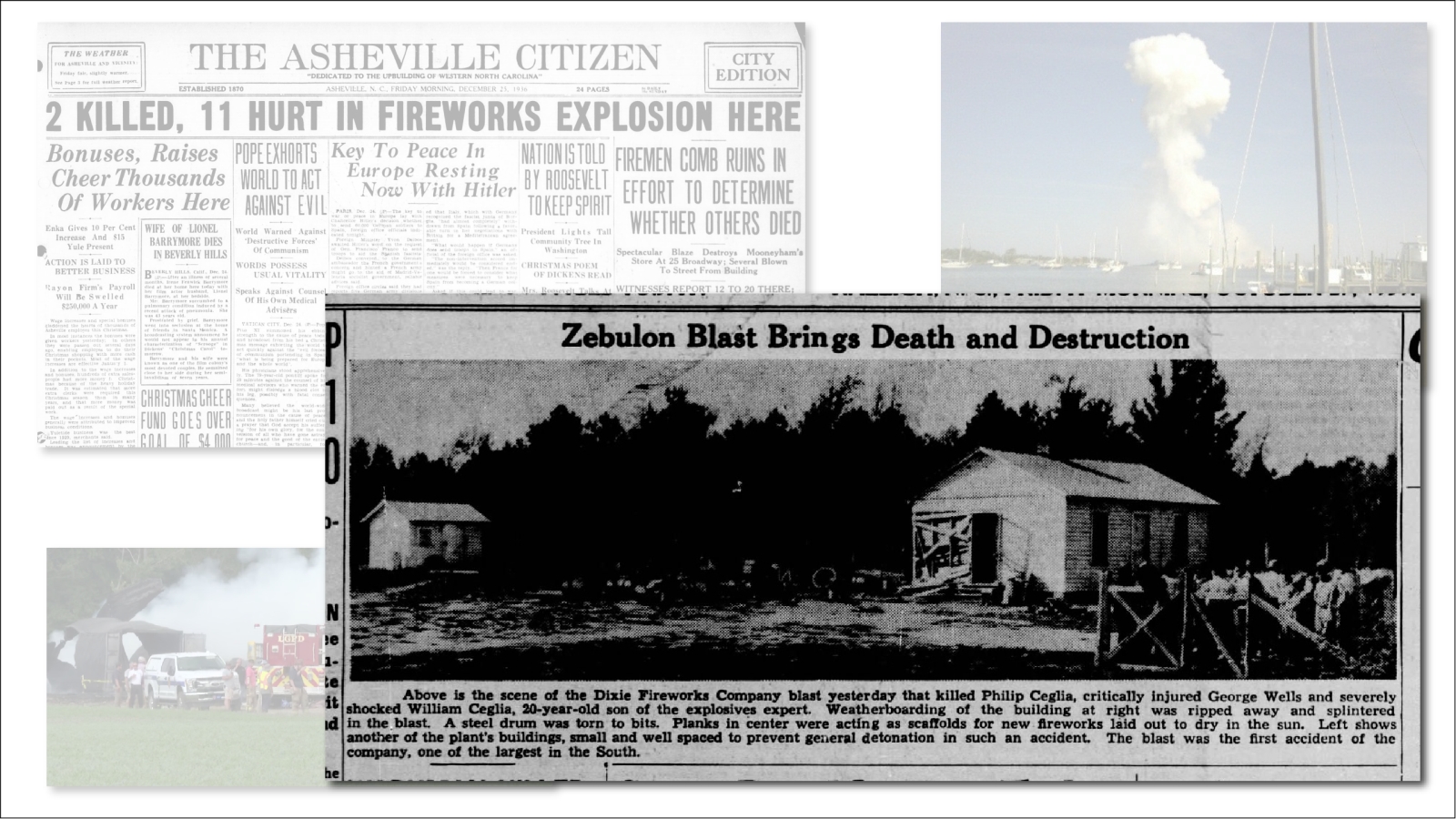
This is part one of a multi-part series about fireworks incidents and disasters in North Carolina. Read others: Part 2 | Part 3
Part 1 – Dixie Fireworks Company Explosion – Zebulon, NC – October 26, 1939
See source materials in this Google Drive folder.
Background
On October 12, 1937, the Zebulon Record ran a front-page story that the newest business in the eastern Wake County town was “flooded with many orders.” The Dixie Fireworks Plant “manufactory” was owned and operated by A. V. Medlin[1] and located in the Perry building, which was “opposite the fire house.”[2][3]
Medlin was “already known away from home as the fireworks king of the South” and he had fifteen employees. Some were “experts from the North” who supervised and performed “the more complicated part of the work.” The rest were “from this community.”
Mr. Medlin was the largest distributor of fireworks in the South, it said.
[1] Albert V. Medlin, his full name was noted in a short retrospective in the Zebulon Record on October 17, 1957.
[2] By 1939, the plant had moved outside of downtown. It was described in various articles as “just east of town,” “just outside the town limits,” and “outside the town limits on Highway 64.”
[3] Where was the Perry Building located and/or the fire station in 1937?
From 1937 to 1939
Advertisements in the Zebulon Record included a text-only ad on June 10, 1938, reading
ZEBULON, N.C.
HOME OF
Dixie Fireworks Co.
Manufacturer and Distributor
of Commercial and Display
Fireworks
Largest in the South
On July 2, 1939, the Winston-Salem Journal published a page-length, single-column feature (not including photos) on the company. Among the details were (a.) Mr. Medlin had been “connected with the pyrotechnics trade” for 18 years, (b.) his “little plant” was the largest fireworks distributing plant in the South, (c.) it consisted of “eight buildings, whose walls house powder by the tons, paste by the barrels, cardboard by the reams, and fuse by the hundreds of thousands of feet.”
The buildings were “small wooden sheds” and “spaced a good way apart” for safety. They included one for the final assembly road and others that were “loading houses” where a worker loaded “salutes, aerial bombs, and star shells the whole day through.” That is, unless there was a thunderstorm. Then, the entire plant “is closed down and the workers all hurriedly retreat to their homes.”
Because even “one spark in this plant would destroy them all, as well as the property.” And when the plant was open, there was “not a sign of electrical interference” in the loading houses. The floors were kept covered in water, to “keep the humidity of the air at a high degree.”
Among his employees were Phillip Sieglar and his three boys, including Gus, age seven.
Explosion – October 26, 1939
From the next day’s Zebulon Record:
Serious Explosion Yesterday At Dixie Fireworks Plant
One Man Killed, Another Will Probably Die
A few minutes before noon Thursday, a terrific explosion was heard in Zebulon. Very quickly word came that it was at the Dixie Fireworks place just east of town. A large crowd of people quickly assembled. The west end of the east building was splintered and pushed in. Pieces of clothing were scattered around. Blood and brains had spattered along the ground. The body of Phillip Ceglia was lying perhaps 30 feet distant from the wrecked building. It was torn and mutilated and still in death. A little farther distant lay George Wells with his face badly torn and a great hole torn in his abdomen. The ambulance hurried him to a Raleigh hospital.
Earlier in the day the editor of the Record was at the plant. Mr. Ceglia, his two sons and young Wells were all very busy bringing out newly made fireworks to dry in the sun. Thousands of these were lying on scaffolds and benches drying. Little white houses, like children houses, dotted the high fenced enclosure while far back were other smaller houses which contained the high explosives used in the manufacture of all kinds of fireworks. The powder is kept in a house to itself and brought in small quantities as needed.
The two sons of Mr. Ceglia who assist him regularly were lying down in the back end of the building where the explosion occurred. He was outside near the door, it seems, closing or packing the ends of Dago or other bombs. George Wells was nearby. No one will ever know why nor how the explosion occurred. One moment all was quiet and next the terrible explosion and death—perhaps to two men, one suddenly and the other later. Mr. Ceglia came to Zebulon a few years ago from Baltimore. He was Italian by birth. He was an expert in the manufacture of fireworks and had perfected a number of unusual noise making explosives. He only, it is said, knew the ingredients and quantities used in their manufacture.
The Dixie Fireworks is a local enterprise established several years ago by A. V. Medlin. The plant is just outside the town limits and consists of about a dozen buildings. They are built some distance apart and small in case of such an accident as occurred Thursday. Some of the most beautiful and also loudest noise producing fireworks made are manufactured by this concern. Thirty or more employees work at the plant, during the busiest season. It is said to be one of if not the largest plant of its kind in the south, its products being sold throughout the country.
More Reporting
From the next day’s Raleigh News and Observer:
Photo Caption
Above is the scene of the Dixie Fireworks Company blast yesterday that killed Philip Ceglia, critically injured George Wells and severely shocked William Ceglia, 20-year-old son of the explosives expert. Weatherboarding of the building at right was ripped away and splintered in the blast. A steel drum was torn to bits. Planks in center were acting as scaffolds for new fireworks laid out to dry in the sun. Left shows another of the plant’s buildings, small and well spaced to prevent general detonation in such an accident. The blast was the first accident of the company, one of the largest in the South.”
Story
The town of Zebulon was rocked by an explosion about noon yesterday that instantly killed a fireworks maker and seriously injured two others at the plant. Timbers were blasted from the end of a building and debris scattered in all directions.
Philip Ceglia, 49, was at work with explosives when the blast ripped off his clothing and catapulted him 50 feet into a pile of planks and steel drums. He apparently died instantly.
George Wells, 20, was rushed to Rex Hospital with a deep gash torn in his abdomen, his face lacerated and suffering numerous powder burns. His condition last night was regarded as critical.
William Ceglia, 20-year-old son of the fireworks maker, escaped with only shock. He was sleeping on a bed at the other end of the building outside which his father was working.
Summoned by the concussion that rattled windows for blocks away, citizens of Zebulon rushed to the scene to render assistance to the victims. Wells was in no condition to be questioned, and residents were at a loss to explain the detonation.
Wreckage marked the spot of perfect order of a moment before. Earlier in the day, Ceglia, his two sons and Wells had removed a batch of newly-made fireworks to dry in the sun. Thousands of the bombs were placed on scaffolds and benches near one building, far removed from other small buildings containing high explosives. After the blast, no trace of the new fireworks existed.
The only explanation offered was that Ceglia was adding fuses and packing the ends of aerial bombs—a type of skyrocket which hurls a bomb to explode in mid-air. Ingredients of the bombs, like those of many of his products, was a secret with Ceglia.
The plant was Dixie Fireworks Company, an enterprise established several years ago by Albert V. Medlin just beyond the Zebulon corporate limits. The plant included a dozen buildings, all small and spaced to avoid general detonation in the event of an explosion. As many as 30 employees worked in the plant at peak seasons. No previous accident ever occurred there.
Ceglia, an Italian by birth, came to Zebulon a few years ago from Glencoe, N.Y. He was considered an expert on explosives and perfected many novelties in the field of fireworks. The plant ranked with the largest fireworks firms in the South.
Dr. Charles E. Flowers, who identified the dead man, said the blast was “terrific.”
“It shook practically all the windows in town,” he said. “We all wondered what had happened. We thought maybe it was an earthquake or that the Germans were coming.”
Wells, a Zebulon boy, had much of his clothing torn off by the concussion, and bits of his and Ceglia’s clothes were scattered far and wide.
S. C. Eddins, operator of a filling station at Zebulon, timed the explosion between 11:30 and 11:45 o’clock yesterday morning.
Then What Happened, Part 1 – The Victims
Phillip Ceglia died in the explosion. His death certificate listed him as a married white male, 47 years old. His residence was Zebulon. The cause of death was “accidental fireworks explosion.” The time of death was 11:40 a.m. He was buried in Brookville [?], ___ [?], on October 31. The undertaker was “Zebulon Supply Co.,”. The document was filed on November 1, 1939.
George Wells died on October 29. He had been transported to Rex Hospital in Raleigh and received a blood transfusion, with blood donated by Willie B. Hopkins, who was the town’s fire chief (correct?). Wells received the transfusion on Friday night, and though “his condition was known to be desperate,” said the Zebulon Record on November 3, 1939, “he was conscious enough to recognize and thank” Hopkins. The article added that he was a former employee, but at the time of the explosion “was not connected with the firm.”
His death certificate listed him as a single while male, 19 years old. His residence was Zebulon. The cause of death was “shock – burns – lacerations – bruises – peritonitis [?]” and caused by “explosion fireworks factory.” He was buried in Zebulon[1] on the same day. The undertaker was “Zebulon Supply Co.,”. The document was filed on November 1, 1939.
[1] He was buried in Zebulon Cemetery on Saturday afternoon, October 30. The service was conducted by “Pastor Griffin,” noted the Zebulon Record on November 3.
Then What Happened, Part 2 – The Business
The company resumed operations.
Medlin died on August 23, 1942. He was 47 years old. He died of a heart condition. His wife Mamie Lee continued operating the business, though on a “small scale.”
Read an advertisement in the Zebulon Record on November 9, 1945, they offered a “complete line” and “wholesale and retail,” but were not open for retail business on Sunday. The phone was 2931. The location was Zebulon, N.C. with no street address listed.
But the company “had its demise” when the 1946 state legislature “passed an act making the sale and manufacture of fireworks illegal in North Carolina.”
Advertisement – Durham Herald Sun – December 23, 1946
FIREWORKS
WHOLESALE
Dixie Fireworks Company,
Zebulon, N.C.
We have a full line of the highest quality merchandise and especially have large stock of the fastest selling items:
Torpedoes — Sparklers — Whistling Items
2-Inch Salutes — Roman Candles — 2-3-5-9 and 10 Shots
Bull Dogs — Sky Lights — Pistols and Caps
BB Salutes — Aerial Bombs — Novelties
Fountains — Night Candles — Auto Jokers
ZEBRA CHINESE CRACKERS AND OTHERS
SPECIAL ALL NOISE ASSORTMENT
Retail value $9.15 — Special price $4.95
SPECIAL FAMILY ASSORTMENT
Retail value $18.00 — Special price $10.00
DIXIE FIREWORKS COMPANY
Zebulon, N.C.
Open from 8 A.M. to 12 Midnight including Sundays until Jan. 1st.
24 hour phone, ZEBULON 3931