This is a blog version of a Facebook posting from December 2019.
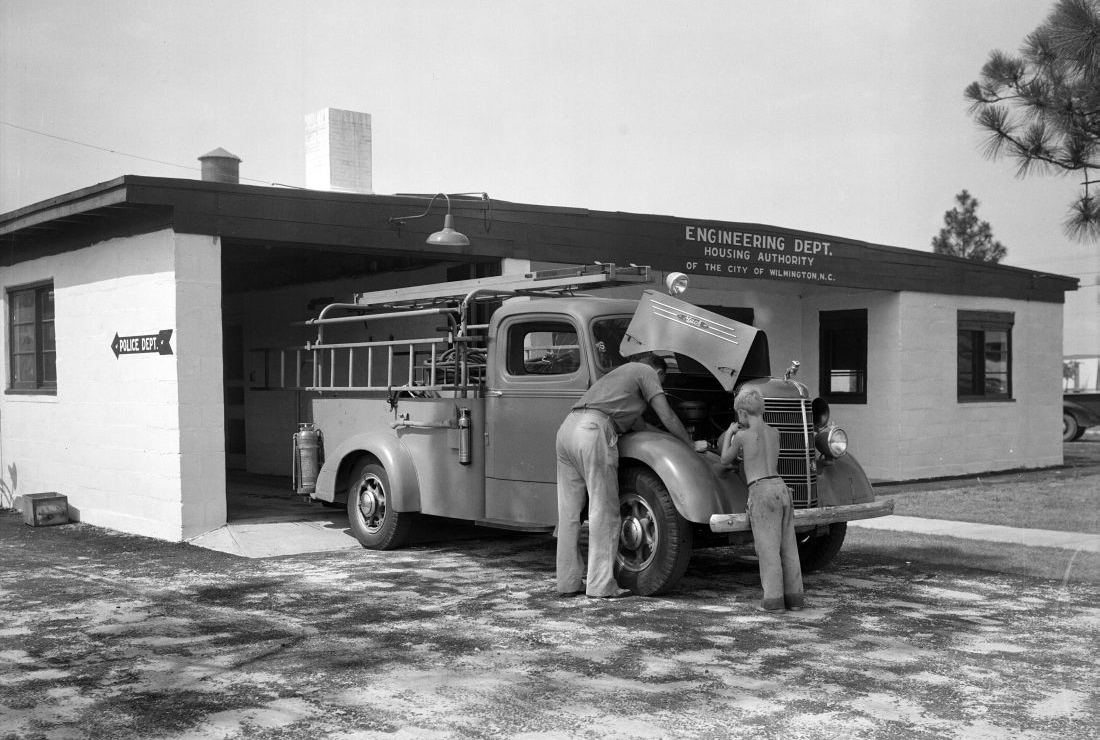
Wilmington, 1945. What are we seeing here?
Mark Stiller posted this picture to the group N.C. Old Photos and Things of Interest. [1] Almost looks like a maintenance truck, notably with the building labeled “Engineering Dept. Housing Authority.” But it’s a fire engine.
Was this one of Wilmington’s “auxiliary fire trucks” that they operated back in the day, along with Raleigh, Durham, and Greensboro? Could be, except… this truck doesn’t look like what’s pictured here: legeros.com/ralwake/photos/weblog/pivot/entry.php?id=3998
Rather, this seems more likely the truck that served Maffitt Village FD, which was an early precursor of South Wilmington FD. From this page of mine: legeros.com/history/new-hanover/south-wilmington.html
“During World War II, the population of Wilmington was exploding. By 1943, the number of residents had grown from 33,407 in 1939 to more than 120,000. Many had come to help with the country’s defense and worked for the North Carolina Shipbuilding Company on the Cape Fear River. At its height, the shipyard employed 21,000.
To help with the resulting housing shortage, the Housing Authority of the City of Wilmington helped build and manage several federally-funded projects. One was started south of the city and near the shipyard as the Captain John N. Maffitt homes.
A combination of duplexes and multi-family units, they were completed in November 1943, with a total of 4,182 units. The community also included a twelve-bed infirmary, recreation areas, and a strip mall on Vance Street, with a grocer, barber, beauty shop, drug store, and post office. Two churches were nearby, and an 800-seat theater was built across Carolina Beach Road from the Village.
The village also had a volunteer fire department by July 1950, and perhaps months or years earlier. They had a fire truck, and a garage for storing the apparatus.”
Readers, your thoughts?
[1] Source photo is N_53_16_2092 Wilmington Housing Authority Activities and Offices 1945. Photo by Albert Barden. From the Albert Barden Collection, State Archives of North Carolina, Raleigh, NC