This is a blog version of a Facebook posting.
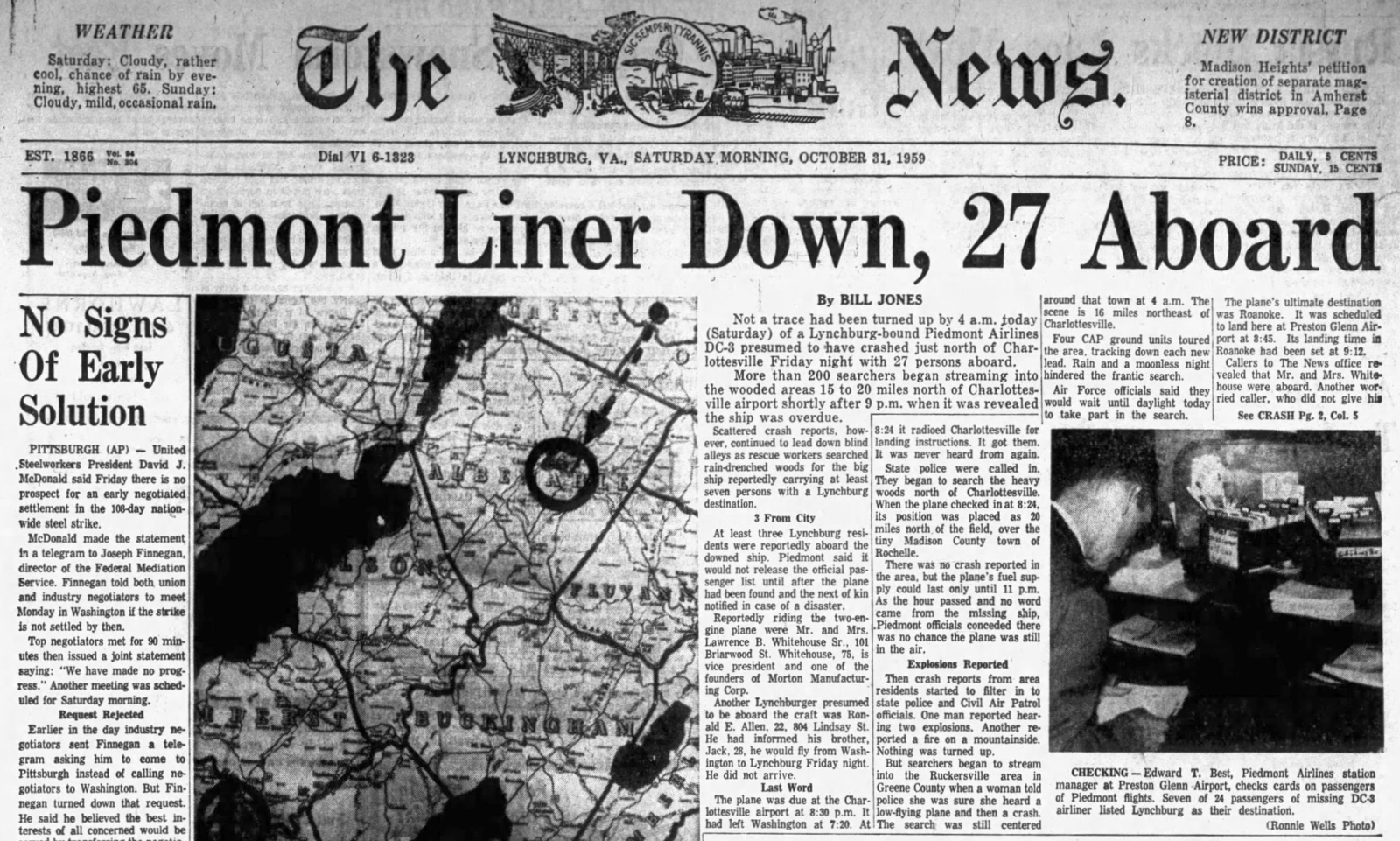
More Piedmont Airlines history. More air crash history. Before the July 1967 midair collision and crash in Hendersonville (NC) that killed 82 people [1][2], the Winston-Salem-based airline suffered two earlier fatal crashes. Let’s look back at the first one in October 1959.
Piedmont Aviation was incorporated in July 1940 as an aircraft sales and service business. Later in the decade, they expanded to passenger service. Their first scheduled flight was conducted on February 20, 1948. By February 1954, they had carried their millionth passenger since it started. They were also the first local-service airline to carry a million passengers.
[1] About the July 16, 1967, midair collision and crash, see prior posting.
[2] About an earlier incident involving the jet, struck by a car on the ground, see prior posting.
PIEDMONT AIRLINES FLIGHT 349
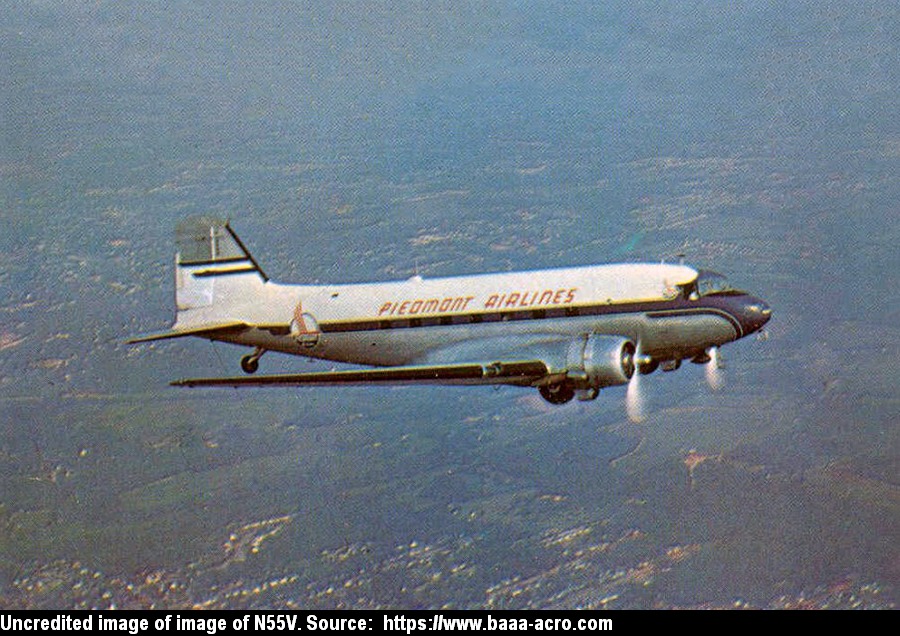
On Friday night, October 30, 1959, Flight 349 was approaching Charlottesville-Albemarle Airport in Virginia, having departed from Washington National Airport. It was operating a Douglas DC-3 named the Buckeye Pacemaker, registration number N55V. There were 27 souls aboard, including three crew members.
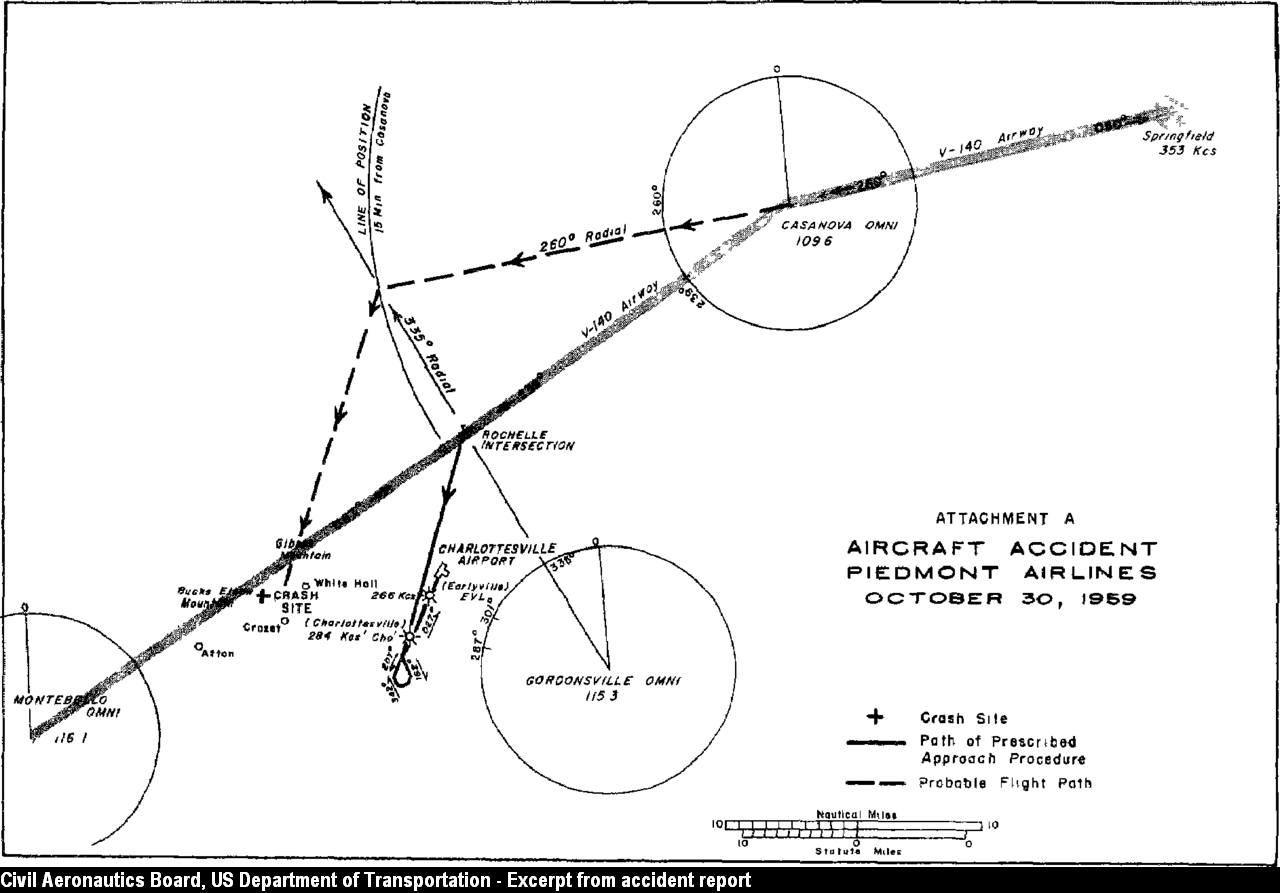
At 8:34 p.m. and six minutes away from its scheduled landing, the plane gave its last radio check. Once overdue, officials and other volunteers started searching for the aircraft. Its last radio position was determined as over the small town of Rochelle, VA, in Madison County.
The flight’s final destination was Roanoke, VA, scheduled for a landing there at 9:12 p.m.
Overdue and Presumed Crashed
Reported in the next day’s Lynchburg “News and Advance,” more than 200 searchers “began streaming into the wooded areas 15 to 20 miles north” of the airport shortly after 9 p.m. But “scattered crash reports” led rescuers “down blind alleys” as they searched the “rain-drenched woods.”
State police were called and they began searching the “heavy woods” north of the airport. There had been no crash reported, but the plane only had enough fuel to fly until 11:00 p.m.
Crash reports began to be received by the state police and Civil Air Patrol (CAP) officials. One man said he heard two explosions. Another person “reported a fire on a mountainside.” Searchers “began to stream into the Ruckersville area in Greene County” after a woman said “she was sure she heard a low-flying plane and then a crash.”
Four CAP ground units participated in the search, but Air Force officials said they would wait until daylight to join the effort.
Wreckage Located, With Survivors
On Sunday, November 1, an Associated Press story said that unofficial reports were received on Saturday night that the plane’s wreckage had been located in the Blue Ridge Mountains, about 45 miles southwest of Charlottesville. And, said the Chief of Police at Buena Vista, VA, there may be survivors.
The ”rugged Bald Mountain” was located a few miles east of the town, and that’s where a Blue Ridge Parkway ranger had spotted an unidentified object. Ranger Tom Gassright notified CAP authorities “and then plunged into the mountainous terrain.”
Added the AP story, rescue squads were called to the scene and two groups of U.S. rangers and Virginia state police “were on hand.”
Said the story, “a reliable source theorized that the pilot could have missed” the airport and then “over the mountains, tried to turn back” and instead crashed. It added, “the mountain was appreciably taller than the plane’s normal altitude of 4,000 feet.”
By that time, more than 1,000 people had participated in the search. Helicopters and other aircraft had also been used.
Added a sidebar story, a ham radio operator in Burlington, KY, overhead “shortwave messages” saying that the missing airliner had been found. He said that radio messages said that survivors were found at the scene and being taken to Buena Vista. Also, rescue units were on the scene and “all available ambulances” had been dispatched from Montebello, VA.
One Survivor
On Monday, November 2, 1959, the “Covington Virginian” reported on the discovery of the crash site as well as its lone survivor, E. Phil Bradley, 33, a “union official” from Clifton Forge, VA. The survivor recounted his “36-hour ordeal in the wilderness” after the crash.
He said the pilot never gave any indication of a problem. And when they crashed “it sounded like the roaring of an ocean” and felt like “the wings cutting the tops of the trees.”
Bradley was seated near the rear of the plane. He was thrown from the cabin while still strapped to his seat. But he was injured, suffering a dislocated hip. Unable to free himself from the seat, he found a pole and “managed to fish for a coat and blankets” to keep warm.
He remembered yelling to see if anyone else was alive, but no one answered. He also suffered some minor cuts.
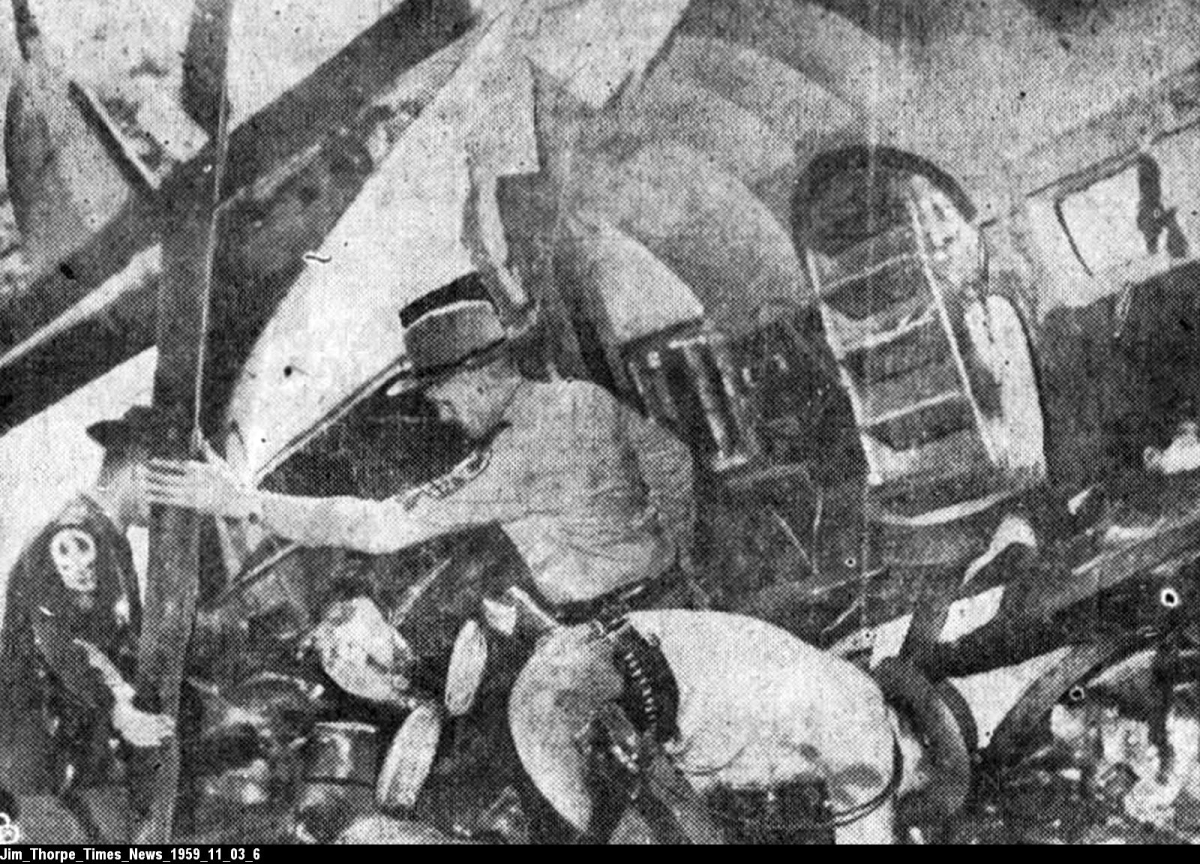
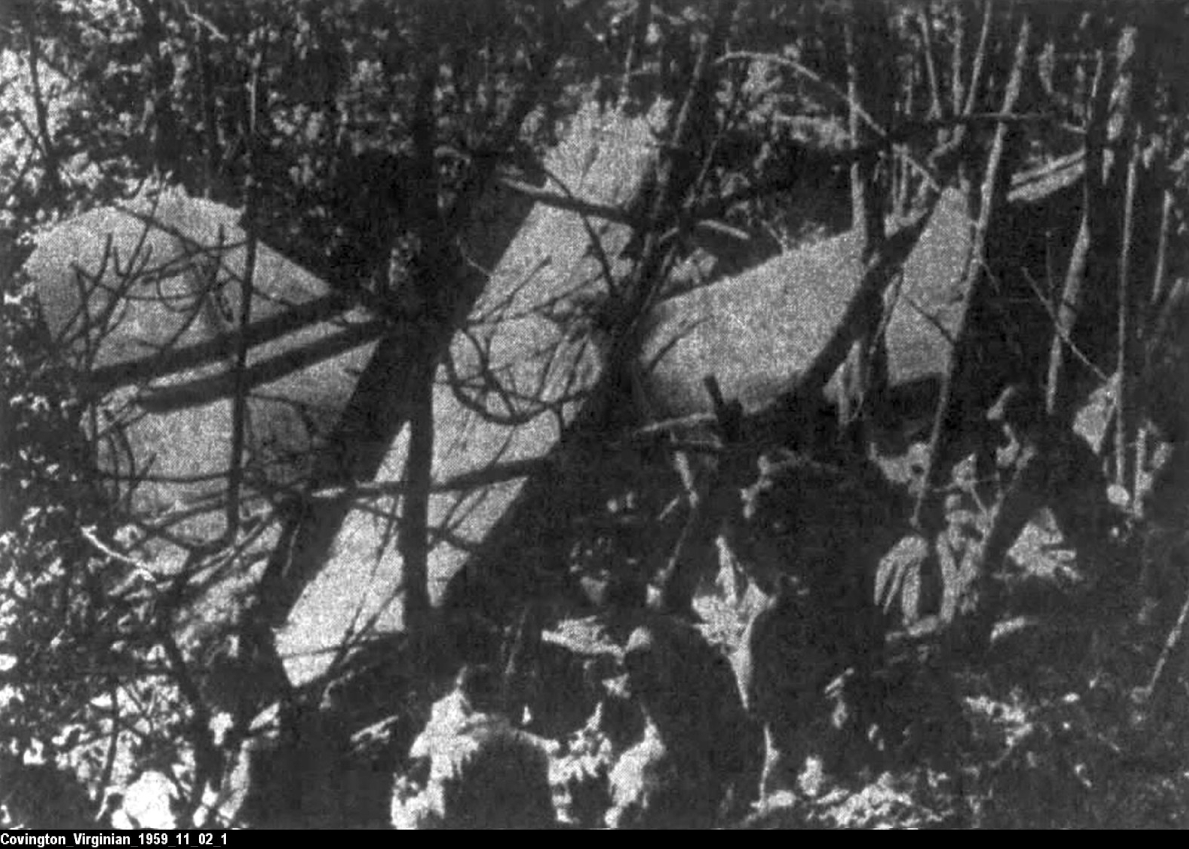
The wreckage was spotted by an Air Force helicopter about 500 to 700 feet from the top of the mountain, in a heavily wooded section. Reported the story, “its front half [had] disintegrated and the fuselage [was] mangled.” But there had apparently been no fire.
The crash site was located 18 miles west of Charlottesville and was spotted at 8:30 a.m. on Sunday, November 1.
Investigation and Cause
From the Wikipedia entry, the DC-3 was on instrument landing approach (ILS) to the airport when it crashed. It was “performing an inbound turn toward the runway” when the wing clipped the ground and crashed along Bucks Elbow Mountain at 2,600 feet.
The cause was determined as “A navigational omission which resulted in a lateral course error that was not detected and corrected through precision instrument flying procedures. A contributing factor to the accident may have been pre-occupation of the captain resulting from mental stress.”
However, the Air Line Pilots Association conducted their own investigation and reached a different conclusion. “Rather than missing the one turn on their flight, the pilot and co-pilot, according to ALPA, may have been led astray by faulty radio beacons. The ALPA report, citing numerous instances of an intermittent signal at the beacon for the Charlottesville airport, found that the beacon for a private field in Hagerstown, Maryland, could have overridden and caused the collision with the mountain.”
Surviving Wreckage
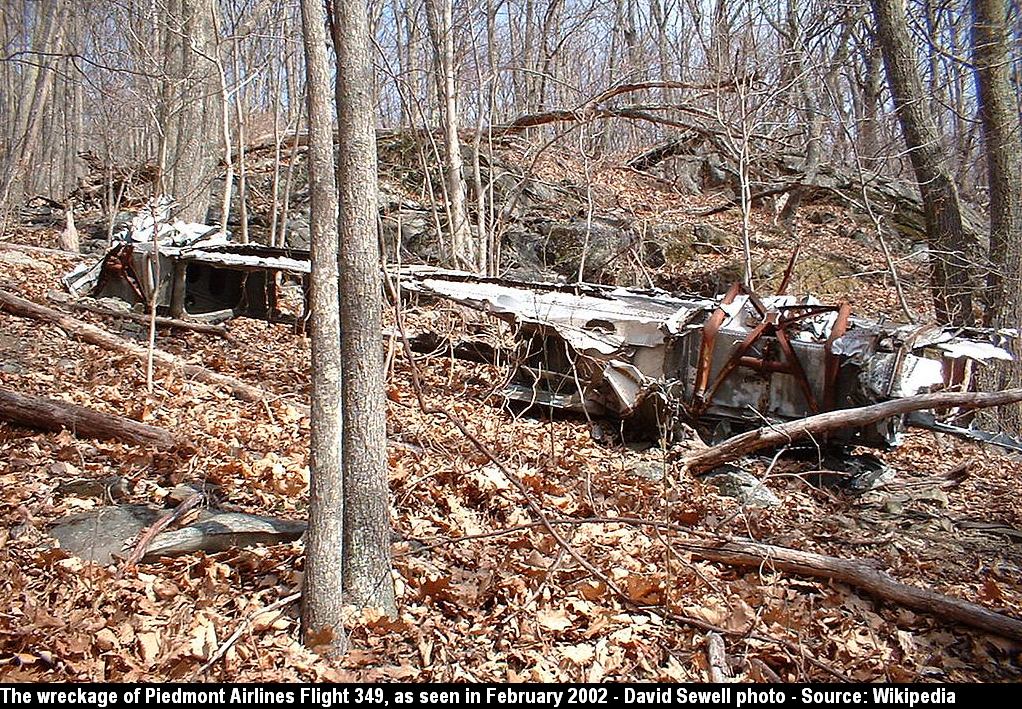
The wreckage of the plane remained on the mountain. And 60 years later, a group of volunteers brought one of the wheels down from the mountain, to integrate into a memorial about the crash. See WTOP story.
Sources
- Cited newspaper reports
- https://en.wikipedia.org/wiki/Piedmont_Airlines_Flight_349
- https://www.jetpiedmont.com/milestones
Citations