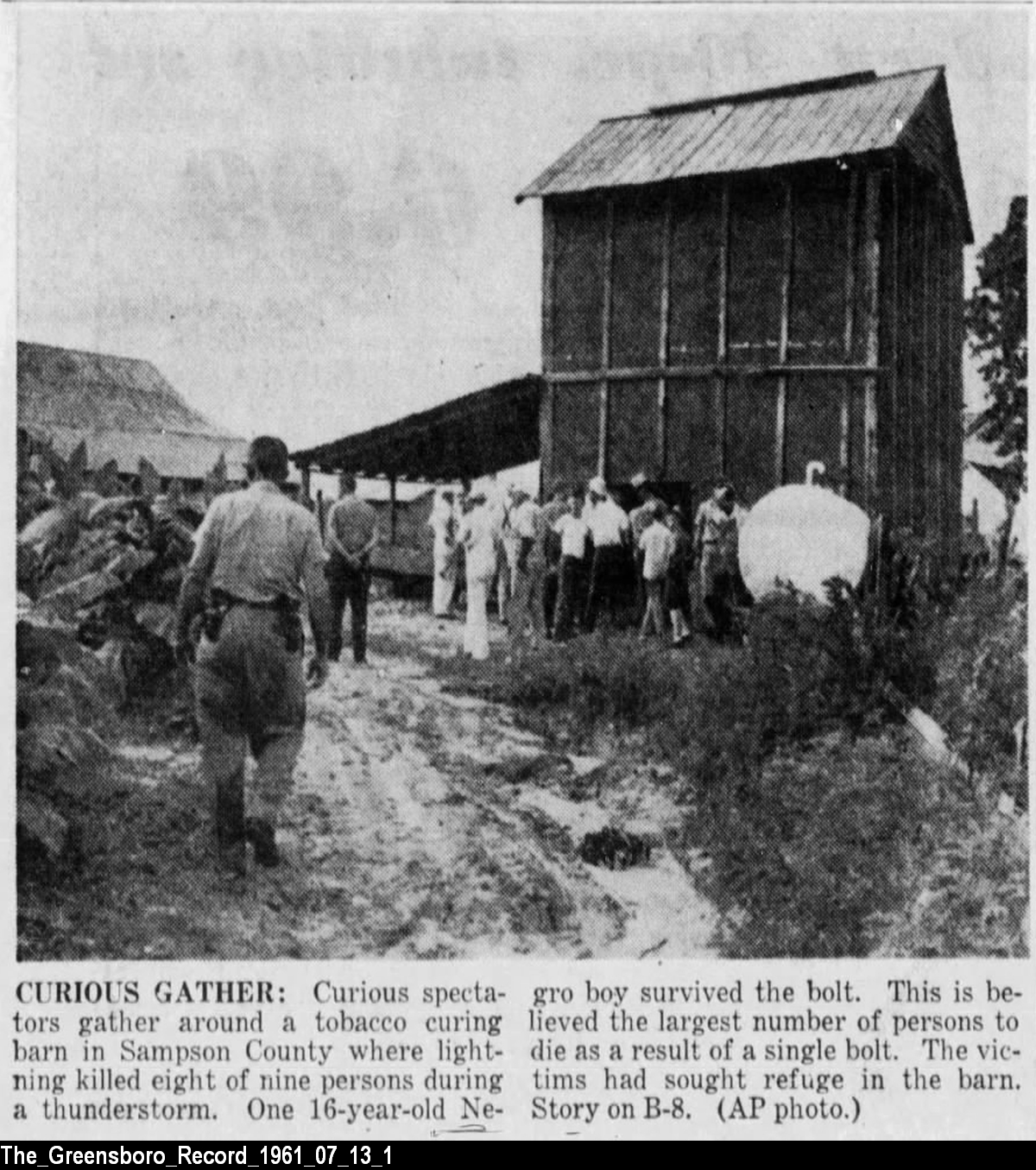
Transcription of News and Observer story about eight people killed by lightning on July 12, 1961, in Sampson County, NC. Plus news photo from the Greensboro Record.
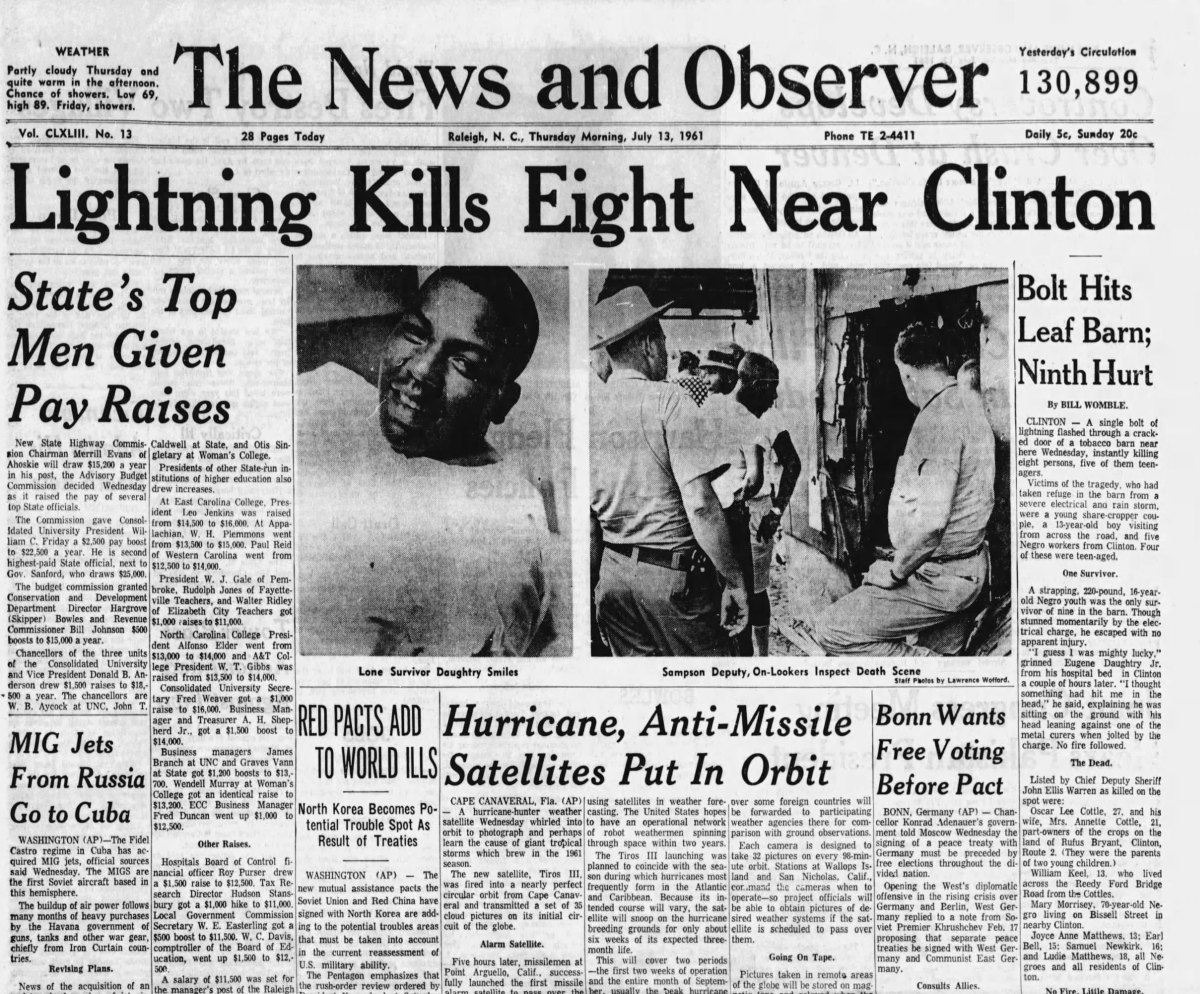
News and Observer, July 13, 1961
Lightning Kills Eight Near Clinton
Bolt Hits Leaf Barn; Ninth Hurt
By BILL WOMBLE.
CLINTON — A single bolt of lightning flashed through a cracked door of a tobacco barn near here Wednesday, instantly killing eight persons, five of them teenagers.
Victims of the tragedy, who had taken refuge in the barn from a severe electrical and rain storm, were a young share-cropper couple, a 13-year-old boy visiting from across the road, and five Negro workers from Clinton. Four of these were teen-agers.
One Survivor.
A strapping, 220-pound, 16-year-old Negro youth was the only survivor of nine in the barn. Though stunned momentarily by the electrical charge, he escaped with no apparent injury.
“I guess I was mighty lucky,” grinned Eugene Daughtry Jr. from his hospital bed in Clinton a couple of hours later. “I thought something had hit me in the head,” he said, explaining he was sitting on the ground with his head leaning against one of the metal curers when jolted by the charge. No fire followed.
The Dead.
Listed by Chief Deputy Sheriff John Ellis Warren as killed on the spot were:
Oscar Lee Cottle, 27, and his wife, Mrs. Annette Cottle, 21, part-owners of the crops on the land of Rufus Bryant, Clinton, Route 2. (They were the parents of two young children.)
William Keel, 13, who lived across the Reedy Ford Bridge Road from the Cottles.
Mary Morrisey, 70-year-old Negro living on Bissell Street in nearby Clinton.
Joyce Anne Matthews, 13; Earl Bell, 15; Samuel Newkirk, 16; and Ludie Matthews, 18, all Negroes and all residents of Clinton.
No Fire, Little Damage.
The bolt struck at 1:15 p.m. shortly after the crew of workers had returned to the fields and the barn after lunch.
When the rain storm first hit, some were out cropping tobacco, others were looping under the shed adjoining the barn, and a couple, including Gene Daughtry, were inside hanging up the sticks of leaf.
Several came in from the fields, and, together with three or four who had been under the shed, went into the nearby-filled barn, pulling the small door to behind them.
“We were mostly sitting around, leaning against the curers,” Daughtry related. “I had my head against one curer, and I saw the lightning when it came in. Something seemed to hit the back of my head. Then I heard the thunder, and that’s all I remember.
“Next thing I knew, I was lying on the front porch of Mrs. Cottle’s house. Somebody told me two colored women helped me out of the barn and put me on the porch.
“I heard that three others got out of the barn.”
Chief Deputy Warren and Deputy W. B. Lockerman, the latter the first officer to reach the scene, said no one except Daughtry escaped alive.
Apparently, first word of the tragedy to reach nearby homes was brought by two young Negro girls who had remained under the looping shed, thus probably saving their lives.
One ran to a house and reported, “All those people in the barn have been shocked. They need a doctor.”
One was sent a couple of hundred yards up the road to owner Bryant’s home for help. The scene was about two miles southeast of Clinton.
Soon, aid was on the way. Deputy Lockerman was in the lead, Chief Deputy Warren was not far behind, then came Highway Patrol members and ambulances.
“They were lying all around on the dirt floor, like they were sleeping,” Lockerman said. “No, there was no sign of life in any of them.”
Father Gives Aid.
Oscar Cottle’s 70-year-old father, Joseph Cottle, was on the scene minutes after word got out. He and his wife lived with their son in a tenant house some 30 yards from the barn.
The elder Cottle exhausted himself helping to remove the bodies, those of his son and daughter-in-law included. A couple of hours later, reporters found him sleeping on a cot in the living room, where a dozen neighbors had gathered to offer their help and condolences. He was not disturbed.
Instead, his elderly wife, a small, wiry woman who seemed to be bearing up well, told what they knew of the tragedy.
“We were here in the house when someone came and said the people had been shocked,” she said. “They said they needed doctors, but if any came, I didn’t see them.”
Joe Cottle went immediately to the barn, she said, and when the last body had been removed, he fell exhausted on the cot and soon was asleep. People filed in and out, conversing with Mrs. Cottle, but he slept on.
Two Factors.
Chief Deputy Warren said he believed two factors contributed to the deaths of eight of nine people in the barn. First, all apparently were sitting or leaning against the two metal curers, which were perfect conductors for the electrical charge. Secondly, rains had caused water to seep into the barn and the dirt floor was wet, thus providing a “dead ground” between the curers and the earth.
The bolt hit an outside edge of the door facing, knocking off a small strip of the wood and jolting the door loose from one of two hinges. No other damage was noted.
Apparently the charge hit one curer and raced around the barn, through both curers, electrocuting the eight persons.
Dr. L. C. Peak of Sampson Memorial Hospital said he saw five of the bodies and found but one small injury—a scar on one’s forehead.
“They didn’t even look dead,” he said.
Electric Shock.
In his opinion, said the physician, electrocution was the cause of death in each case, and none was burned by the terrific electric charge.
He added that Daughtry had been admitted to the hospital “for tonight, but he probably will be released in the morning.” The youth showed no signs of injury, except for slight shock, said the doctor.
Chief Deputy Warren said today’s tragedy was Sampson County’s worst since a farmer of the section near Newton Grove went berserk, killing his five children with an axe and club, then taking his own life by gunshot.
“You hear about tragedies when they happen away off and you don’t think about it,” said Warren. “When it happens close at home, it’s different.”