This is a blog version of a Facebook posting from September 13, 2026.
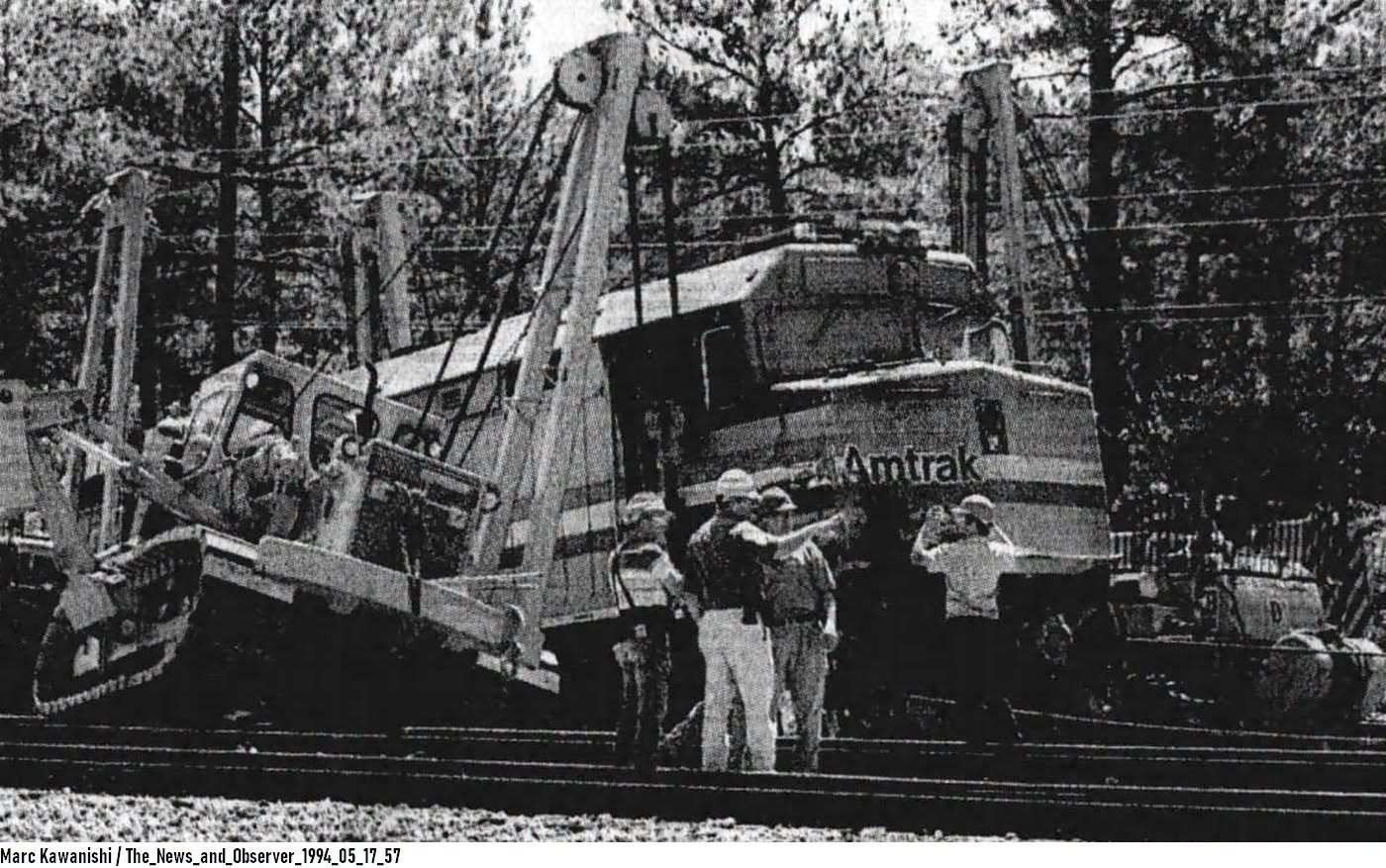
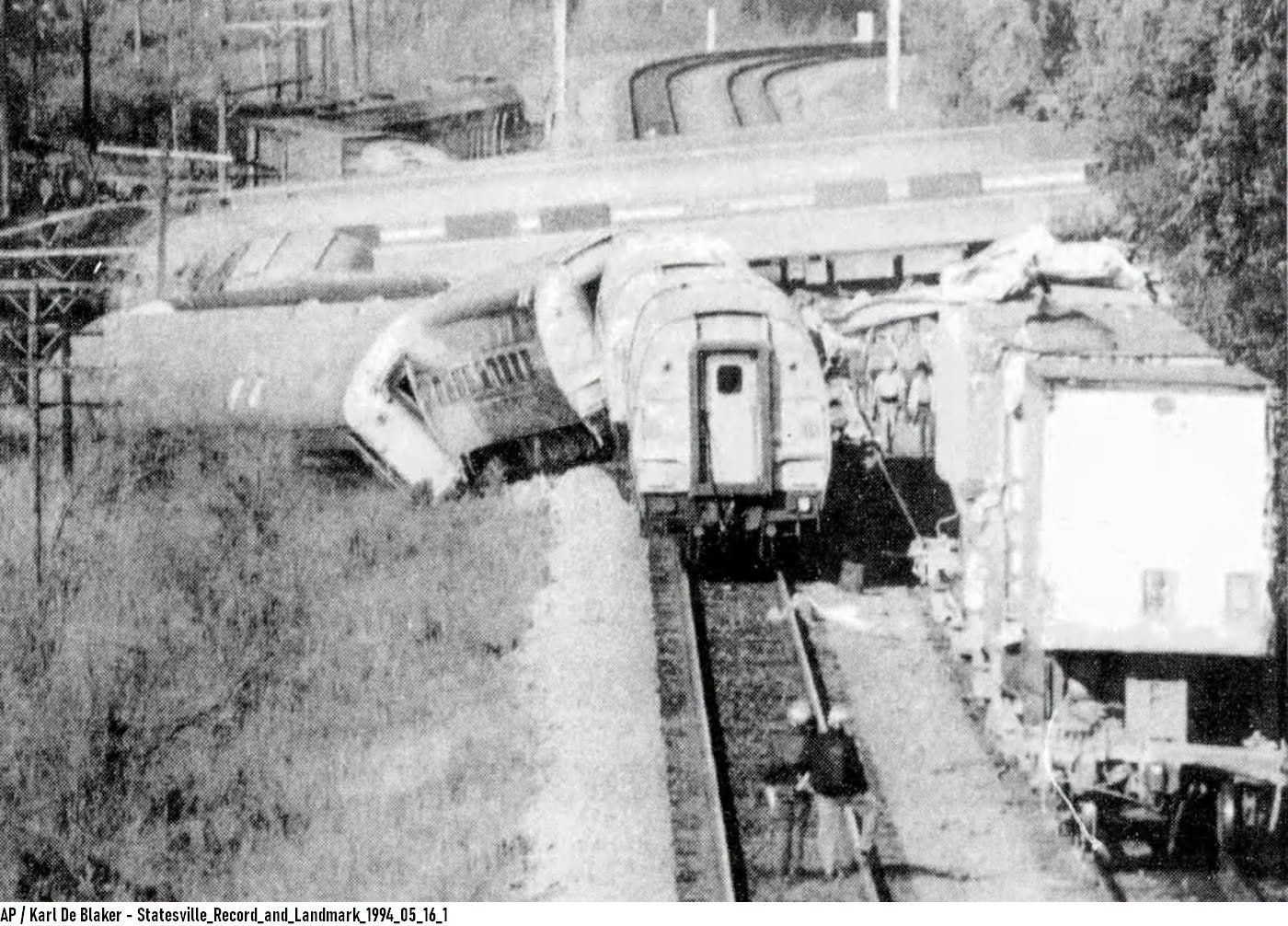
Looking back at the May 1994 derailment in Selma that killed a crew member and injured 121 people. Found a couple photos from newspaper coverage. Looking for others.
On May 16, 1994, at 4:36 a.m., Amtrak Train 87 and CSX freight train 176 passed each other on parallel tracks on the south side of Selma in Johnston County.
The southbound Silver Meteor was traveling from New York City to Jacksonville, Florida. Aboard were 415 passengers, five operating crew members, and 18 onboard-service employees. It had two locomotives and 18 cars.
The northbound freight train had three locomotives and 52 cars. Two of the cars were empty. With some 4,449 trailing tons and a length of 6,188 feet, it was a trailer-on-flatcar/container-on-flatcar intermodal train.
The Accident
As the two trains passed each other, a truck trailer either fell or was falling off the freight train and into the path of the passenger train.
The 51st rail car was an 89-foot flatcar. Two truck trailers were aboard. The one that fell off was 45 feet long and carried some 43,400 pounds of kitty litter. Its cargo was being shipped by Mid-Florida Mining Company of Lowell, Florida.
The Amtrak train was traveling about 70 mph (later research estimated its speed at approximately 75 mph), and its two engineers had virtually no time to react. The approximate point of impact was at latitude 35.52780, longitude −78.28920, along the CSX tracks near Parrish Street, on the southwest side of downtown.
The two engines “veered off the tracks, one of them flipping and landing 150 feet away,” reported the next day’s Raleigh News & Observer. The other went “smashing into a signal tower.”
Assistant Engineer Robert Brooks Woodward, 41, was killed. Engineer William Black was critically injured.
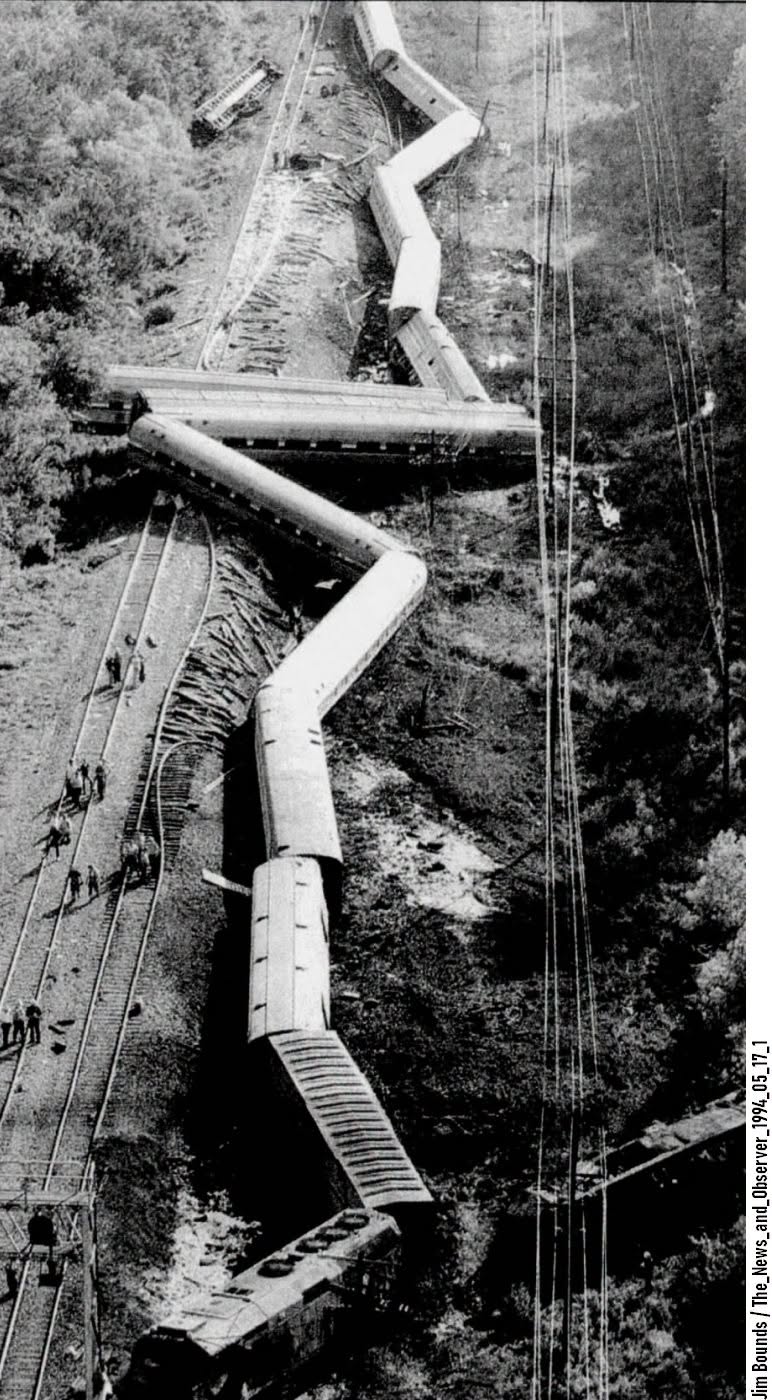
Both locomotives and 17 of the train’s 18 cars derailed, “the jolt waking the passengers and tossing many of them through the darkness.” Only the 51st flatcar on the freight train derailed.
Most of the passenger cars came to rest upright in what later reports described as a “boggy area east of the track.” None of the cars suffered any major intrusion into the occupied spaces.
Sound of Crashing Steel
The sound of “crashing steel” also awakened several people who lived nearby and came to the scene to help.
The crash was reported by a motorist on U.S. Highway 70, about a half-mile away, who dialed 911 using a car phone. Within two minutes, two passengers on the train with cellular phones also dialed 911.
Selma Police Officer R. C. Boyette was the first officer on the scene. He “parked his car behind a grocery store near the tracks and jogged down a path where he had once chased shoplifters.”
He ran from car to car to check for injured passengers. Reaching the front of the train, he found it “totally demolished.” Looking through a shattered window of the engine with a flashlight, he could see one of the engineers, who was trapped inside.
Boyette told the newspaper, “The fire was flaming up, and there was diesel fuel all around me.” He added, “We kicked the rest of the window out and attempted to go inside, but the smoke and fire forced us back.”[1]
[1] Later reports said that Amtrak 357’s fuel tank ruptured and diesel fuel ignited outside the operating compartment. Amtrak employees used portable extinguishers to suppress the fire. The NTSB later concluded that the fire did not cause either the assistant engineer’s death or the engineer’s injuries.
Meanwhile, “throughout the shattered remnants of the train,” passengers and crew were “organizing their own rescue efforts.” Some passengers “used bed sheets to climb down from windows.”
Dining-car waiter Albert Hill, “who had survived six Amtrak crashes,” set out in search of people who needed help. “He found a car full of them, all 49 members of the James Madison Middle School Chorus from Miami.”
Responders Arrive
By 5:00 a.m., responders had arrived from “four fire stations” and “three police departments.”
The NTSB report later noted that 60 firefighters and 50 EMS personnel responded, with 18 EMS vehicles. There were five fire engines, one tanker, two brush trucks, and three equipment or rescue trucks, plus 25 police vehicles.
Arriving responders found most of the passenger cars “completely off the tracks and listing at angles of 45 degrees or more.” Two cars near the middle of the train “lay perpendicular to the tracks.”
At Johnston County Memorial Hospital in Smithfield, staff “swung into disaster alert” and mobilized “every available doctor and nurse.” Two triage units were “up and running” before the first victim arrived at 5:39 a.m.
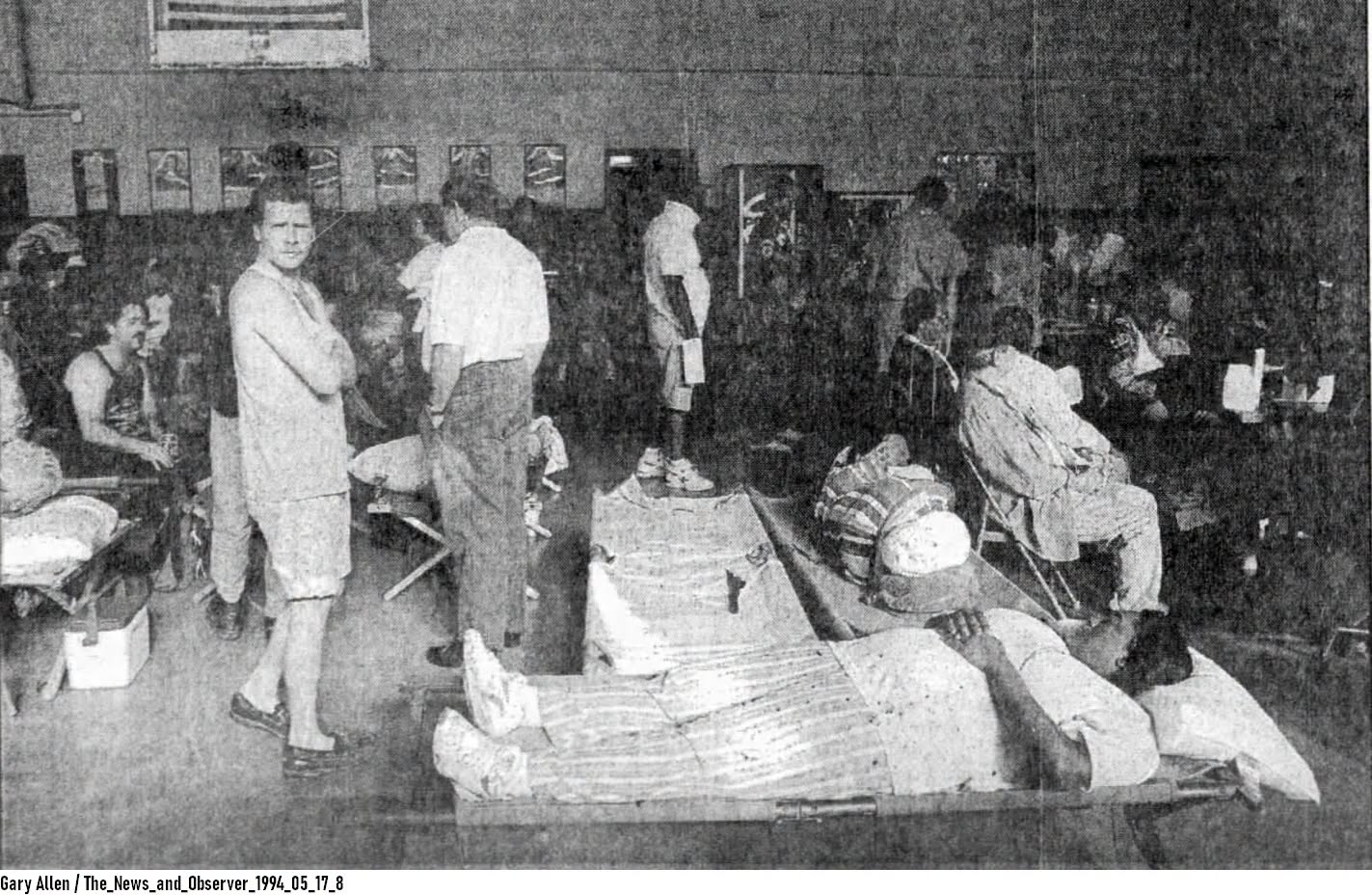
By midmorning, nearly 300 people “had been examined,” with 75 of them “assigned numbers, written on their hands, to speed the process.” Seven were flown to Duke Hospital in Durham, and the rest were treated at the National Guard Armory.
At the armory, the Red Cross established a separate evaluation team, and more than 100 volunteers arrived to give the passengers whatever help they could.
Local businesses also assisted by bringing supplies and food.
Emergency Response
From the NTSB report:
60 firefighters
50 EMS personnel
30 police officers
Five fire engines (pumpers?)
One tanker
Three equipment or rescue trucks
18 EMS vehicles
Two brush trucks
25 police vehicles
The Smithfield fire chief served as incident commander.
Johnston County Memorial Hospital was notified immediately and implemented its mass-casualty plan. A second hospital was also used, and the seriously injured engineer was ultimately treated at Duke.
The county had conducted a large disaster exercise in January 1994. Norfolk Southern had provided the county’s emergency agencies with a two-hour railroad-familiarization program in February, although CSX reportedly had not provided comparable training in the preceding 15 years. Amtrak conducted a three-hour training program for Johnston County responders in January 1995, after the wreck.
Casualties
From various sources:
- Assistant engineer — Fatal injury caused by blunt-force head trauma
- Engineer — Skull fracture, ankle fracture, and facial lacerations
- One onboard-service employee — Minor injuries; admitted to a hospital
- 119 passengers — Bruises, abrasions, or other minor injuries
Of those passengers:
- 11 were admitted to local hospitals for observation
- 108 were treated in emergency departments and released
No injuries were reported aboard the freight train.
Amtrak Train 87
Two F40PH diesel locomotives: lead unit Amtrak 357 and trailing unit Amtrak 325
One material-handling car
Two baggage cars
Ten coaches
Two lounge cars
One buffet car
One sleeping car
One dining car
The train had two locomotives and 18 cars. Aboard were:
415 passengers
Five operating crew members
18 onboard-service employees
Aftermath
The estimated damage reported by Amtrak and CSX was:
Track — $60,000
Signals and communications — $75,000
Railroad equipment — $3,595,000
Total — $3,730,000
CSX replaced:
819 feet of Track 2
234 feet of Track 1
Seven communications poles
One signal-equipment case
All but the final Amtrak car sustained some derailment damage, primarily to the running gear, car ends, and collision posts.
Investigation
The NTSB determined that the probable cause was the “failure of the CSX Intermodal Corporation loading crew to properly secure the intermodal trailer to the flatcar and CSX Intermodal Corporation’s failure to have a comprehensive inspection program.”
Read the NTSB report (PDF)