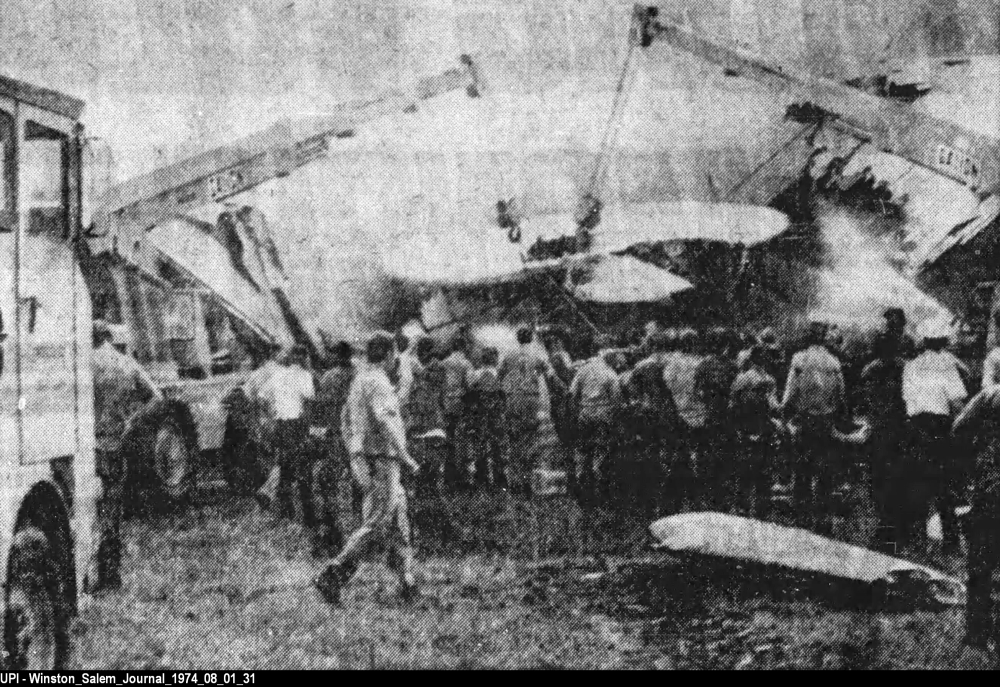
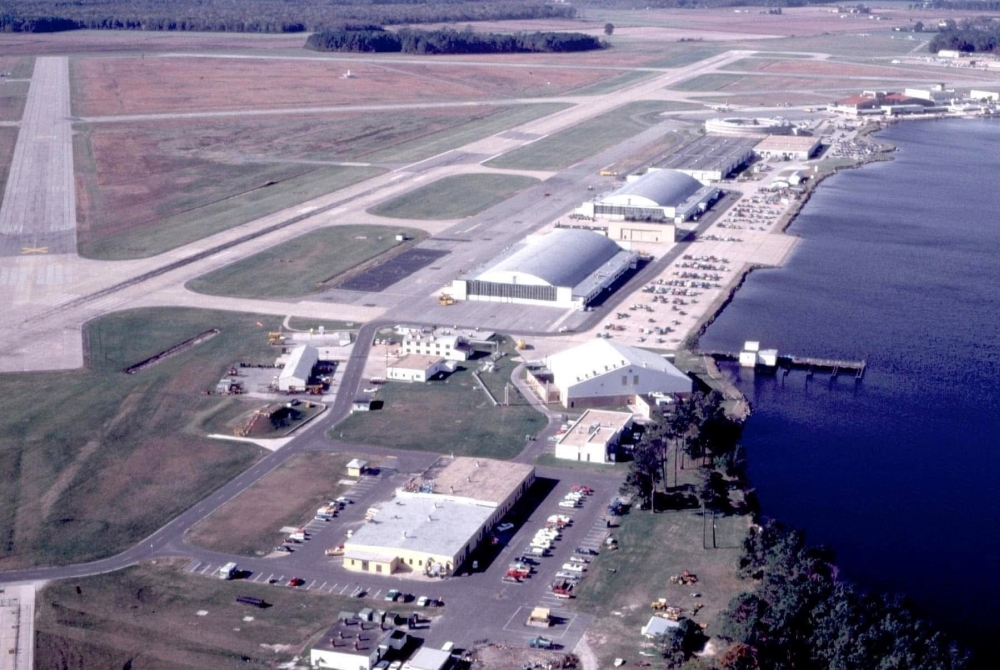
For our Friday history, let’s head over to Pasquotank County and Coast Guard Air Station Elizabeth City on July 31, 1974, when Navy radar plane crashed into a building, killing the pilot and three civilian workers inside. Two others aboard the plane survived with injuries, along with 12 others, including several firefighters.
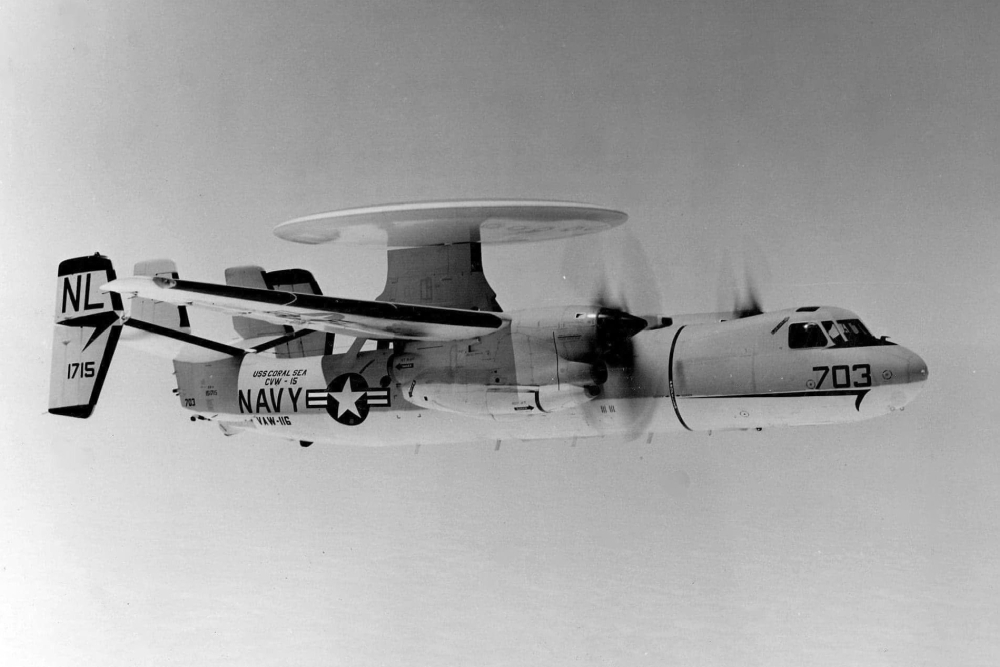
On that Wednesday morning, a U.S. Navy Grumman TE-2A Hawkeye “submarine chaser” was practicing touch-and-go operations when it struck the aircraft maintenance and supply center at the end of the base runway about 9:15 a.m.
As reported in the next day’s Raleigh News and Observer, Lt. Cmdr. Walter M. Coburn was watching the air traffic from a helicopter. He said the aircraft skidded 200 feet and struck the building, which had once served as the base dining hall.
He said “the plane veered off the runaway after its engine failed during a third attempt at takeoff.” Smoke and flames started about 15 seconds after the impact. But there was no apparent explosion.
The building was occupied by 23 civilian employees. They had no advance warning of the crash, but some were able to run out of the building after the impact.
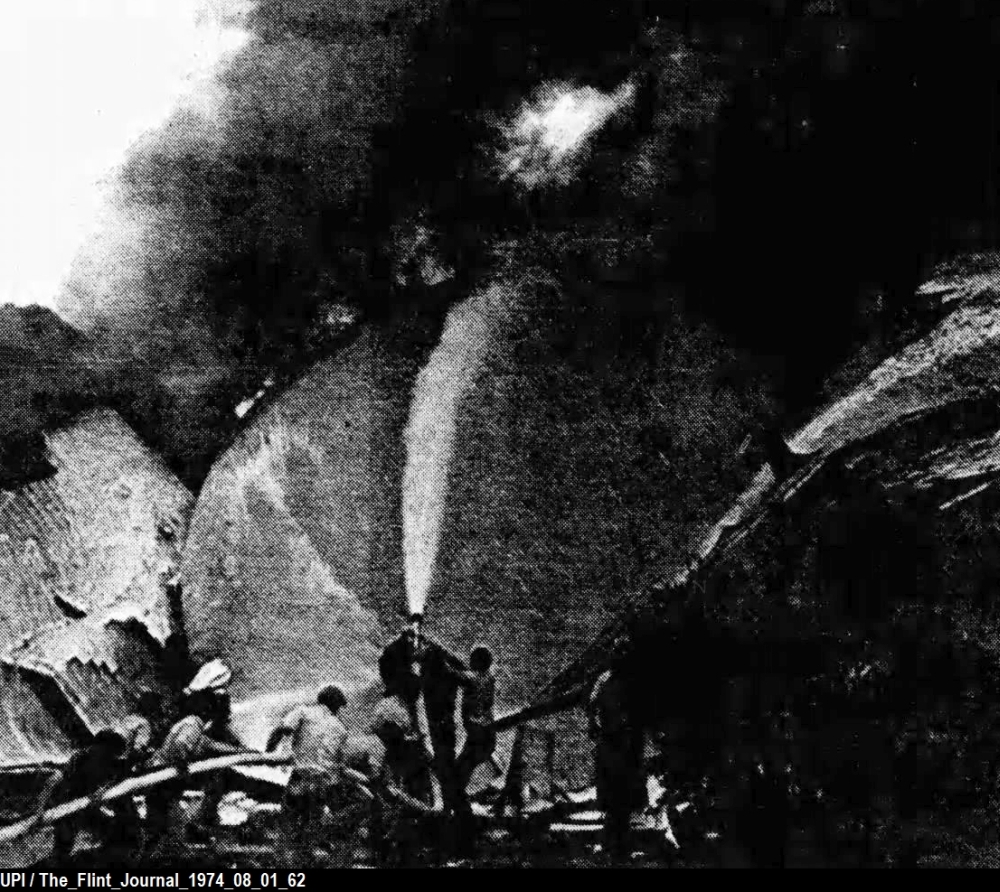
Crash Truck Gets Close
The Coast Guard Aviation Association in a posting on Facebook, with excerpts from a Virginian-Pilot newspaper article on July 30, 1994, provides more details about what happened next.
An Oshkosh crash truck was already on the flight line, possibly on stand-by during the aircraft’s operations. It was likely a U.S. Navy MB-1 equipped with 1000 gallons of water and 130 gallons of foam, plus dry-chemical. Learn more about these trucks.
[Need rank] James Lambert was the driver, or “the hot spot crash driver that day.” Beside him was Petty Officer Ralph Brunke, the “turret man.” They already had the truck moving after they saw the plane “leave the runway and swerve into the building.” After the truck was positioned as close as possible, “despite difficulties with the equipment and inaccessibility of the fire source,” they sprayed their entire amount of foam.
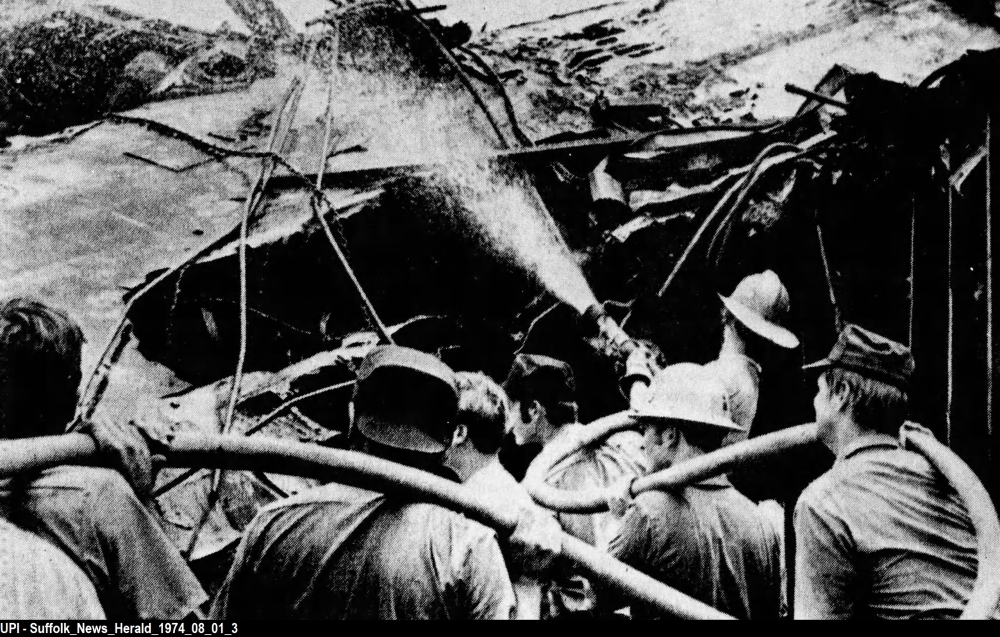
Turret Operator Leaps Into Action
Brunke’s subsequent actions later resulted in a citation for heroism: “when the foam supply was depleted, without regard for his own safety, he left the truck and entered the burning building to search for crew members of the aircraft. He courageously walked through burning fuel and approached a hole in the fuselage to search for survivors before being driven out by flames, extreme heat, and noxious/toxic fumes.”
“Once outside, ignoring the very real threat of a catastrophic jet fuel explosion, Petty Officer Brunke took over as nozzleman on a 2-inch hose and led a crew into the burning structure in an attempt to reach the cockpit.”
“Shortly after entering the building, when the hosemen were overcome by smoke, Petty Officer Brunke was left alone on a wildly swinging hose, struck in the neck by the whipping nozzle, and knocked over an upholstery table into the edge of the fire. He retreated from the area and was treated at the scene for a neck bruise, leg abrasions, and smoke inhalation. Only when the hose was under control and being utilized by a new crew did he permit himself to be taken to an aid station for treatment.”
Brunke and three other servicemen were awarded medals for assisting with rescues. AM3 Ralph Brunke, AD2 Melvin Burress, ASM1 Larry Farmer and BM1 Fred Ellinwood all earned the Coast Guard Medal for assisting in the rescue of survivors. Their stories are noted in the aforementioned Coast Guard Aviation Association posting on Facebook.
Extensive Mutual Aid
How many firefighters and pieces of apparatus were assigned to the base, at the time of the crash? TBD. Need reader help on that one.
Fire departments and rescue squads responded from as far away as Moyock, NC, which is 26 road miles away and near the Virginia state line.
Nearby Elizabeth City was just four road miles away. In 1974, believe they had two fire stations, four frontline pumpers and an aerial ladder, and a combination of full-time and volunteer firemen. Local peeps, need history help here.
Many firefighters were later treated for smoke inhalation at Albemarle Hospital in Elizabeth City and at a Coast Guard base infirmary.
Victims were transported to the hospital by area ambulances and by Coast Guard helicopters. At the hospital, local policemen and other law officers “aided with routine patients as they were brought to the emergency entrance” to ensure priority treatment for those arriving from the base, reported the local newspaper, the Daily Advance, on August __, 1974.
“It took rescue workers more than four hours to clear the debris” and recover the body of the last victim.
Other Notes
The Navy Grumman TE-2A Hawkeye was assigned to the 120th Airborne Early Warning Squadron at Norfolk Naval Air Station.
Killed in the crash was Navy Pilot LCDR Oscar E. Lynge and ARSC employees Gilbert L. Spitzer, Joseph Spruill Jr., and Maylon D. Jones.
The crash was caused by a failure of the port engine’s auto-feather system, investigators later determined.