Looking back at the Charlotte Chemical Laboratories Explosion on July 9, 1959, that injured 11 firefighters. Below are research notes.
Contents
- News stories
- History book excerpt
- Recollections of George Greene
- Full Operational Reconstruction
Part 1 – News Stories
Part 2 – Charlotte Fire Department History Book Excerpt – Published 2000
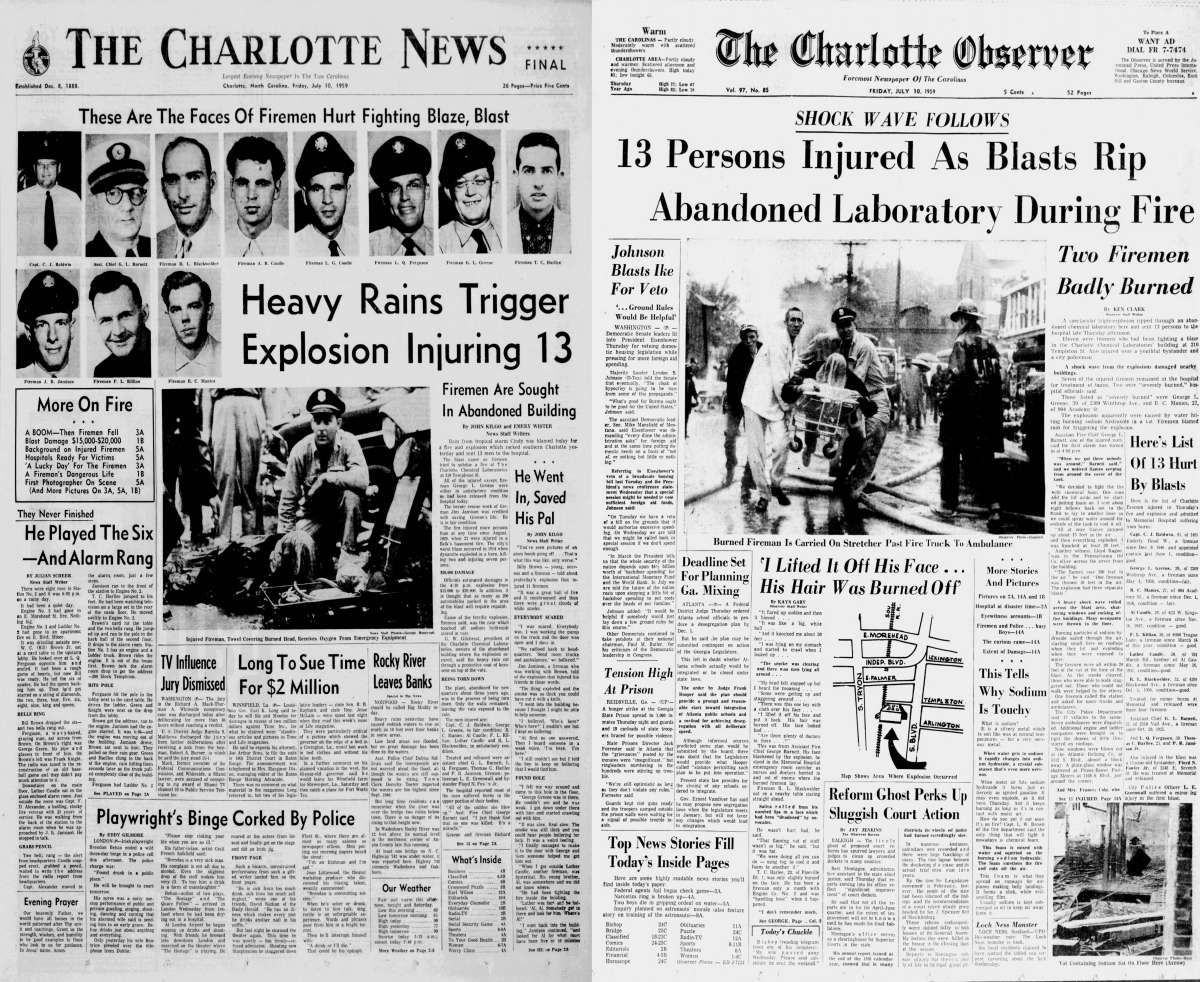
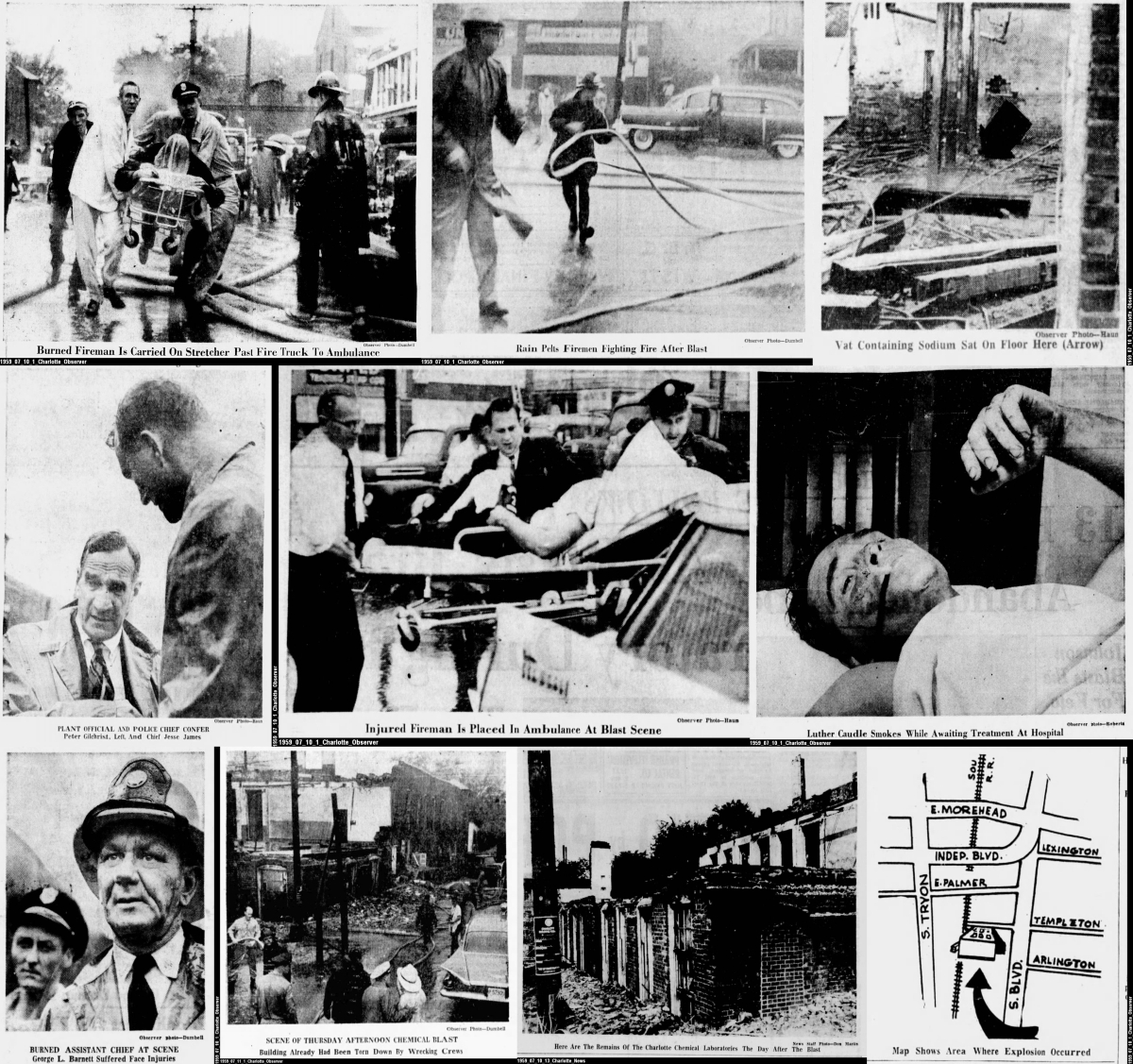
On July 9, 1959, firefighters responded to an alarm at the site of the former Charlotte Chemical Company on West Templeton Avenue just off South Boulevard. The building was being demolished; a large vat had been left, perhaps forgotten, in the basement. Charlotte had been hit by the remnants of a hurricane earlier in the month. The heavy rains penetrated the exposed vat, which held a hundred pounds of metallic sodium sealed in kerosene, and came in contact with the sodium, setting off a violent reaction which ignited the kerosene.
When firefighters arrived, they assumed it was merely a kerosene fire and fought it as such, but to no avail. In spite of their efforts, the fire grew hotter and more intense. They had just decided to use foam when the vat exploded. Miraculously, no one died, but thirteen firefighters were injured, several critically. One lost both ears and most of his face and had to retire because of these injuries.[1] Another later committed suicide.[2]
This incident shook the Department to its foundations and had several profound effects. The need for and use of training was immediately obvious, and firefighters began studying as they never had before. The department began to buy and issue protective clothing; previously, individuals had been responsible for buying their own. The Fire Prevention inspection program was broadened.
Fire Marshal J.F. Morris developed a marking system to identify hazardous materials in buildings. He designed a set of diamond-shaped symbols to indicate the presence of hazardous materials and their levels of flammability, health hazards, and reactivity.[3] The National Fire Protection Association later adopted the system as Standard 704.
[1] George Greene underwent 28 operations over 30 months to rebuild his face. From oral history accounts, he never returned to Operations. He worked in Fire Prevention until the time of his retirement. He died at age 80 on July 13, 2000. See more below.
[2] Charles Jackson Baldwin committed suicide on April 28, 1972. From his certificate of death, the cause was gunshot wound to the head (face). The time of his injury was before 3:00 p.m. He died within minutes of his injury. The place of death was his home. He was a Captain in the fire department and had served the department for 31 years. Note: His obituary listed his age as 52 years old, while his death certificate listed his age as 54.
[3] From CFD historian Shane Nantz: “Charlotte Department of Transportations Sign shop had pre-made diamonds for other signs. That’s where the shapes came from. The colors also were used by the sign shop and corresponded somewhat. Blue was for the hospital, health; Fire/flammability was obvious, crosswalks or putting cars and people together creates a reaction. Reactivity. And special hazard was special information at the time. Fire lane signs as an example were white and black.” Source: Facebook, Legeros Fire Line, May 11, 2020, https://www.facebook.com/share/p/14fePpB8kGe.
Part 3 – Recollections of George Greene in September 1988
Charlotte Observer – September 18, 1988
For ‘Mayor’ Of Charlottetown Terrace
Love Triumphs Over Life’s Scars
By Frye Gaillard
Staff Writer
Even when he’s happy, which is nearly all the time these days, the memory is never very far. He can still feel the white ball of fire exploding in his face, burning it away.
He remembers the string of delicate operations in a Charlotte hospital — 28 in one 30-month period — and he remembers the depression that occasionally overtook him.
But George Greene will also tell you, with a smile that pulls at the scar tissue on his chin, that he has been a lucky man.
For one thing, even in the worst of times, there was always Chris, his wife of 49 years, who helped him cling to the faith that the pain would go away.
And eventually, it did.
It has been a little more than 29 years since the accident, an explosion at a Charlotte chemical company, and for many of those who have known him during that time, Greene has quietly emerged as a hero.
At the age of 69, he is an honored resident at Charlottetown Terrace, a public housing high rise not far from uptown — a community of 200 elderly and handicapped people, where they call him “the mayor.”
Officially, he is president of the residents’ organization, and in that capacity, he helps serve the meals, organizes bingo and trips to the mountains, counsels other residents about the problems of growing old.
He knows that life could be grim at a place like the Terrace — that it could be one of those antiseptic institutions where the old and infirm are simply waiting to die.
“But here it’s not,” Greene says. “Most people will tell you it’s like a big extended family. We try to have fun and enjoy each other, try to keep people interested in life. I’ve taken people to the beach who were 80 years old and never seen the ocean. The thing is, you have to keep interested. You have to keep going.”
In all his pursuits, Greene seeks to apply what he’s learned since that shattering afternoon of July 9, 1959.
It was 4 p.m., as Greene remembers it, and the firefighters at Station No. 2 were playing cards in a room upstairs, when the alarm sounded and Greene threw on his coat.
He knew he had to be careful this time. The fire was right up the street at the Charlotte Chemical Laboratories, and the firefighters didn’t know for sure what was stored inside.
Still, Greene wasn’t any more worried than usual. He had been a firefighter for a little more than nine years, and before that, he had been a Marine in World War II, fighting on Guam and Guadalcanal, and in all that time, he had come through without a scratch.
On this particular afternoon, however, his luck ran out.
“We had been fighting the fire about five or six minutes,” Greene remembers today, “when all of a sudden, ‘boom,’ a white ball hit me in the face. After that, I didn’t know anything until I came to under the building. I couldn’t see, and my skin was on fire, it felt like, all over.”
They rushed him to Charlotte Memorial Hospital, along with six other firefighters who were hurt less seriously, and he was in surgery for nearly 11 hours.
For seven weeks, bandages covered the length of his body, and doctors sedated him as well as they could against the pain.
For Chris Greene, meanwhile, the vigil was constant. She sat beside his bed and held his hand, and though she prayed simply that her husband would survive, she wondered sometimes about the permanence of the damage.
Finally, the day came when they unwrapped his face. The doctors told Chris she had to be strong. If she fainted, or even if she showed any negative emotion, George might lose the fragile will to live.
Chris assured them that she would be fine, though when the bandage was removed she couldn’t quite stifle a private wave of shock.
“George was just unrecognizable,” she remembers, telling the story calmly after so many years. “His face was just gone. But it didn’t matter. Those eyes were there, looking right up at mine. I just grinned and winked and said, ‘Hi.’”
Gradually, the doctors rebuilt George’s face. There were 28 operations over the next 30 months, and though the progress was real, it was also slow, and there were times when the uncertainty was nearly overwhelming.
“George didn’t know if he was ever going to be able to do anything anymore, able to do any kind of work anymore,” says Chris. “Our two sons just didn’t hardly know how to cope with it. When George would try to eat, it was hard for him because he didn’t have any lips.
“Our oldest son, who was 16, would just leave the table and go off to the bathroom to cry, and then George’s eyes would fill up with water. He would get pretty depressed sometimes.”
Finally, one day George ran away. Maybe a year or so into the whole ordeal, he walked out of the house without telling anyone where he was going. He had no particular plan, but he was tired of being a burden to the people he loved. So he left.
“But then I got a mile or two down the road,” George remembers, “and I realized I was too tired to keep walking. So I just called my wife and told her to come and get me, ’cause I was tired.”
Chris Greene did without a word of reprimand, and something seemed to change with that episode. Certainly, in the years since then, it has come to represent a central truth in their lives: that life can be hard and discouraging sometimes, and that nobody, in fact, should have to bear it alone.
But with enough support, they say, life can be richer than most people imagine.
“I love him more today more than I did when we married,” says Chris. “We went through some hard times right after the accident, but you just couldn’t afford to let it get you down. You just get in there and fight as hard as you can, and the things you go through can bring you together.”
The Greenes have carried that knowledge through the rapidly passing years — through George’s recovery and his return to the fire department, through his later stroke problems and Chris’s recent stroke — and in their 11 years in Charlottetown Terrace, they have used it to buoy the spirits of their neighbors.
Recently, the Greenes were among the subjects of a public television documentary called “Just Listen: Living With Medical Choices,” in which all are cast as winners.
“What George and Chris show us,” says Kathryn Frye, producer of the show, “is that human beings can endure, but they can do more than that. With faith in themselves, and faith in each other, they can also triumph. For George and Chris, it’s not enough just to know that. They have also done their very best to share it — and that may be their greatest triumph of all.”
Part 4 – Full Operational Reconstruction (Expanded Narrative + Analysis) via ChatGPT
Date: July 9, 1959
Location: 310 Templeton St., Charlotte, NC
Weather: Heavy rain, Tropical Storm Cindy
Injured: 13 total (11 firefighters, 1 police officer, 1 civilian)
1. Pre-Incident Conditions (Hidden Hazard Environment)
The incident began in what would now be classified as a high-risk, unknown hazardous materials environment:
- Structure: Abandoned chemical laboratory (vacant ~2–3 years)
- Status: Partially demolished (roof removed, walls remaining)
- Contents:
- Large vat of metallic sodium (≈20 years old)
- Stored under oil, but deteriorating into sodium oxide / sodium hydroxide
- Exposure:
- Rainwater had direct access due to missing roof
- Fire department awareness:
- No knowledge of hazardous material present
- No inspection authority over vacant structures at the time
Critical condition:
Firefighters responded to what appeared to be a routine fire—but were entering a reactive chemical environment already primed for explosion.
2. Initial Response (4:02–4:10 p.m.) Dispatch
- Alarm received: ~4:02–4:03 p.m.
- First alarm units:
- Engine 2
- Ladder 2
- Additional escalation:
- Engine 20 (second alarm)
- Engine 1 (third alarm)
- Additional ladder company
Station No. 2 Turnout
- 8 firefighters on duty
- Activities:
- Card game upstairs
- TV in dayroom
- Alarm room staffed
Immediate response sequence:
- Alarm bells sound
- Address taken: Templeton St.
- Engine 2 leaves within ~1 minute
- Ladder 2 follows seconds later
Arrival Conditions (~4:08–4:10 p.m.)
Fireground observations:
- Fire described as:
- “small”
- “gasoline-like blaze”
- Flames:
- 15–30 feet intermittently
- Location:
- Inside/open vat structure
- Civilians already observing
Operational mindset:
Standard working fire with minor chemical involvement—not perceived as explosive.
3. Initial Fireground Operations Tactical Approach
Firefighters initiated:
- Foam application → to smother burning sodium
- Water streams → to cool surrounding area and tank exterior
This combination is key.
Critical Moment (Unrecognized Trigger)
- Foam applied to burning material
- Water applied externally
- Heavy rain ongoing
Simultaneous factors:
- Rainwater entering vat
- Water streams near/into vat
- Possible disturbance/opening of lid
- Sodium already deteriorating
Result:
Water + sodium → rapid chemical reaction → heat + hydrogen → explosion
4. Explosion Event (~4:10–4:12 p.m.) Explosion Characteristics
- Triple explosion sequence
- Described as:
- “atomic blast”
- “big concussion”
- “white ball of fire”
- Flame column:
- Estimated up to 200 feet
- Shockwave:
- Felt blocks away
- Stopped clocks at 4:12 p.m.
- Fireball + chemical spray:
- Burning sodium/hydroxide dispersed across area
Firefighter Positioning at Blast
- Crews were within ~20 feet of the vat
- Direct exposure:
- Flash
- Blast pressure
- Burning chemical spray
Immediate Effects on Personnel
- Burns (primarily upper body, face, arms)
- Temporary blindness (chemical + flash)
- Disorientation
- Knockdown / blast displacement
- One firefighter thrown ~10 feet into air
- Another had boots blown off
- Multiple had clothing burned or stripped
5. Post-Blast Fireground Conditions Environment
- Dense white chemical smoke
- Burning particles landing across:
- Streets
- Roofs
- Vehicles
- Secondary fires igniting
Scene Chaos
- “Mass confusion”
- Firefighters:
- Walking in daze
- Calling for help
- Attempting rescues
- Civilians:
- Flooding scene
- Blocking apparatus routes
- Police:
- Rapid escalation to 17 vehicles
- EMS:
- 7 ambulances dispatched
6. Rescue Operations (Critical Actions) Interior Rescue – Jamison / Greene
Firefighter James R. Jamison Jr.:
- Re-entered building post-blast
- Visibility:
- Zero (smoke + chemical)
- Located George L. Greene:
- In hole in floor
- Unable to see
- Weak, burned
Rescue method:
- Voice-based search (“keep hollering”)
- Crawling extraction
- Assisted removal to exterior
This was the most critical lifesaving action of the incident.
Additional Rescue Actions
- Firefighters assisting each other despite injuries
- Removal of blinded personnel
- Civilians assisting in initial extraction
- Ambulance crews loading victims under active hazard
Secondary Explosion
- Occurred during EMS operations
- Bricks and debris thrown
- Ambulance crews continued operations regardless
7. EMS And Transport Operations Field Conditions
- Victims:
- Burned
- Many partially blinded
- Triage:
- Informal, rapid
- Firefighters:
- Often walked or staggered to ambulances
Notable Observations
- Some firefighters calm despite severe injuries
- Many could not see
- Repeated question:
- “Is everybody out?”
Transport
- Primary destination:
- Memorial Hospital
- Some transported by:
- Ambulance
- Civilian vehicles
8. Hospital Response (4:30–5:30 p.m.) Critical Issue
- No prior notification
- Hospital learned of disaster:
- From first arriving patients
Disaster Plan Activation
- Time: ~4:30 p.m.
- Actions:
- PA system activation
- Full staff mobilization
- Oxygen, stretchers, supplies deployed
- ER expanded
- Student infirmary converted
Treatment Conditions
- 13 victims in ER simultaneously
- Burns:
- Face
- Arms
- Upper body
- Chemical exposure requiring:
- Immediate decontamination
- Clothing removal
Outcome
- Situation controlled within ~1 hour
- No fatalities (remarkable given severity)
9. Damage And Community Impact Physical Damage
- Windows blown out:
- Multiple commercial buildings
- Roof damage:
- Nearby structures
- Vehicles:
- Up to 200 damaged
- Chemical contamination:
- Spread across multiple blocks
Infrastructure Impact
- Traffic collapse:
- South Boulevard blocked
- Power disruptions
- Communications overload:
- Police/fire switchboards saturated
10. Injury Summary Most Serious
- George L. Greene → severe burns
- Richard C. Manies → severe burns
Others (Firefighters)
- Burns ranging from minor to significant
- Several treated and released
- Others hospitalized but stable
11. Root Cause Analysis Immediate Cause
- Water (rain + hose streams) contacting sodium / sodium hydroxide
Contributing Factors
- Unknown hazard
- No record of sodium in building
- No inspection authority over vacant structures
- Structural condition
- Roof removed → direct rain exposure
- Chemical degradation
- Sodium deteriorated over decades
- Fireground operations
- Water application near reactive material
12. System Failures Identified Fire Service
- Lack of hazmat intelligence
- No pre-incident planning for abandoned industrial sites
Regulatory
- No ordinance covering hazardous materials in vacant buildings
Communications
- Hospitals not notified
- No unified disaster coordination
13. Aftermath And Policy Impact Immediate Changes
- Development of:
- Police disaster control plan
- Improved hospital notification procedures
- Recognition of:
- Need for interagency coordination
Investigation Findings
- Sodium present ~20 years
- Known deterioration prior to incident
- Removal delayed due to demolition logistics