This is a blog version of a Facebook posting on July 30, 2025.
In the wake of last week’s multi-fatality accident on I-485 that killed six people in a three-vehicle collision, let’s look back at the worst car accident in the history of the Charlotte area.
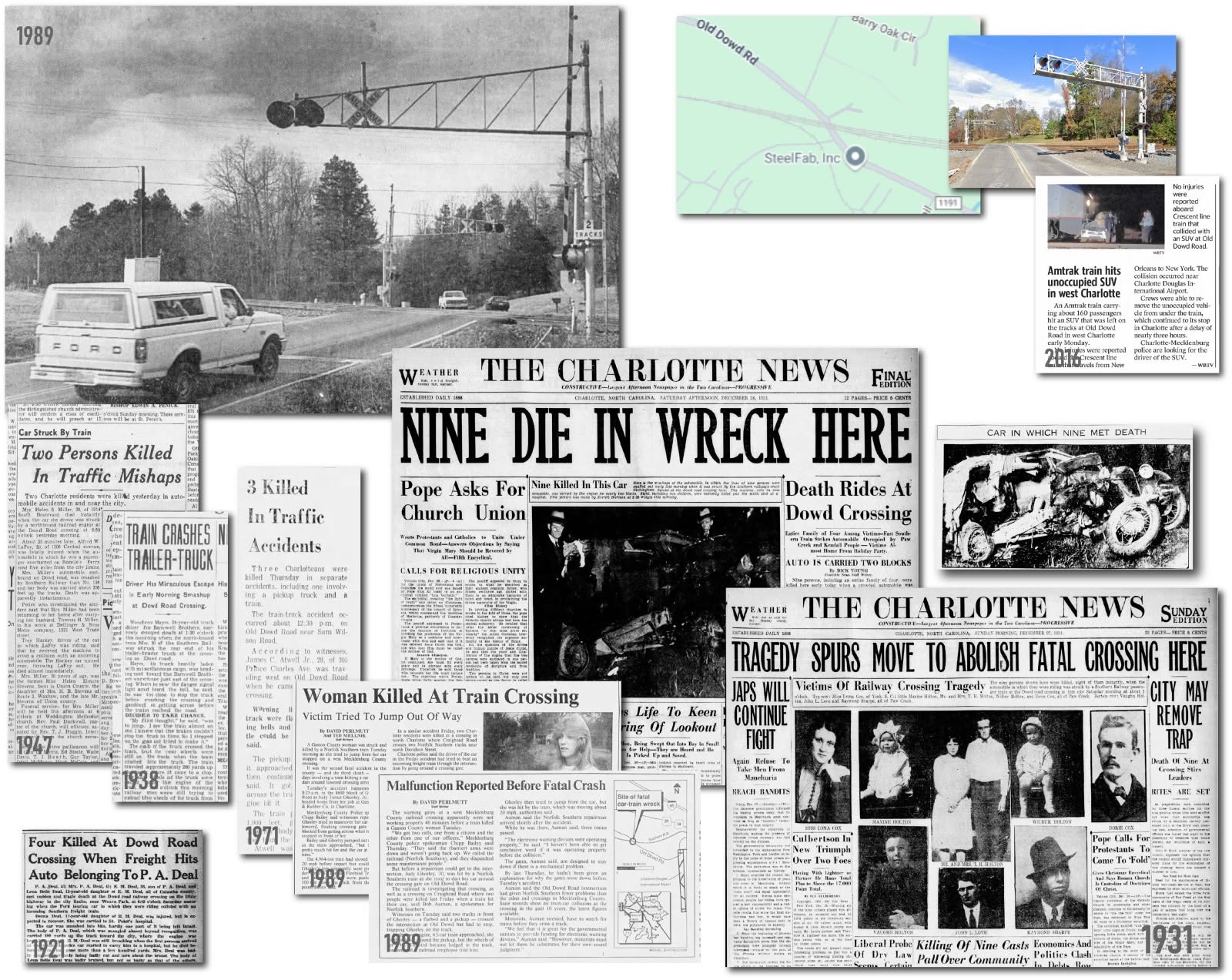
Early Saturday morning, December 26, 1931, nine people were killed when their “light touring car” was struck by a “northbound Birmingham special” at the Dowd Road crossing. Shown in the montage are the next day’s and subsequent day’s headlines in the Charlotte News, one of the city’s two newspapers at the time.
Also shown are other crashes that have occurred at the Dowd Road crossing over the decades, including another that killed five people on New Year’s Day, 1921. See those news stories in this Google Drive folder.
Blind Crossing From Three Approaches
Reported news accounts from after the deadly collision in the wee hours of December 26, 1931, the Dowd Road crossing was a “blind crossing” from three of the four approaches to the tracks.
In a 1931 Ford sedan, nine adults and children were returning from a Christmas Party in York, SC. Eight were residents of Paw Creek Township in Mecklenburg County. On the tracks, a Southern Railway passenger train was approaching the crossing.
At approximately 1:00 a.m., the westbound Model A drove onto the crossing at the exact moment the fast-moving northbound locomotive “dashed from behind the cut of thick trees.” The crossing had no warning lights nor barrier arms.
The car was pushed several hundred yards up the tracks by the locomotive. Eight of the nine occupants died at the scene and were likely killed instantly. The ninth, a 19-year-old girl, was extricated and later died.
Three separate funeral services were conducted on December 27, 1931, for Mr. and Mrs. T. H. Holton and their children Wilbur, age four, and Maxine, age two; his brother Vaughn Holton; John L. Love, 42; Raymond Sharpe, 19; Loma Cox, 21; and Dorie Cox, 57.
Trains Were Required to Be Stopped and Flagged
City officials later learned that the city code contained an existing ordinance requiring that railroad companies install gates and place a watchman at the Dowd Road Cross, and that all trains be “stopped and flagged.”
The ordinance had been enacted during World War I, when Camp Greene was located near the crossing and Dowd Road was the only means of reaching the camp from the city.
Since that time, Wilkinson Boulevard had been built and had “relieved Dowd Road of its once heavy traffic,” noted the Charlotte Observer on December 29, 1931.
As far as city officials could determine, Southern Railway had never halted trains at the crossing, nor in recent years, maintained a watchman on duty at night. However, there was a watchman on duty during the day.
The Charlotte News on December 31, 1931, reported that Southern Railway officials were to be notified by the city manager to comply with the requirements of the ordinance, as council instructed at their meeting the day before. City council members also planned to visit the crossing and begin plans for “ultimate elimination of the crossing.” However, the crossing was never eliminated.
The Charlotte Observer noted on January 21, 1932, city officials had been informed that “the provisions of the ordinance had not been carried out.” The city manager was instructed to “inform railroad officials a second time” of the ordinance and “demand that they carry out its provisions regarding the dangerous crossing.”
Haunted Crossing?
Local author David Aaron Moore looked back at the incident on Halloween 2012, answering a reader question about the crossing and stories of yore that it was haunted.
He notes the crossing was the scene of at least 14 car-train deaths and perhaps more, according to locals.
Deadliest Disasters Database
See these research notes for additional context of deadliest disasters and other major incidents.