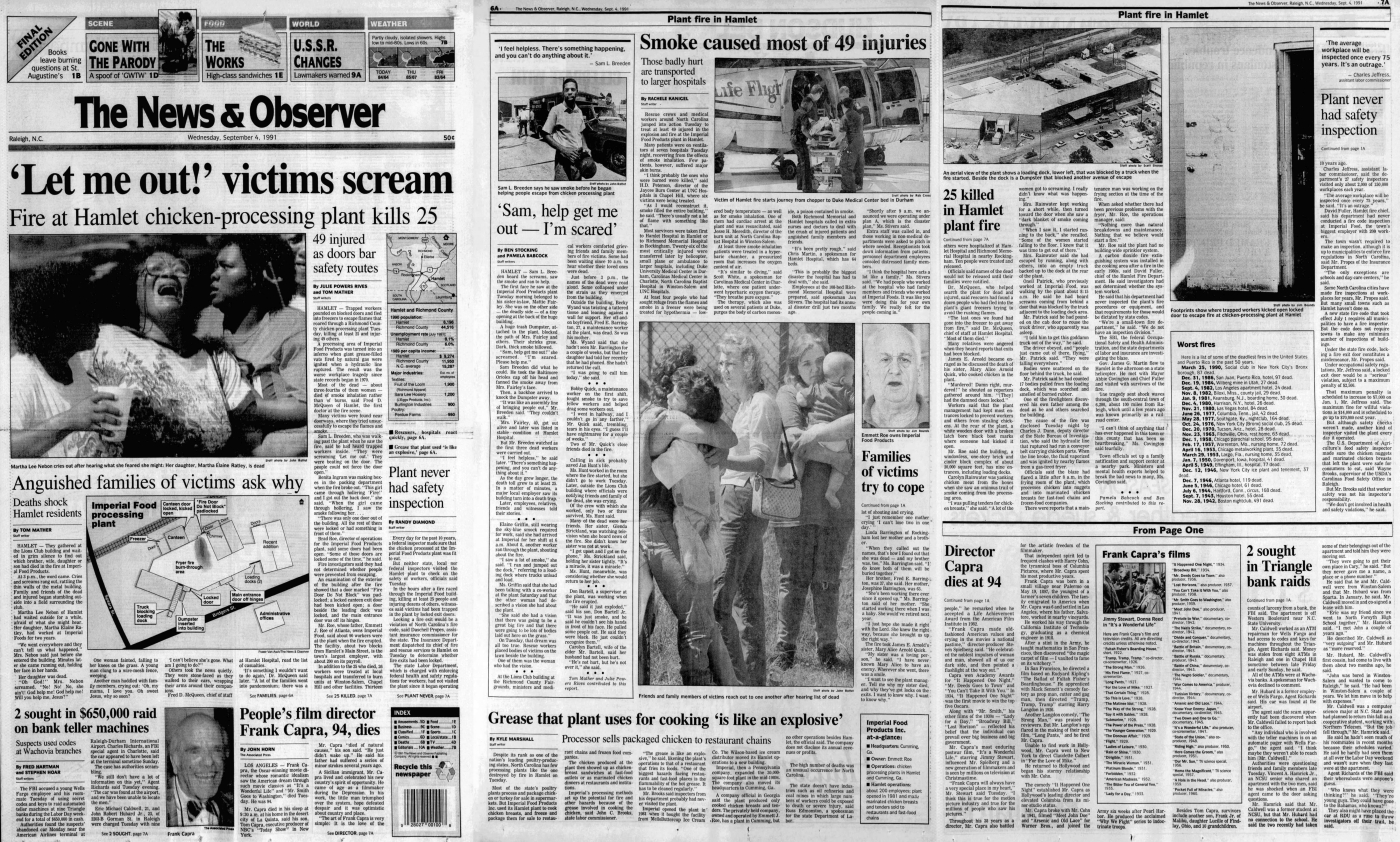
Presenting reporting by the Raleigh News & Observer on September 4, 1991, the day after the deadliest structure fire in the state’s history in Richmond County, at a food processing plant in Hamlet.
“Let me out!” victims scream
Fire at Hamlet chicken-processing plant kills 25
49 injured as doors bar safety routes
By Julie Powers and Tom Mather
Staff writers
HAMLET — Trapped workers pounded on blocked doors and fled into freezers to escape flames that roared through a Richmond County chicken-processing plant Tuesday, killing at least 25 and injuring 49 others.
A processing area of Imperial Food Products was turned into an inferno when giant grease-filled vats fired by natural gas were ignited when a hydraulic line ruptured. The result was the worst workplace tragedy since state records began in 1970.
Most of the dead — about three-fourths of them women — died of smoke inhalation rather than burns, said Fred D. McQueen of Hamlet, the first doctor at the fire scene.
Many victims were found near doorways, where they tried unsuccessfully to escape the flames and smoke.
Sam L. Breeden, who was walking past the plant when he saw the fire, said he had heard trapped workers inside. “They were screaming, ‘Let me out.’ They were beating on the door. The people could not force the door open.”
Benita Ingram was making boxes in the packing department when the fire broke out. “This girl came through hollering ‘Fire!’ and I got out the back door,” she said. “When she said some smoke was coming through, hollering, I saw the smoke following her.”
“There was only one door out of the building. All the rest of them were locked or had something in front of them.”
Brad Roe, director of operations for the Imperial Food Products plant, said some doors had been open. “Some of those doors are locked some of the time,” he said.
Fire investigators said they had not determined whether people were prevented from escaping.
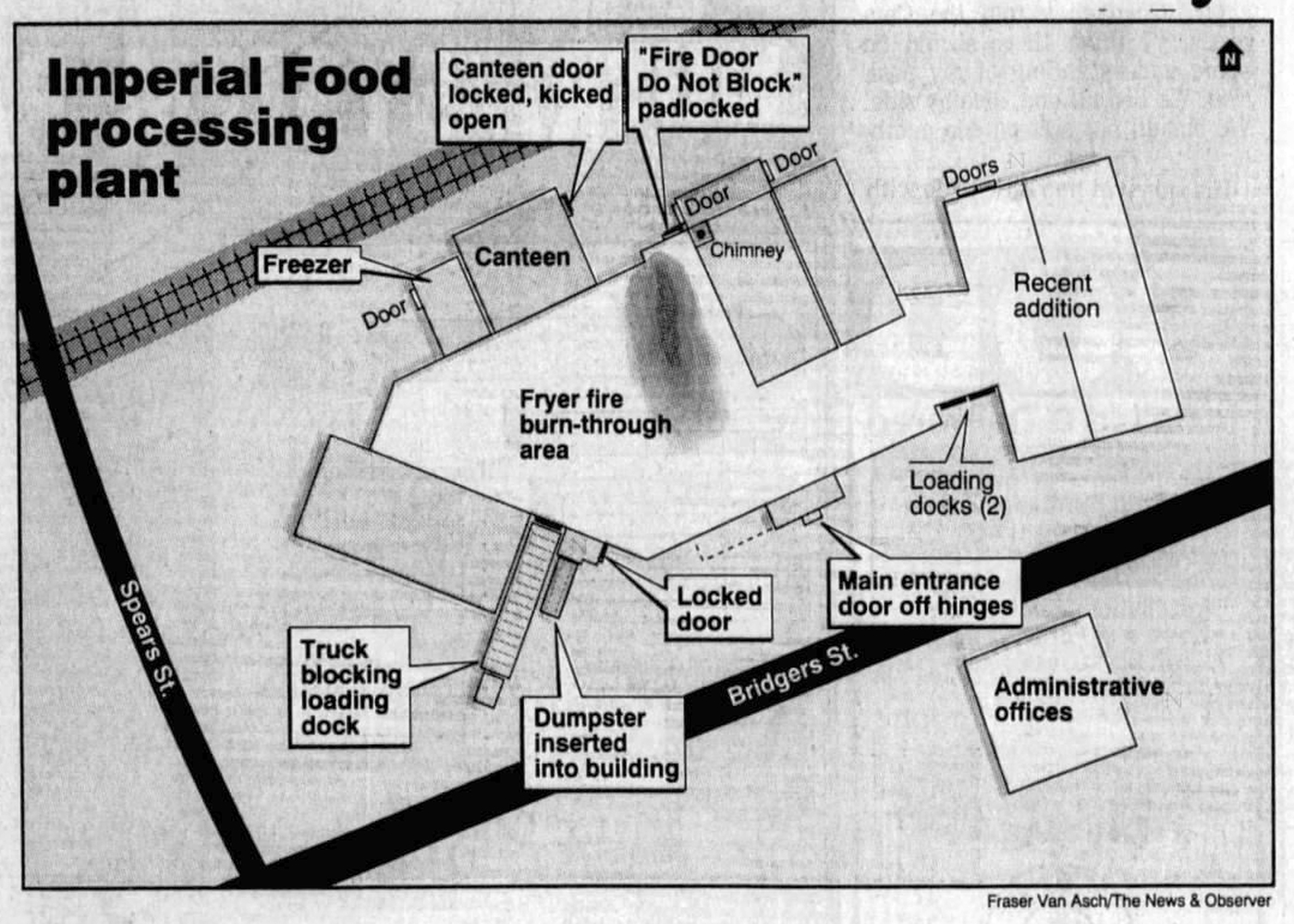
An examination of the exterior of the building after the fire showed that a door marked “Fire Door Do Not Block” was padlocked; a locked canteen exit door had been kicked open; a door beside the loading dock was locked; and the main entrance was one of the few ways out.
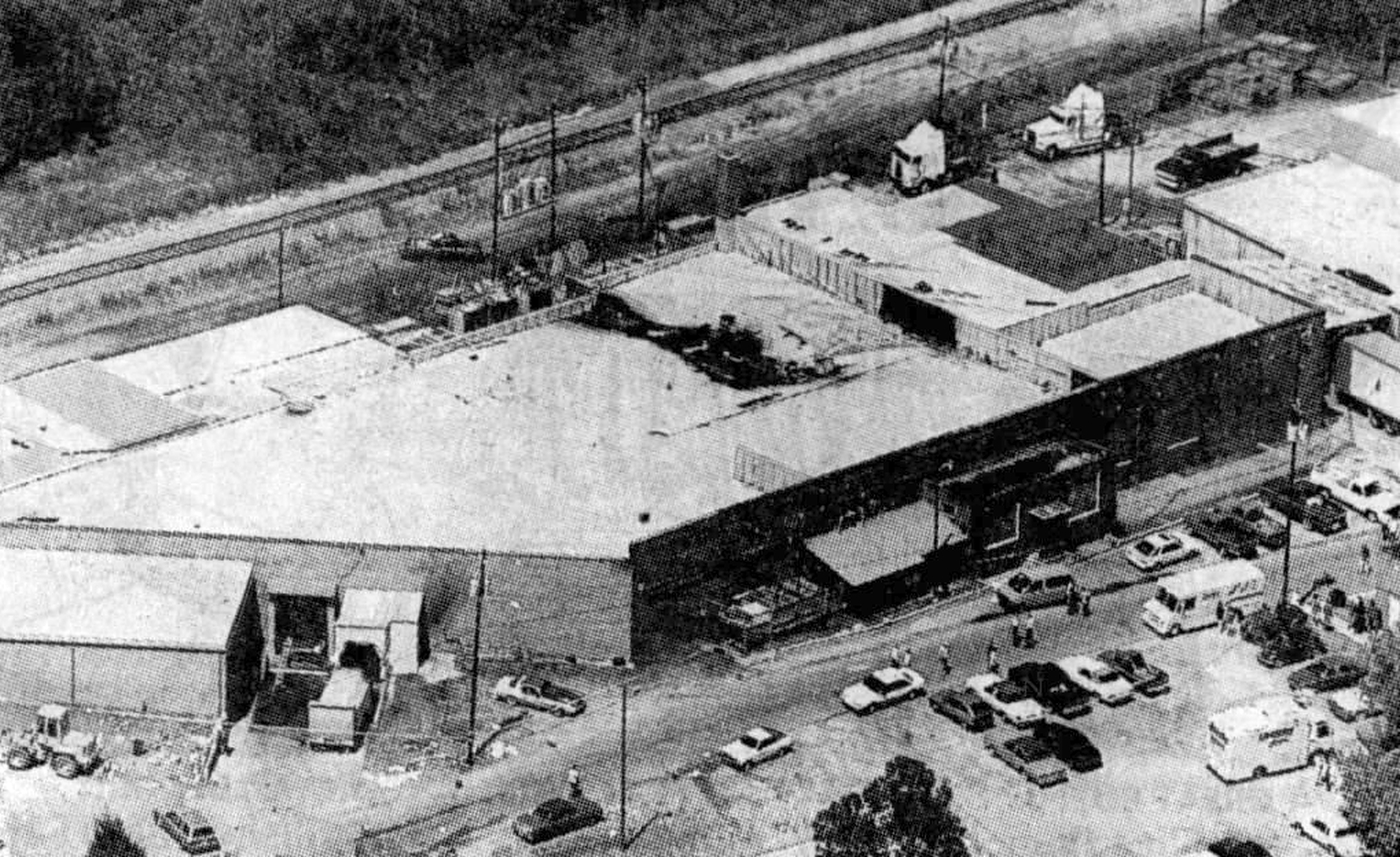
Mr. Roe, whose father, Emmett J. Roe of Atlanta, owns Imperial Food, said about 90 workers were at the plant when the fire erupted. The facility, about two blocks from Hamlet’s Main Street, is the town’s largest employer, with about 200 on its payroll.
In addition to the 25 who died, 26 workers were treated at local hospitals and transferred to burn units at Winston-Salem, Chapel Hill and other facilities. Thirteen others were treated at Hamlet Hospital, read the list of casualties.
“It’s something I wouldn’t want to do again,” Dr. McQueen said later. “A lot of the families went into pandemonium; there was vomiting, screaming. I really didn’t know what was happening.”
Mrs. Carolyn Rainwater, who had worked at the plant for only a short while, turned toward the door when she saw a “dark blanket of smoke coming through.”
“When I saw it, I started running to the back,” she recalled. “Some of the women started falling to the floor. I knew that it was time to get out of there.”
Mrs. Rainwater said she escaped by running, along with others, into an empty truck backed up to the dock at the rear of the plant.
Jim Patrick, who previously worked at Imperial Food, was walking by the plant about 8:15 a.m. He said he heard screams coming from behind a door that was blocked by a truck adjacent to the loading-dock area.
Mr. Patrick said he pounded on the cab door to rouse the truck driver, who apparently was asleep.
“I told him to get this goddamn truck out of the way,” he said.
The driver obeyed, and “people just came out of there, flying,” Mr. Patrick said. “They were falling everywhere.”
Seventeen bodies were scattered on the floor behind the truck, he said. Mr. Patrick said he had counted 17 bodies from the loading dock, which was scorched and smelled of burned rubber.
One firefighter discovered his own father among the dead as he and others searched the building.
The cause of the fire was disclosed Tuesday night by Charles J. Dunn, deputy director of the State Bureau of Investigation. He said a hydraulic line that ruptured had operated a conveyor belt carrying chicken parts. When the line broke, the fluid vaporized and was ignited by nearby flames from a gas-fired fryer.
Officials said the blaze started a little after 8 a.m. in the frying room of the plant, which processed chicken into nuggets and marinated chicken breasts for fast-food chains and frozen-food companies.
There were reports that a maintenance man was working on the frying section at the time of the fire.
When asked whether there had been previous problems with the fryer, Mr. Roe, the operations manager, said:
“Nothing more than natural breakdowns and maintenance. Nothing that we believe would start a fire.”
Mr. Roe said the plant had no building-wide sprinkler system.
A carbon-dioxide fire-extinguishing system was installed in the cooking area after a fire in the early 1980s, said David Fuller, chief of the Hamlet Fire Department. He said investigators had not determined whether the system worked.
He said his department had never inspected the plant’s fire procedures or equipment, and that requirements for those would be dictated by state codes.
“We’re a small-town fire department,” he said. “We do not have an inspection division.”
The SBI, the federal Occupational Safety and Health Administration, and the state departments of labor and insurance were investigating the blaze.
Gov. James G. Martin flew to Hamlet in the afternoon on a state helicopter. He met with Mayor Abbie Covington and Chief Fuller and visited with survivors of the fire.
The tragedy sent shock waves through the south-central town of 6,901, about 100 miles from Raleigh, which until a few years ago was known primarily as a railroad center.
“I can’t think of anything that has ever happened in this town or this county that has been so heartbreaking,” Ms. Covington said tearfully.
Town officials set up a family-notification and support center at a nearby park. Ministers and mental-health experts helped break the bad news to many, Ms. Covington said.
Pamela Babcock and Ben Stocking contributed to this report.
Anguished families of victims ask why
Deaths shock Hamlet residents
By Tom Mather
Staff writer
HAMLET — They gathered at the Lions Club building and waited in grim silence to find out which brother, wife, daughter or son had died in the fire at Imperial Food Products.
At 3 p.m., the word came. Cries and screams rang out, rattling the thin walls of the metal building. Family and friends of the dead and injured began stumbling outside into a field surrounding the clubhouse.
Martha Lee Nebon of Hamlet had waited outside for a while, afraid of what she might hear. Her daughter, Martha Elaine Ratley, had worked at Imperial Foods for two years.
“We went everywhere and they can’t tell us what happened,” Mrs. Nebon said just before she entered the building. Minutes later, she came running out, holding her face in her hands.
Her daughter was dead.
“Oh God!” Mrs. Nebon screamed. “No! No! No, she ain’t! God help me! God help me!”
One woman fainted, falling to her knees on the grass. A young man clung to a wire-mesh fence, weeping.
Another man huddled with family members, crying out: “Oh, my mama. I love you. Oh sweet Jesus, why so soon?”
“I can’t believe she’s gone. What am I going to do?”
Others took the news quietly. They were stone-faced as they walked to their cars, wrapping their arms around their companions.
Fred D. McQueen, chief of staff at Hamlet Hospital, read the list of casualties.
“It’s something I wouldn’t want to do again,” Dr. McQueen said later. “A lot of the families went into pandemonium; there was vomiting, screaming.”
“Sam, help get me out — I’m scared”
By Ben Stocking and Pamela Babcock
Staff writers
HAMLET — Sam L. Breeden heard the screams, saw the smoke and ran to help.
The first face he saw at the Imperial Food Products plant Tuesday morning belonged to his sister-in-law, Mattie Fairley. She was on the other side — the deadly side — of a tiny opening at the back of the huge building.
A huge trash Dumpster, attached to the plant, blocked the path of Mrs. Fairley and others. Their shrieks grew. Dark, thick smoke billowed.
“Sam, help get me out!” she screamed. “I’m scared. Please help me.”
Sam Breeden did what he could. He took the Baltimore Orioles cap off his head and fanned the smoke away from Mrs. Fairley’s face.
Then, a backhoe arrived to knock the Dumpster away.
“It was like an assembly line of bringing people out,” Mr. Breeden said. “They couldn’t wait.”
Mrs. Fairley, 40, got out alive and later was listed in stable condition at Hamlet Hospital.
But Mr. Breeden watched as the first three dead workers were carried out.
“I feel helpless,” he said later. “There’s something happening, and you can’t do anything about it.”
As the day grew longer, the death toll grew to at least 25. In a matter of minutes, a major local employer saw its building turn into a death trap: friends, employees, relatives, their souls witnessed lost forever.
Elaine Griffin, still wearing the sky-blue smock required at Imperial for her shift at 6 a.m., was sitting in her car at about 8. Another worker ran through the plant, shouting about the fire.
“I saw a lot of smoke,” she said. “I ran and jumped out the dock,” referring to a loading dock where trucks unload and load.
Ms. Griffin said she had been talking with a co-worker at the plant Saturday and that the other woman had described a vision she had about the plant.
“She said she had a vision that there was going to be a great big fire and that there were going to be lots of bodies laid out here on the grass.”
On Tuesday, that dream was all too true. Rescue workers placed bodies of victims on the lawn beside the building.
One of them was the woman who had the vision.
At the Lions Club building at the Richmond County Fairgrounds, ministers and medical workers comforted grieving friends and family members of fire victims. Some had been waiting since 10 a.m. to hear whether their loved ones were dead.
Just before 3 p.m., the names of the dead were read aloud. Some collapsed under the strain as they emerged from the building.
Outside the building, Becky Wyand was twisting a tattered tissue and leaning against a wall for support. Her off-and-on friend, E.W. Swain, a maintenance worker at the plant, was dead. So was his mother.
Ms. Wyand said that she had not seen Mr. Swain for a couple of weeks, but that her daughter had told her recently that he had phoned. She had not returned the call.
“I was going to call him today,” she said.
Bobby Quick, a maintenance worker on the first shift, fought smoke to try to save fellow workers and helped drag some workers out.
“I went in halfway, and I couldn’t go in any farther,” Mr. Quick said, trembling, tears in his eyes. “I guess I’ll have nightmares for a couple of weeks.”
Two of Mr. Quick’s close friends died in the fire.
Calling in sick probably saved Jan Hunt’s life.
Ms. Hunt worked in the room where the fire started, but she called in sick Tuesday. Outside the Lions Club building where officials were notifying friends and family of the dead, she was crying.
Of the crew with which she worked, only two or three survived, Ms. Hunt said.
Many of the dead were her friends. Her sister, Glenda Strickland, was watching television when she heard news of the fire. She didn’t know her sister was not at work.
“I got upset and I got on the phone,” Ms. Strickland said, holding her sister tightly. “It’s a miracle. It was a miracle.”
Ms. Hunt, meanwhile, was considering whether she would return to her job.
Don Bartell, a supervisor at the plant, was working when the fire erupted.
“He said it just exploded,” said his son, Don Bartell Jr. “It was just smoke, and he said he couldn’t see his hands in front of his face. He pulled some people out. He said they were black. He just couldn’t recognize them.”
Carolyn Bartell, wife of the elder Mr. Bartell, said her husband had not been hurt.
“He’s not hurt, but he’s not over it,” she said.
Tom Mather and Julie Powers Rives contributed to this report.
Smoke caused most of 49 injuries
Those badly hurt are transported to larger hospitals
By Rachele Kanigel
Staff writer
Rescue crews and medical workers around North Carolina jumped into action Tuesday to treat at least 49 injured in the explosion and fire at the Imperial Food Products plant in Hamlet.
Many patients were on ventilators at seven hospitals Tuesday night, recovering from the effects of smoke inhalation. Few patients, however, suffered major skin burns.
“I think probably the ones who were burned were killed,” said M.D. Peterson, director of the Jaycee Burn Center at UNC Hospitals in Chapel Hill, where six victims were being treated.
“As I would reconstruct it, smoke filled the entire building,” he said. “There’s usually not a lot of flame with something like that.”
Most survivors were taken first to Hamlet Hospital in Hamlet or Richmond Memorial Hospital in Rockingham. Twenty-six of the most critically injured were transferred later by helicopter, small plane or ambulance to larger hospitals, including Duke University Medical Center in Durham, Carolinas Medical Center in Charlotte, North Carolina Baptist Hospital in Winston-Salem and UNC Hospitals.
At least four people who had sought refuge from the flames and smoke in a freezer were being treated for hypothermia — lowered body temperature — as well as for smoke inhalation.
One of them had cardiac arrest at the plant and was resuscitated, said Jesse H. Meredith, director of the burn unit at North Carolina Baptist Hospital in Winston-Salem.
At least three smoke-inhalation patients were treated in a hyperbaric chamber, a pressurized tent that increases the oxygen content of air.
“It’s similar to diving,” said Scott White, a spokesman for Carolinas Medical Center in Charlotte, where one patient underwent hyperbaric-oxygen therapy. “They breathe pure oxygen.”
The therapy, which also was used on several patients at Duke, purges the body of carbon monoxide, a poison contained in smoke.
Both Richmond Memorial and Hamlet hospitals called in extra nurses and doctors to deal with the crush of injured patients and anguished family members and friends.
“It’s been pretty rough,” said Chris Martin, a spokesman for Hamlet Hospital, which has 64 beds.
“This is probably the biggest disaster the hospital has had to deal with,” he said.
Employees at the 108-bed Richmond Memorial Hospital were prepared, said spokeswoman Jan Stivers. The hospital had its annual disaster drill just two months ago.
“Shortly after 9 a.m., we announced we were operating under a Plan A, which is the disaster plan,” Ms. Stivers said.
Extra staff was called in, and those working in non-medical departments were asked to pitch in where needed. Receptionists took room-information calls from patients; personnel-department employees collected distressed family members.
“I think the hospital here acts a lot like a family,” Ms. Stivers said. “We had people who worked at the hospital who had family members and friends who worked at Imperial Foods. It was like you were doing this for your own family. We really felt for the people coming in.”
Families of victims try to cope
Continued from Page 1A
“I just remember one crying, ‘I can’t lose two in one day.’”
Linda Barrington of Rockingham lost her mother and a brother.
“When they called out the names, that’s how I found out that she was dead — and my brother was, too,” Ms. Barrington said. “I know both of them will be buried together.”
Her brother, Fred E. Barrington, was 37, she said. Her mother, Josephine Barrington, was 63.
“She’s been working there ever since it opened up,” Ms. Barrington said of her mother. “She started working there when I was a baby. She would’ve retired next year.
“I just hope she made it right with the Lord. She knew the right way, because she brought us up the right way.”
The fire took James E. Arnold’s sister, Mary Alice Arnold Quick.
“My sister was a loving person,” he said. “I have never known Mary Alice to have an enemy. Wherever she went, there was a smile.
“I want to see the plant manager. Tell me why my sister died, and why they’ve got locks on the exits. I want to know why. I want to know why.”
Plant never had safety inspection
By Randy Diamond
Staff writer
Every day for the past 10 years, federal inspectors made sure that the chicken processed at the Imperial Food Products plant was fit to eat.
But neither state, local nor federal inspectors visited the Hamlet plant to check on the safety of workers, officials said Tuesday.
In the hours after a fire raced through the Imperial Food building, killing at least 25 people and injuring dozens of others, witnesses said victims had been trapped by exits that had been locked.
The state Labor Department, which is charged with enforcing federal health and safety regulations for workers, had not visited the plant since it began operating 10 years ago.
Charles Jeffress, assistant labor commissioner, said the department’s 27 safety inspectors visited only about 2,000 of 150,000 workplaces each year.
“The average workplace will be inspected once every 75 years. It’s an outrage,” he said.
David Fuller, Hamlet fire chief, said his department had never conducted a fire-code inspection at Imperial Food, the town’s biggest employer, with about 200 workers.
The town wasn’t required to make an inspection, although it is up to municipalities to enforce fire regulations in North Carolina, said Mr. Propes of the Insurance Department.
“The only exceptions are schools and day-care centers,” he said.
Some North Carolina cities have made fire inspections at workplaces for years, Mr. Propes said. But many small towns such as Hamlet haven’t done so.
A new state fire code that took effect July 1 requires all municipalities to have a fire inspector. But the code does not require towns to make any minimum number of inspections of buildings.
Under the state fire code, locking a fire-exit door constitutes a misdemeanor, Mr. Propes said.
Under occupational-safety regulations, Mr. Jeffress said, a locked exit door would be a “serious” violation, subject to a maximum penalty of $2,500.
That maximum penalty is scheduled to increase to $7,000 on Jan. 1, Mr. Jeffress said. The maximum fine for willful violations is $14,000 and is scheduled to go up to $70,000 next year.
But although safety checks weren’t made, another kind of inspector visited the plant every day it operated.
The U.S. Department of Agriculture’s food-safety inspector made sure the chicken nuggets and marinated chicken breasts that left the plant were safe for consumers to eat, said Wayne Brooks, supervisor of the USDA’s Carolinas Food Safety Office in Raleigh.
But Mr. Brooks said worker safety was not his inspector’s responsibility.
“We don’t get involved in health and safety violations,” he said.
Grease that plant uses for cooking “is like an explosive”
Processor sells packaged chicken to restaurant chains
By Kyle Marshall
Staff writer
Despite its rank as one of the nation’s leading poultry-producing states, North Carolina has few processing plants like the one destroyed by fire in Hamlet on Tuesday.
Most of the state’s poultry plants process and package chicken or turkey for sale in supermarkets. But Imperial Food Products Inc. used its Hamlet plant to cook chicken breasts and freeze and package them for sale to restaurant chains and frozen-food companies.
The chicken produced at the plant then showed up as chicken-breast sandwiches at fast-food outlets or as marinated chicken entrees at restaurants and institutions.
Imperial’s processing methods set up the potential for fire and other hazards because of the grease involved in cooking the chicken, said John C. Brooks, state labor commissioner.
“The grease is like an explosive,” he said, likening the plant’s operations to that of a restaurant that fries its foods. “One of the biggest hazards facing restaurants and fast-food places is the flammability of the hot grease. It has to be cleaned regularly.”
Mr. Brooks said inspectors from his department probably had never visited the plant.
Imperial opened the plant in 1981 when it bought the facility from Mello-Buttercup Ice Cream Co. The Wilson-based ice-cream distributor moved its Hamlet operations to a new building.
Imperial, then a Pennsylvania company, expanded the 30,000-square-foot plant in the mid-1980s. The company also moved its headquarters to Cumming, Ga.
A company official in Georgia said the plant produced only cooked chicken breasts and tenders. The privately held company, owned and operated by Emmett J. Roe, has a plant in Cumming, but the operations besides Hamlet are not known. The company does not disclose its annual revenues or profits.
The high number of deaths was an unusual occurrence for North Carolina.
The state doesn’t have industries such as oil refineries and coal mines in which large numbers of workers could be exposed to the same danger, said Louis Edmondson, a spokesman for the state Department of Labor.