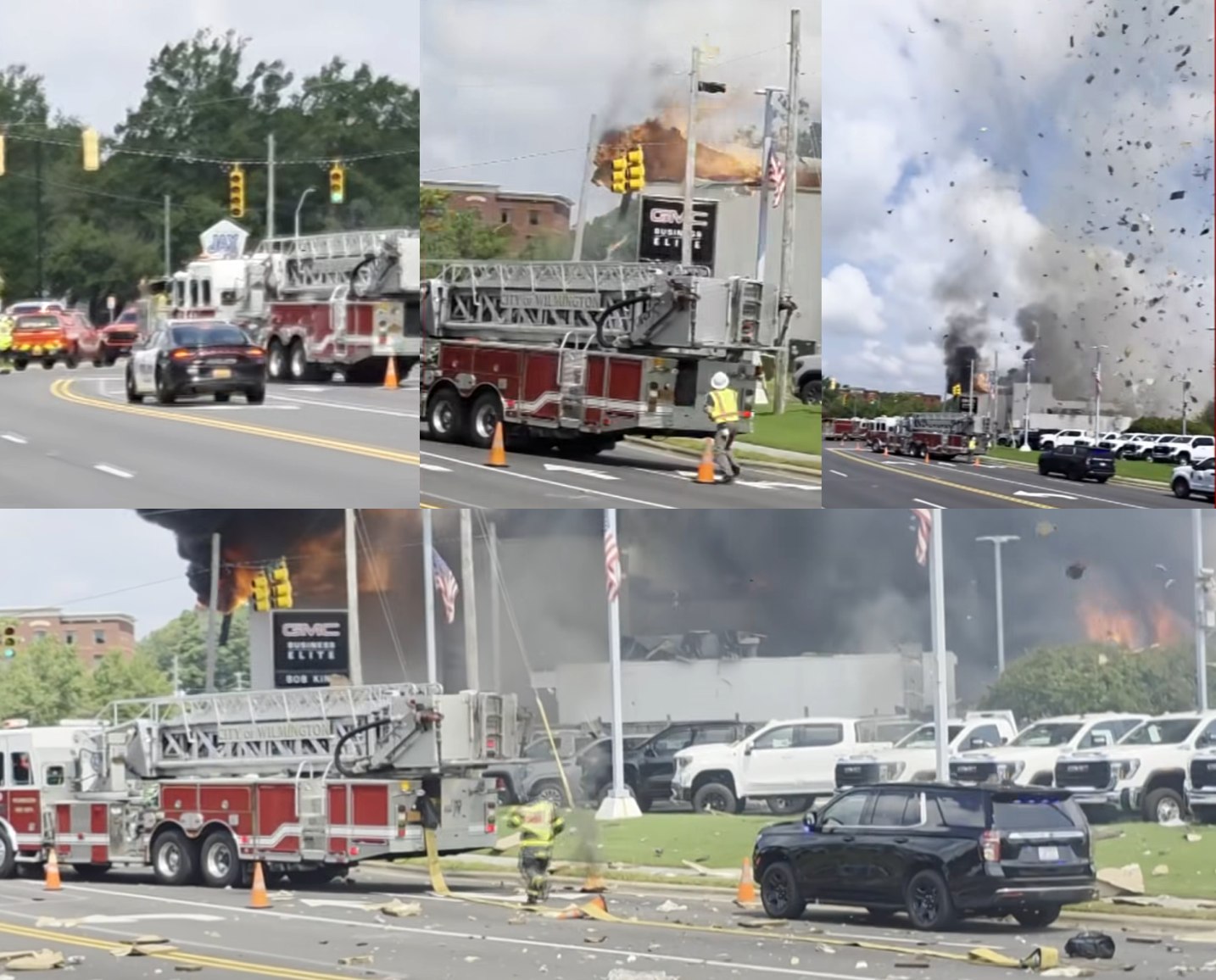
Screen grabs from Ian Cross footage via WECT.
Last updated: August 29, 2025
Introduction
On Tuesday, August 19, 2025, in Wilmington, NC, an impaired drive struck and damaged a gas meter and high-pressure line beside a commercial building that was being renovated for veterinary hospital. The vehicle left the scene. The hospital was planning to open next month.
Some 20 or 30 minutes after fire units arrived at the scene of the active gas leak, the building exploded and injured five firefighters, including one severely. They were inside the building conducting a primary search. They were monitoring the gas levels as they searched and they detected a dangerous concentration just seconds before the explosion.
All five were injured in the blast and emergency evacuation. One firefighter suffered second- and third-degree burns to their hands and was transferred to the burn center in Chapel Hill.
Here are narrative notes and more about the incident, drawn from news articles, the press conference, and other sources.
Incident Timeline
Around 11:00 a.m., a vehicle turning onto New Centre Drive left the roadway and struck the side of an office building at 5051 New Centre Drive. It struck the front right corner, where the gas meter and a high-pressure natural gas line were connected to the building. They were about 30 feet from the roadway. The vehicle left the scene.
Around 11:10 a.m. (?), Wilmington Engine 3 was dispatched to the vehicle versus building, with the single-company response type of Fire Incident. This is a generic call type that expedites dispatch of a unit while additional details are received by the dispatcher and the call coding is completed.
The location was first-due for Engine 8, but they were on another call. Engine 3 responded, and were operating a reserve engine.
As details of a reported gas leak were added to the call, Battalion 1—who was listening on the radio—requested that a truck company be added. The dispatcher replied that Truck 8, Squad 3, and Safety 2 had each already added themselves.
First-Arriving Units
Safety 2 was first-arriving and established command. He reported that there was an active gas leak from a damaged gas line and requested that the gas company be contacted. With the confirmation of an active gas leak, Battalion 1 added himself to the call.
Engine 3 was directed to stretch a protective line to the gas meter. Truck 8 was directed to block New Centre Drive. Squad 3 was directed to also help block New Centre Drive. And by this time, police had been requested to respond, to also help with traffic control.
Five firefighters from Truck 8 and Squad 3 entered the building to perform a primary search and evacuate any occupants.[1]
[1] When the first fire units arrived, they found construction workers at the site. The workers informed them of the “hissing” gas leak, but said nothing about whether or not people were inside the building. There were cars in the parking lot, however.
Battalion 1 arrived around this time and took command. Engine 3 was asked if they had a water supply. Engine 3 answered negative. Command requested an additional engine company, which added New Hanover County Engine 17 to the call. When they arrived, they were directed to lay a dry line to Engine 3.
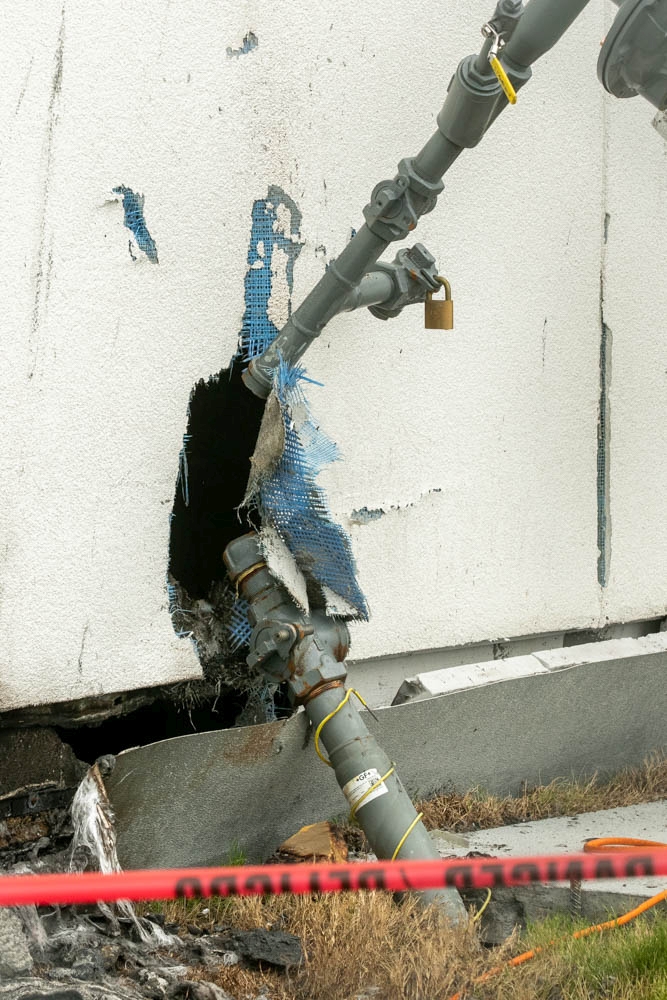
Close view of gas line three days after the incident. Legeros photo, see more in this gallery.
Warning of Danger, Then the Explosion
Squad 3 then contacted Command. They had detected 90% concentration inside the building.[2] Before Command could reply, Safety 2 radioed that there was fire through the roof. Then the explosion occurred. The time was around 11:30 a.m.
[2] This corrects prior reports that the mayday was issued prior to the explosion.
The resulting explosion blew debris straight up and away from the building. Fire also shot horizontally out of the front of the building and across New Centre.
At the time of the explosion, the five firefighters were on the second floor in hallways, as they were clearing rooms.
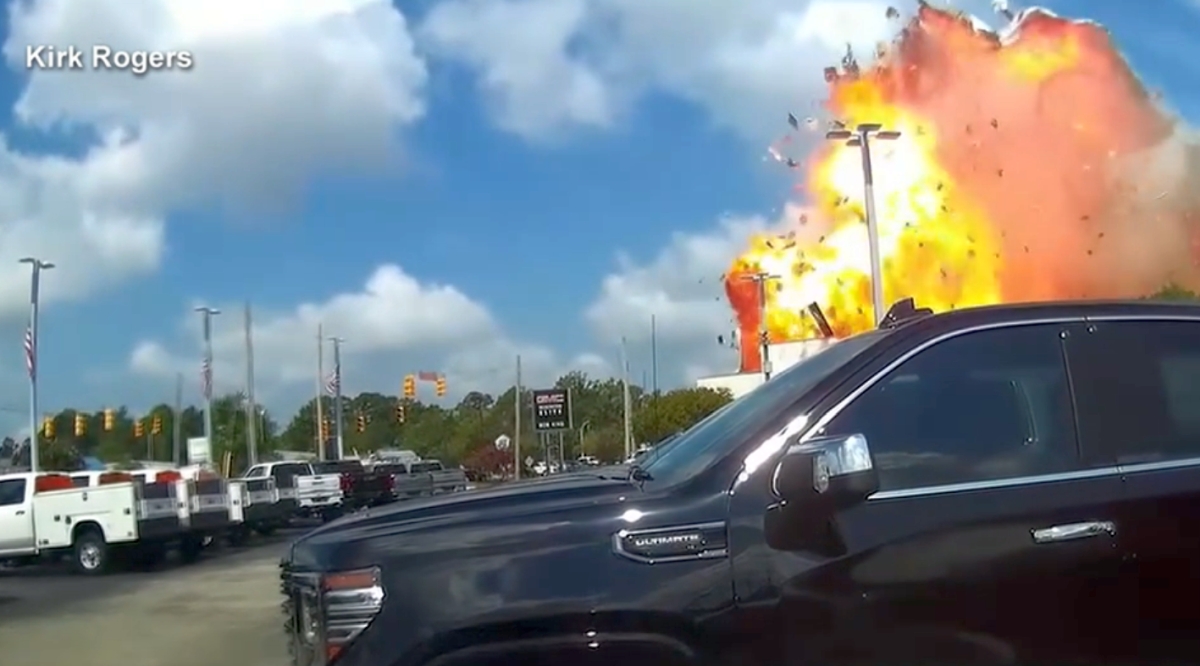
Screengrab from Kirk Rogers video from ABC news.
Maydays Issued
Squad 3 issued the first mayday. After their transmission ended, Truck 8 issued a second mayday.
Command then asked dispatch for a full alarm. This “filled the box” to add the units missing, had the call been originally dispatched as a full alarm assignment. (Which was 3 or 4 engines, 2 trucks, 1 rescue, 2 squads, 1 battalion chief, and safety.)
Command acknowledged the mayday and asked if any firefighters were trapped. They were not. He asked if they were all together. Yes they were together. He told them that if they couldn’t get out of the building using the stairwell to go to the windows and he would have a ladder brought to the window.
The five firefighters found a second-floor window on the bravo side of the building. Safety 2 observed them and directed the ground ladder to that location.
About that time Engine 8 arrived and was directed to perform RIT duties, including helping the firefighters evacuate.
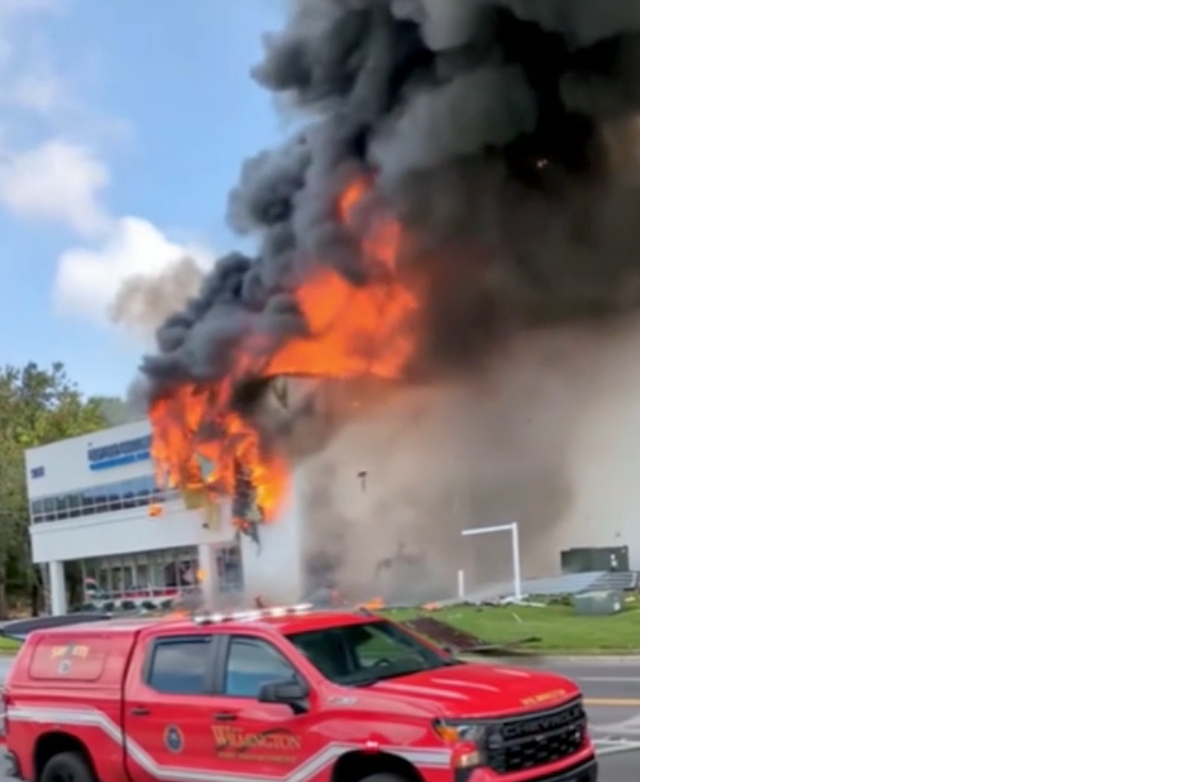 Screengrab from Stanley Waldrip video from ABC news.
Escaped by Ground Ladder
The ground ladder was placed at the window. The five firefighters rapidly evacuated the building and down the ladder. Two firefighters suffered injuries as they rapidly descended the ladder. Three other firefighters had been injured in the explosion, including one with second- and third-degree burns to his hands.
By that time an EMS supervisor had arrived at the scene and reported to Battalion 1, who requested two ambulances to the scene.
Three firefighters were initially transported by EMS. Later, two more were transported. And after the five had been transported, another ambulance stood by at the scene, for the remainder of the incident.
After the five firefighters were out of the building, the mayday was cleared. After there was a break in the radio traffic, Command requested a second alarm.
Suppression, Exposures, Hazards
After the explosion, fire suppression efforts directed by command included:
- Engine 3 to charge the hand line and spray the gas meter. The hand line was later changed to an unmanned blitz monitor.
- Engine 3 to charge their deck gun and spray the roof line.
- Truck 8 to move up to the A/D corner and set-up for aerial operations.
- Next arriving engine to supply Truck 8 with water.
- Truck 1 upon arriving to the C/B corner, to begin flowing.
- Truck 7 on the second alarm to the Delta side, to begin flowing.
In the rear of the building was a tractor-drawn MRI trailer that needed exposure protection. It was powered by a large diesel generator, and power could not be interrupted to the MRI trailer, which would otherwise result in a dangerous catastrophic failure. There was also burning debris in the rear of the building.
Other hazards inside the building included an oxygen generator and three oxygen tanks on the second floor, as well as nitrogen tanks. They were located in the same corner of the building as where the gas line was struck. It was later reported that the oxygen tanks further fueled the fire.
But the main problem was the ruptured gas line, which was feeding the fire in the A/D corner of the building.
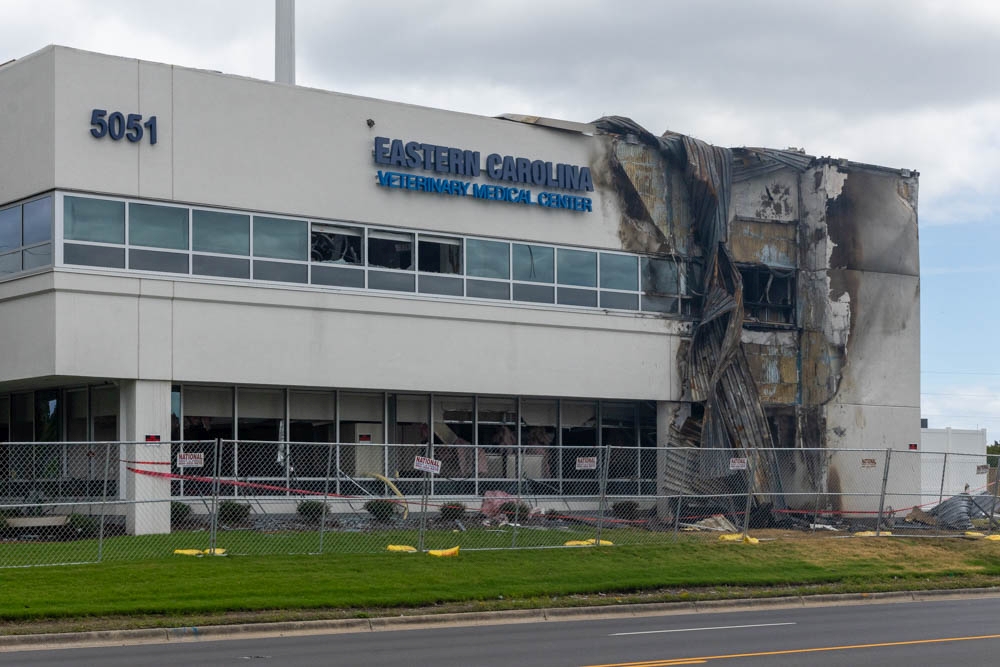 Front of the fire building, three days after the incident. Legeros photo, see more in this gallery.
Later Actions
Level two staging was enacted for the second-alarm units. As companies arrived, their personnel were moved inside the Wilmington Police Department mobile command unit, which was parked at the entrance to Lowes. This kept the crews cooled inside the air-conditioning.
EMS brought their mobile ambulance bus to the scene, which was used as a rehab center.
Battalion 2 arrived and was initially assigned to the B/C corner. Chief 3 and the Logistics Officer later arrived and further assisted command.
Two haz-mat teams responded, from the gas company and the fire department. They worked together to shut off the gas, with firefighters performing the shut-off actions.
The gas was shut off after an hour or two.
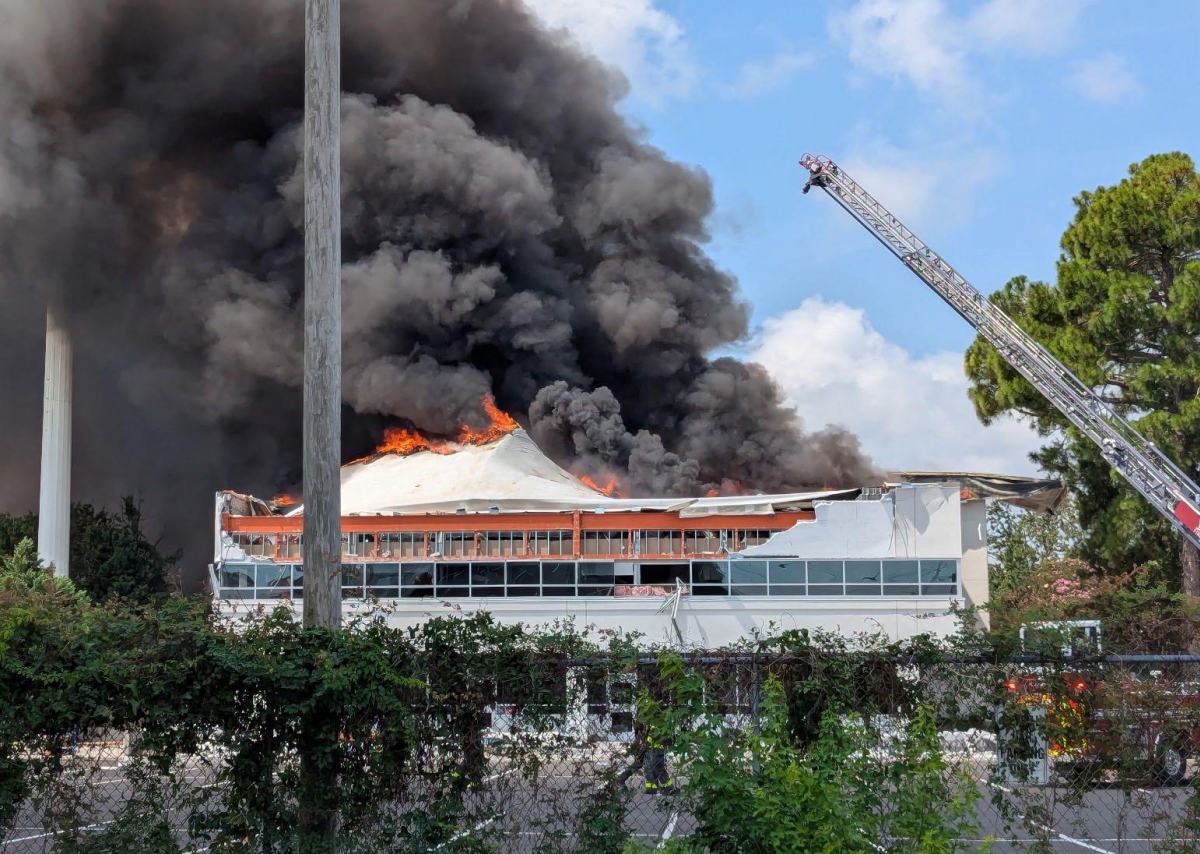
Photo from /r/Wilmington, posted by /u/sodapressingimdiying
Controlled and Extinguished
The fire was controlled at [goes here].
Once controlled, the MRI trailer’s diesel generator was isolated from the building’s electrical grid.
Once controlled, Rescue 2, the WFD technical rescue team, entered the building with Engine 5 and Squad 5 on a hose line to assess structural stability.
As sections of the building were determined to be stable, crews attacked a couple of hot spots inside the structure. An exterior aerial stream also assisted.
About seven hours later, command was terminated after the fire was marked as extinguished and units had demobilized.
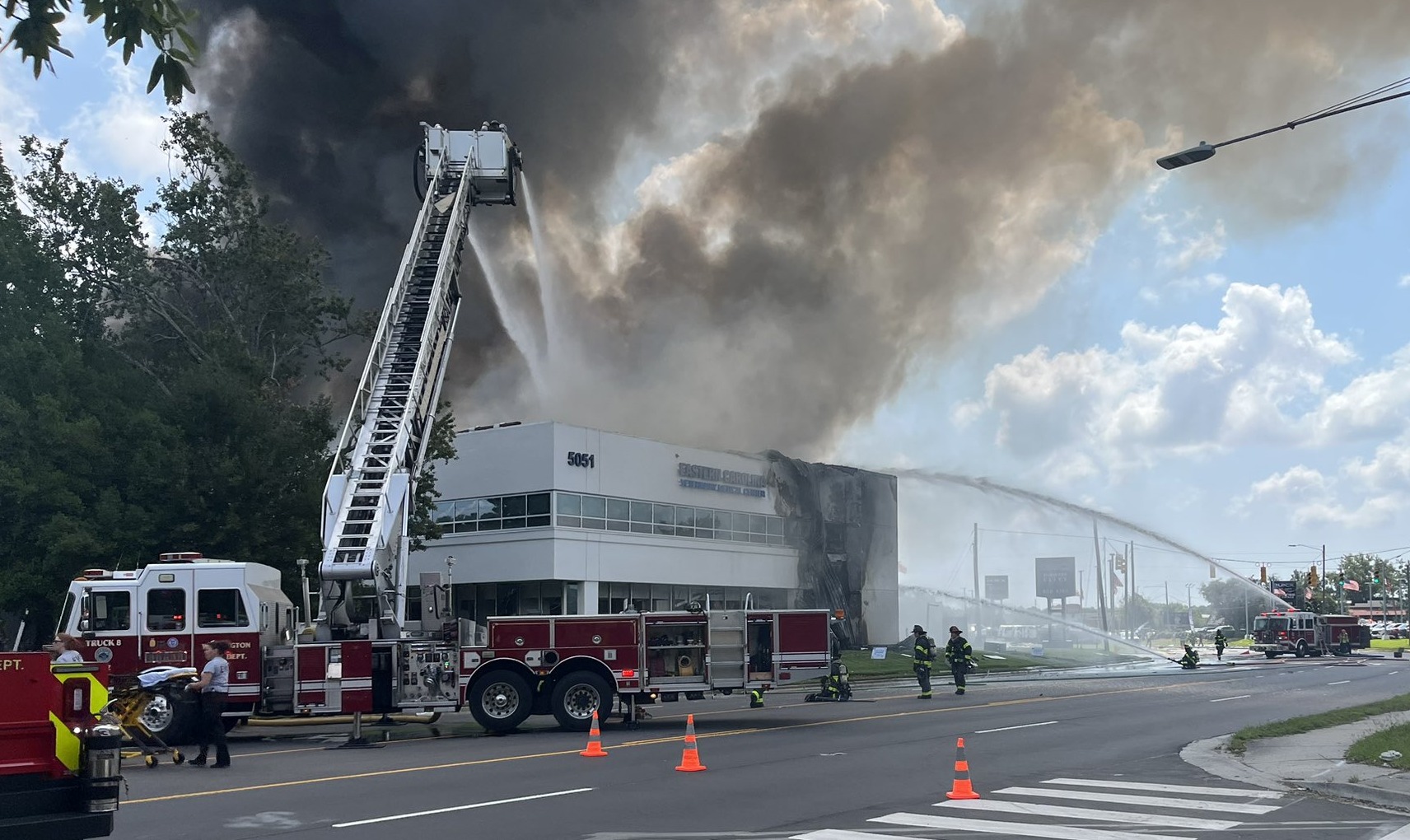
Wilmington Fire Department photo
Photos and Media
- Ian Cross footage from before, during, and after the explosion
- Star-News photos from the incident
- Legeros building photos from three days later
More links to be added.
Run Card
Units on scene included:
Wilmington Fire
E3 E2 E1 E10 T8 T7 T1 R2 Sq3 Sq1 Sq5 Mobile Air 1 B1 B2 Safety 2 Car 3 FM6Brush 3
New Hanover Fire
E17, B3 (cancelled), B4 (cancelled), CF5, CF19, CF18
Leland Fire
E51, late into incident.
And/or, standby at WFD Sta 1
Rocky Point Fire
Standby at NHC Sta 13
Pender EMS & Fire
E18 at NHC Sta14
E29 at NHC Sta 1
New Hanover Regional EMS
EMS11, EMS17
Wilmington Police
Mobile command unit
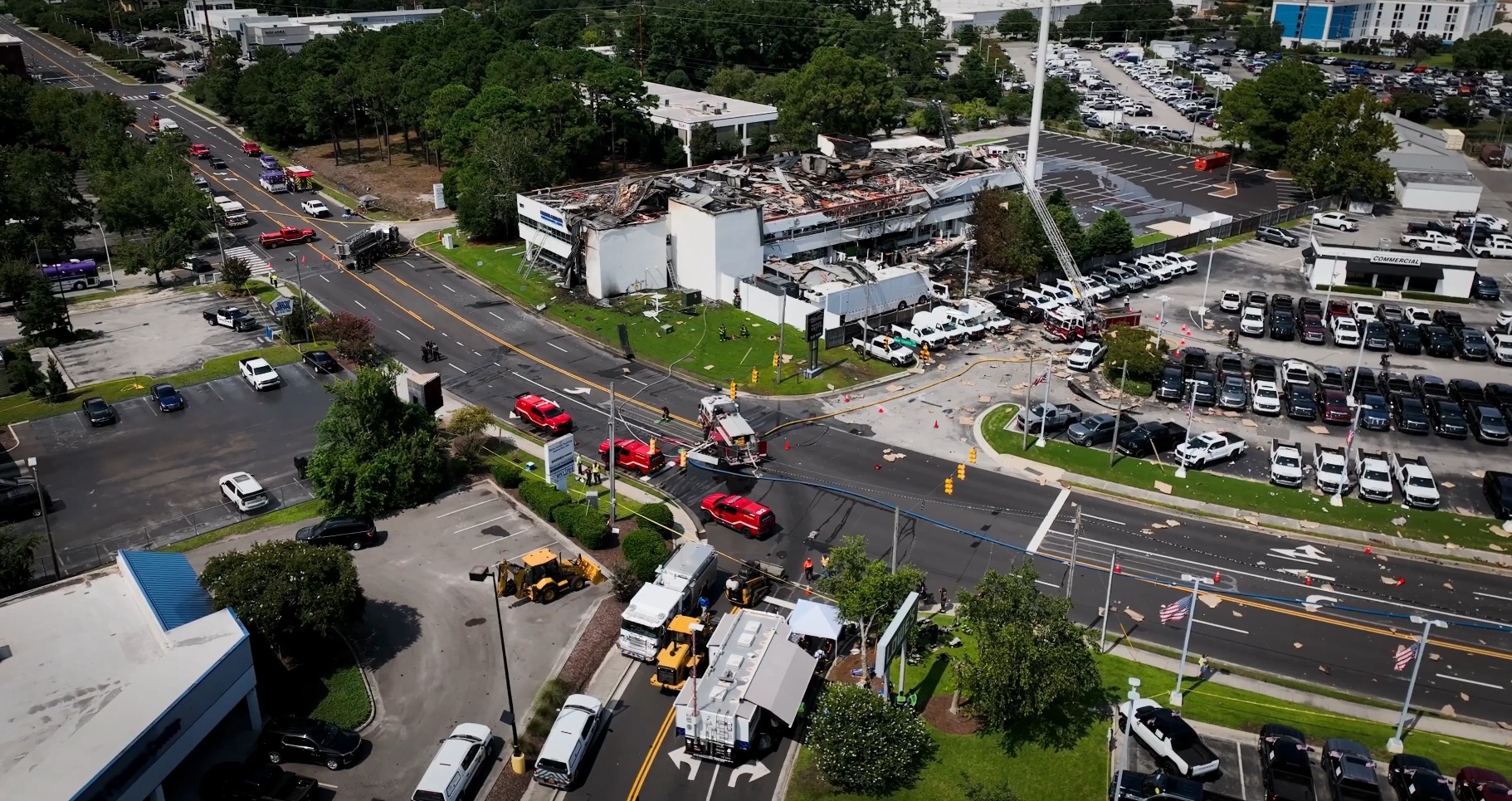
Screengrab from drone footage by @MyDrone.Pro.
Press Conference
The following day, fire and police officials conducted a press conference. As reported in the August 20, 2025, Star-News, they provided additional details about the incident, including:
- Arriving firefighters knew that gas was leaking, but didn’t know the gas line had been pushed into the building. And that gas was entering the building under high pressure, because the regulator–which would otherwise limit and lower the pressure–had been damaged by the vehicle that struck the meter on the outside of the building.
- And, after the explosion and resulting fire, the high pressure of the gas line was also feeding the fire. Firefighters also later found three 120-gallon oxygen tanks that further accelerated the spread of the fire.
- Due to the high pressure of the gas entering the building, and what firefighters didn’t know, was that the building was rapidly filling up with gas. As for the ignition source, it could have been any number of sources, from the HVAC system to “something as simple as a light switch.”
Also:
- The most severely injured firefighter received second- and third-degree burns to his hands. He was transferred to the burn center at UNC Hospital in Chapel Hill. He was undergoing surgery at the time of yesterday’s news conference.
- The building was expected to be a total loss. The certificate of occupancy had already been issued and was set to open in September for the veterinary practice.
Also:
- The 46 year-old male driver of the vehicle that struck the building and damaged the gas line was later apprehended.
- He was charged with “driving while intoxicated, felony serious injury, possession of drug paraphernalia, hit and run/leaving the scene of an accident, reckless driving and failure to maintain lane.”
- His intoxication was not alcohol-related, but cited as related to the inhalation of nitrous oxide. (Thank you, Google.)
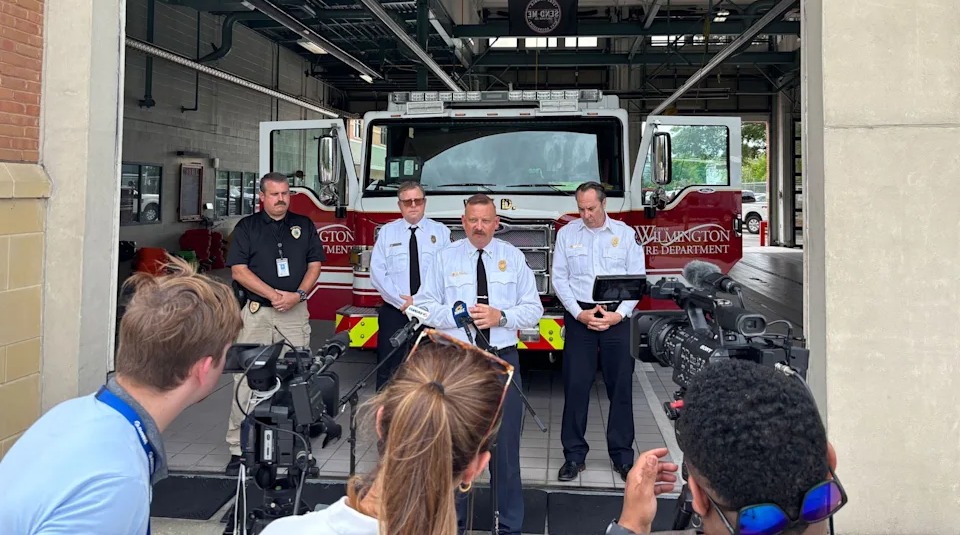
John Staton/Star-News photo, August 20, 2025. Shown from left are Greg Willett (WPD), Asst. Chief Chris Walker, Asst. Chief Derek Mickler, and Fire Chief Steve Mason.
Postscripts and Other Notations
- The building was not new construction. It was being renovated. The building had [goes here] square-feet and was built in [goes here].
- The firefighters inside the building from Squad 3 and Truck 8 were carrying hand-held gas monitors. That equipment is carried on both squad and truck companies in Wilmington.
- The police department dispatched their bomb squad within five minutes of the initial report of the explosion. Bomb squad technicians arrived less than 30 minutes of the explosion. They assisted WFD investigators with the post-explosion investigation. They also recommend that all firefighters on scene at the time of the explosion be evaluated for concussion and soft tissues injuries, based on their exposure to the blast. The firefighters were subsequently evaluated.
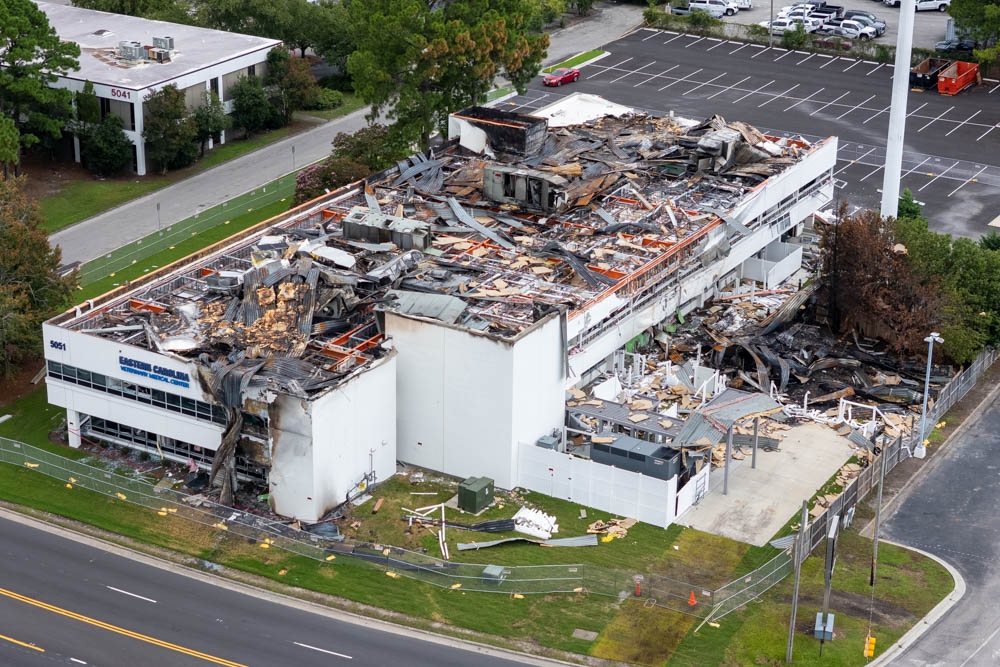
Aerial view of fire building, three days after the incident. Legeros photo, see more in this gallery.
Historical Perspective
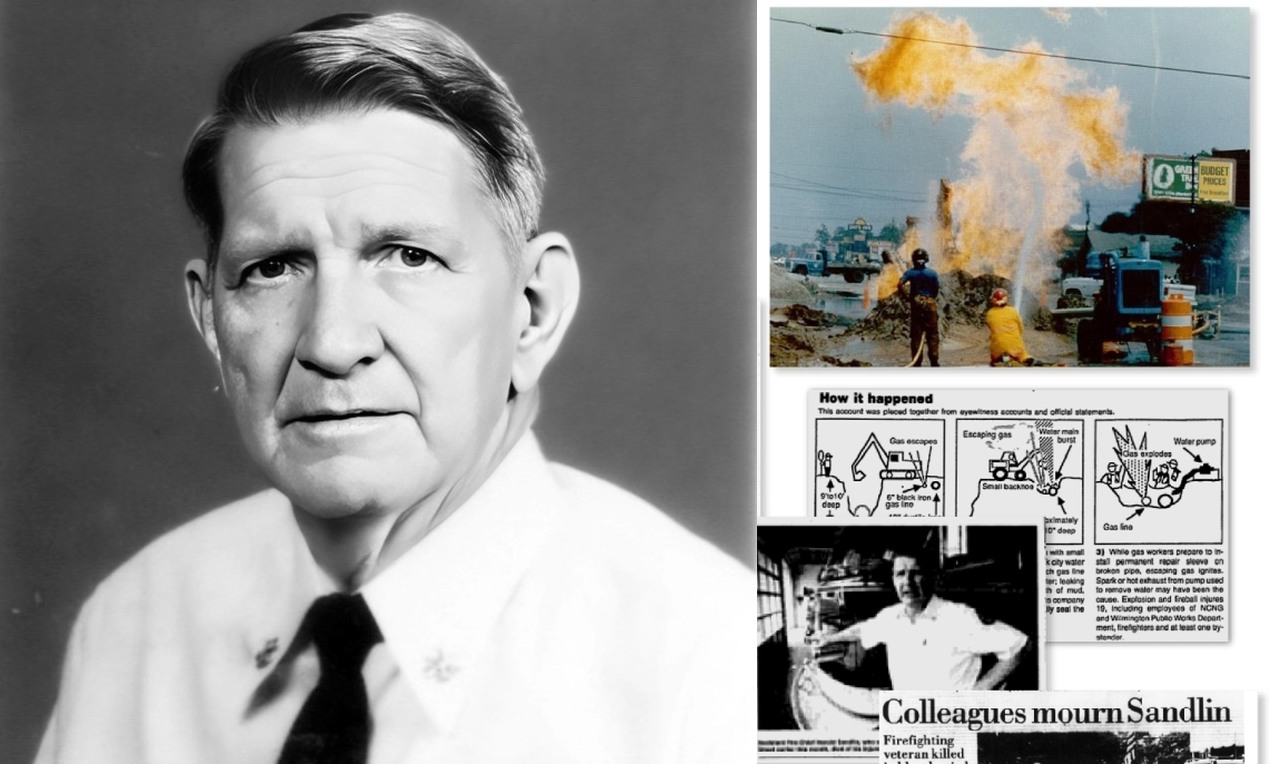
The explosion and fire occurred 38 years and nearly two weeks to the day that Assistant Fire Chief Harold Sandlin died as a result of injuries 14 days after a major gas explosion and fire downtown on August 5, 1987. He was one of 21 firefighters, city employees, and gas company employees who were injured by a flash fire that resulted.
Chief Sandlin suffered second- and third-degree burns to his face, arms, legs, chest, and back. He was transferred to the burn center in Chapel Hill.
He was 67 years old and a 44-year veteran of the department. He had been on a respirator and had developed pneumonia about one week before his death. The director of the burn center said he died from strain on his heart caused by his injuries.
He was buried on Monday, August 23, at Greenlawn Memorial Park.
Read that story at https://legeros.com/blog/wilmington-1987.
Facebook Discussions
Our postings about the incident on Legeros Fire Line:
August 25 – Looking closely at the damaged gas meter
https://www.facebook.com/share/p/1ATTXKc7Pb
August 22 – Aerial view, gas meter location circled
https://www.facebook.com/share/p/16UViVxrj2
August 20 – Ground view of defensive operations underway
https://www.facebook.com/share/p/14HAKEG9Kd6/
August 19 – Drone view after fire was extinguished
https://www.facebook.com/share/p/19fAcUWECi/
August 19 – First posting with pictures of the explosion
https://www.facebook.com/share/p/1Hm5kzkiSr