This is a blog version of a Facebook posting from September 24, 2024.
Morning history. Here’s the story of another multi-fatality hot-air balloon crash in North Carolina. See prior posting on the subject.
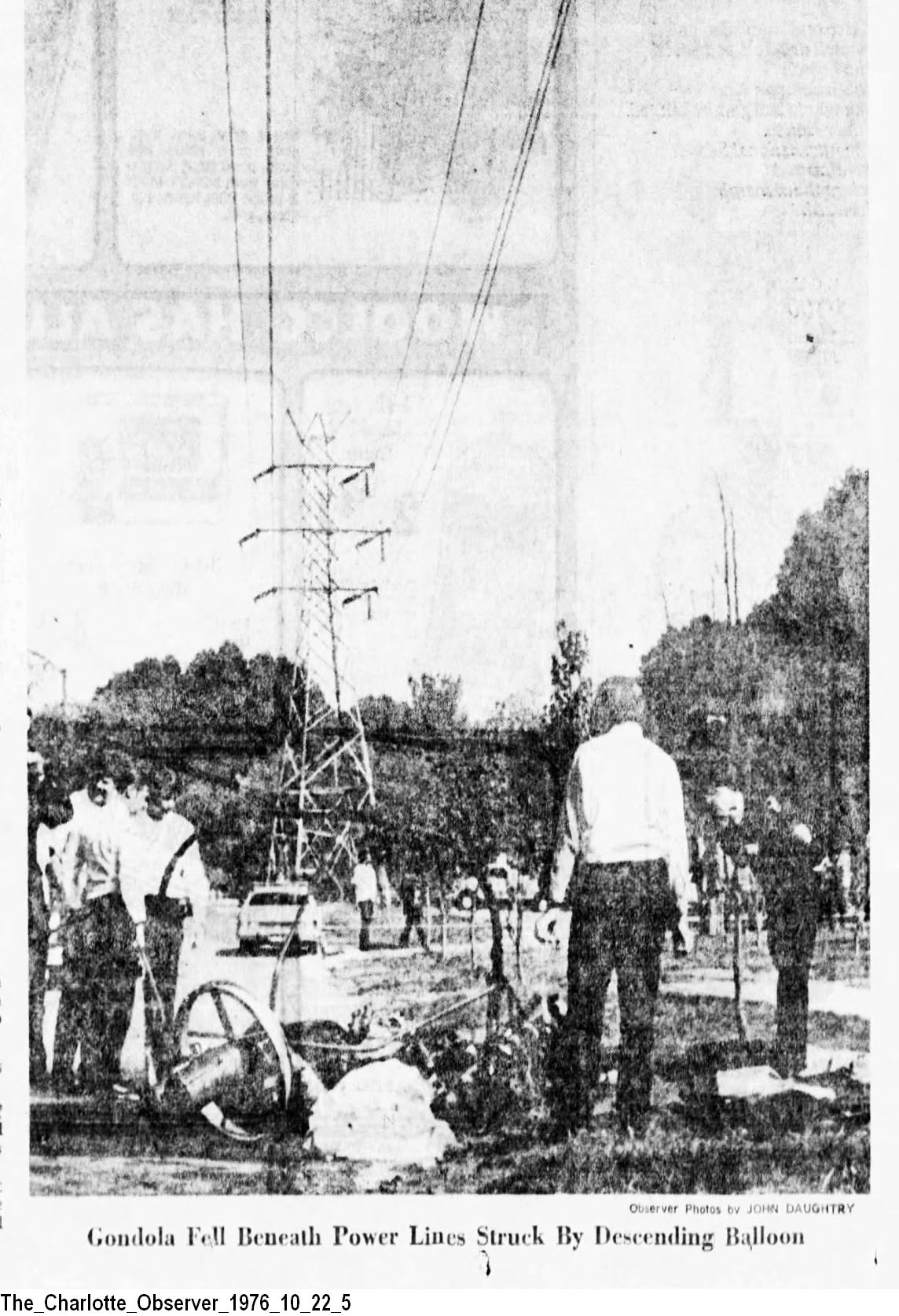
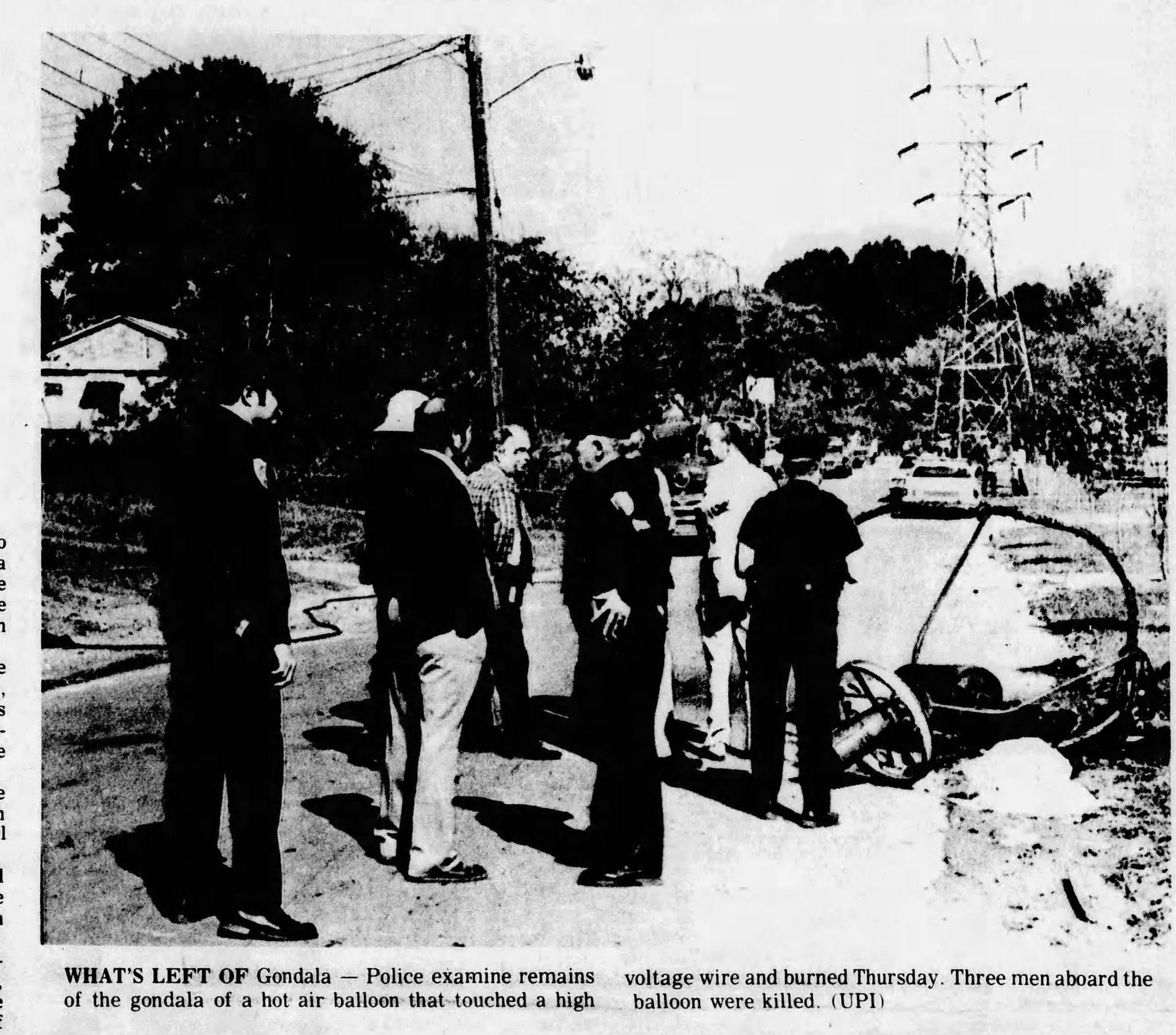
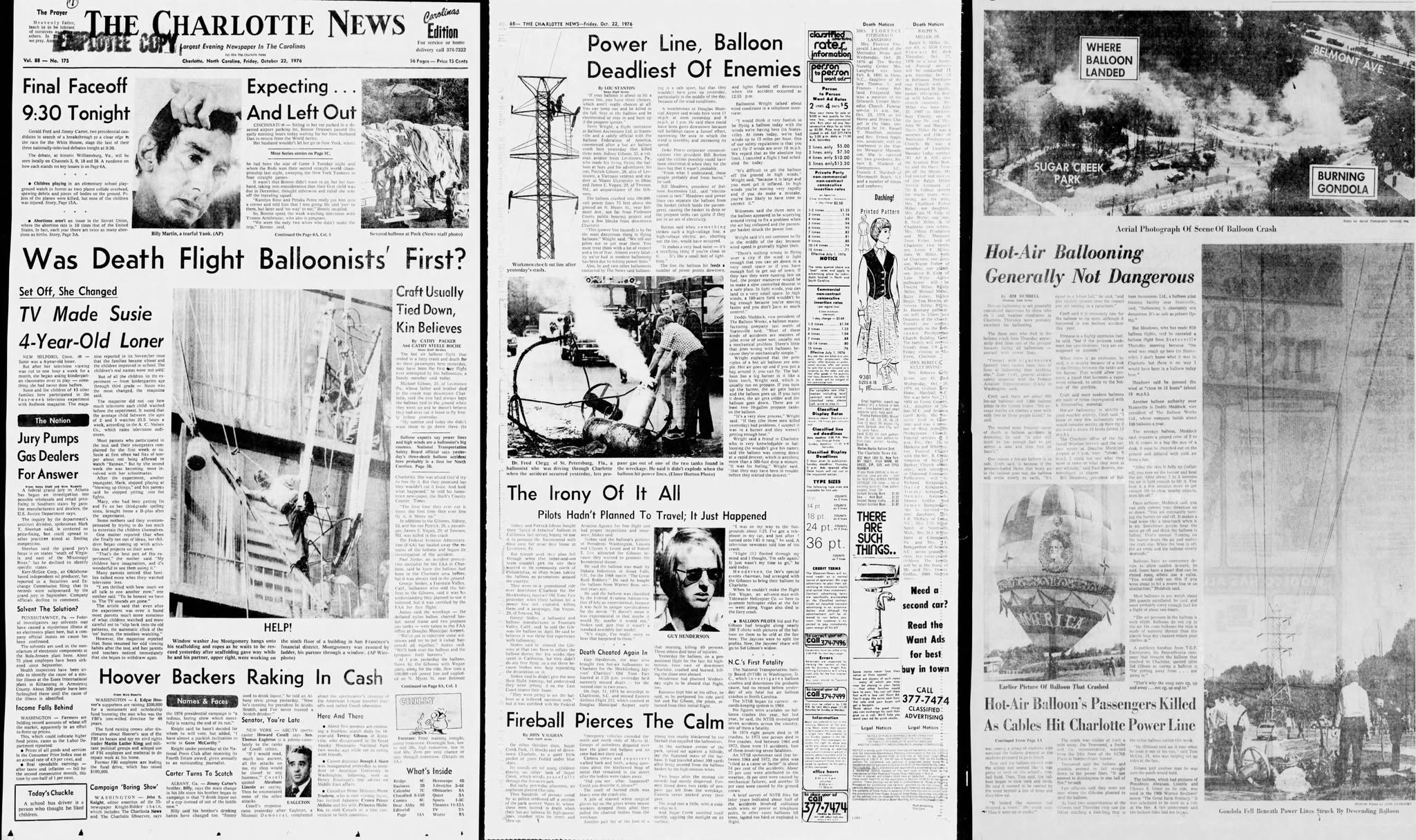
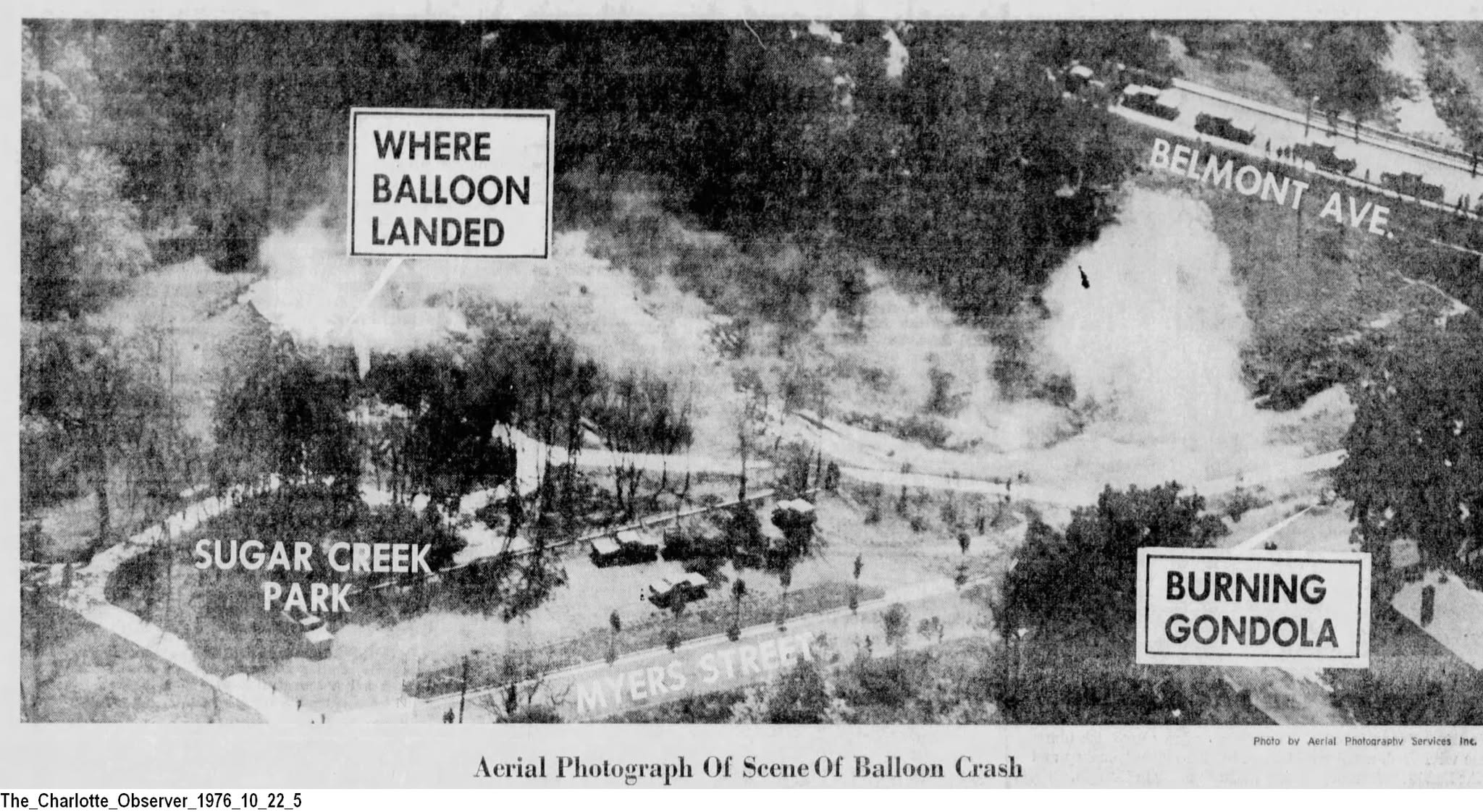
At 12:53 p.m. on October 21, 1976, a hot-air balloon crashed in downtown Charlotte. The two pilots and their passenger were killed. It struck high-tension power lines above Sugar Creek Park, about a mile east of the city center. The wires severed the balloon’s basket and the burning gondola dropped into the street. The deflating balloon traveled about 100 more yards before landing.
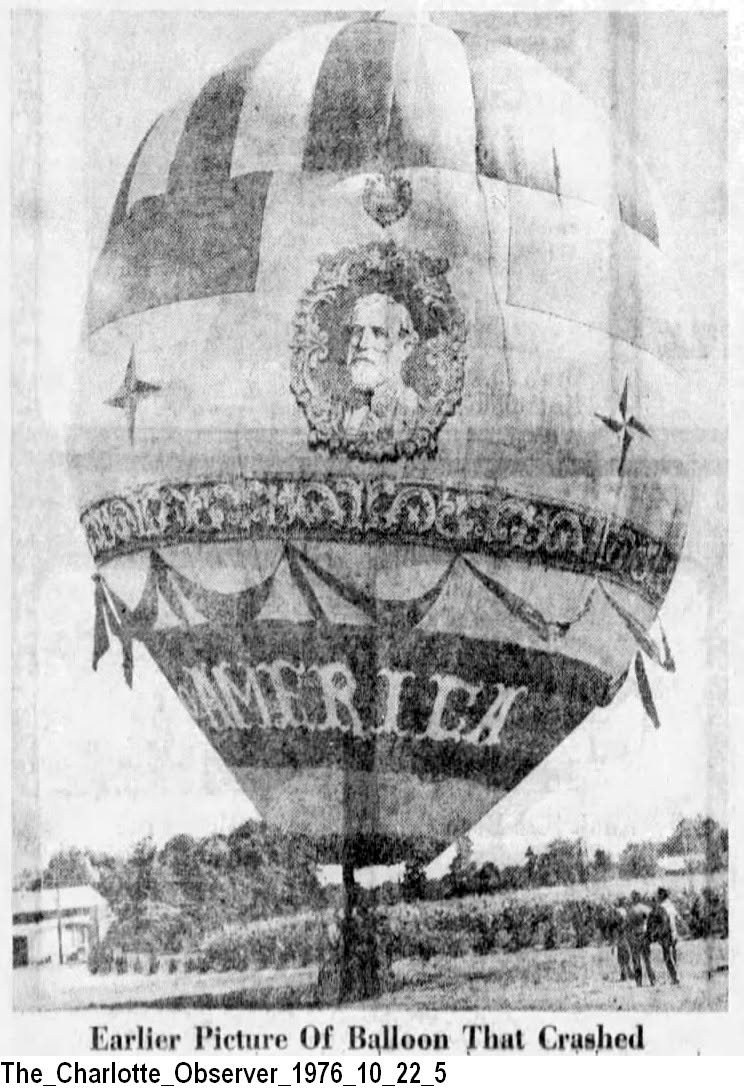
The balloon was named “Spirit of America” and was built by Dakota Industries in Sioux Falls, SD. It was red, orange, blue, and yellow, and had pictures of presidents Abraham Lincoln and Ulysses S. Grant on the side. It was built for the 1968 movie “The Great Bank Robbery” and later sold by Warner Brothers.
The balloon’s current owners and piloting team were father and son Sidney Gibson, 53, and Patrick Gibson, 28. They were from Levittown, PA. They had brought the balloon to Charlotte, to be used as a ride at the Mecklenburg Jaycee’s Old Time Fair, being held that week at the Metrolina Fairgrounds.
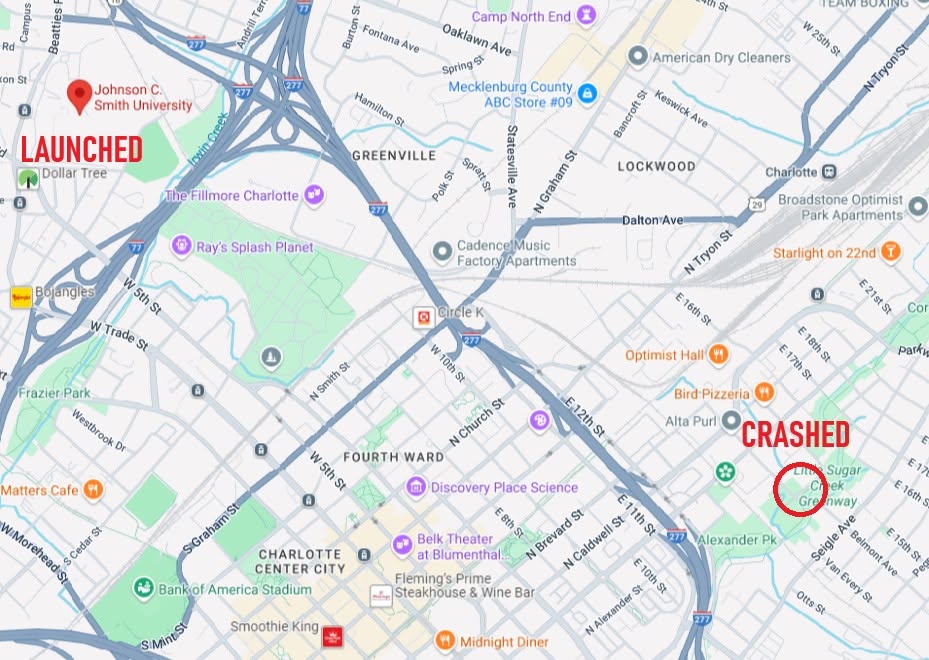
At the time of the crash, they had started a two-hour promotional trip, flying their ten-story balloon over downtown and using a bullhorn to promote the event. They had taken off from the football field at Johnson C. Smith University about 12:30 p.m. They crashed at 12:53 p.m.
The balloon crashed into 100,000-volt power lines that were 75 feet above the ground on North Myers Street, at Belmont Avenue. When they collided with the wires, “lights flashed off downtown” reported the next day’s Charlotte News.[1]
[1] Power to the downtown district was interrupted for several minutes.
Said one unnamed source to the newspaper, the balloon was descending at a rapid rate at the time of the accident, and the balloon may have been in trouble before it started descending. Reported the Associated Press in the Salisbury Post on October 22, 1976, “the balloon might have ascended to as high as 2,000 feet before it began a sudden and steep descent.”
Other witnesses reported seeing the balloon pass over a nearby school and it seemed like it was going to land at the school’s football field. Said one witness in the Charlotte News, “the balloon began to rock back and forth.” It then seemed to be “carried by the wind beyond a line of trees” and then exploded.
The crash was visible at least a mile away, as one witness watched the accident occur from the 24th floor of the NCNB Plaza at Independence Square.
Tommy Geiger, 55, was eating lunch in his yard at 728 Belmont Avenue. He told the Charlotte News that he heard “what sound like a motor go out and saw the balloon sail over the top of a pecan tree, hit a power line, and explode like ‘dynamite’.” He and several others ran to the crash site, where they found the burning wreckage.[2]
[2] See the Charlotte News, Page 6A, from October 22, 1976, for the graphic details of the burning wreckage, the victims, and initial rescue attempts.
Both Gibsons and their passenger, Jim Vogan, 29, were killed. Vogan was a member of the ground crew of a Maryland helicopter company that was selling helicopter rides at the fair.
Investigation
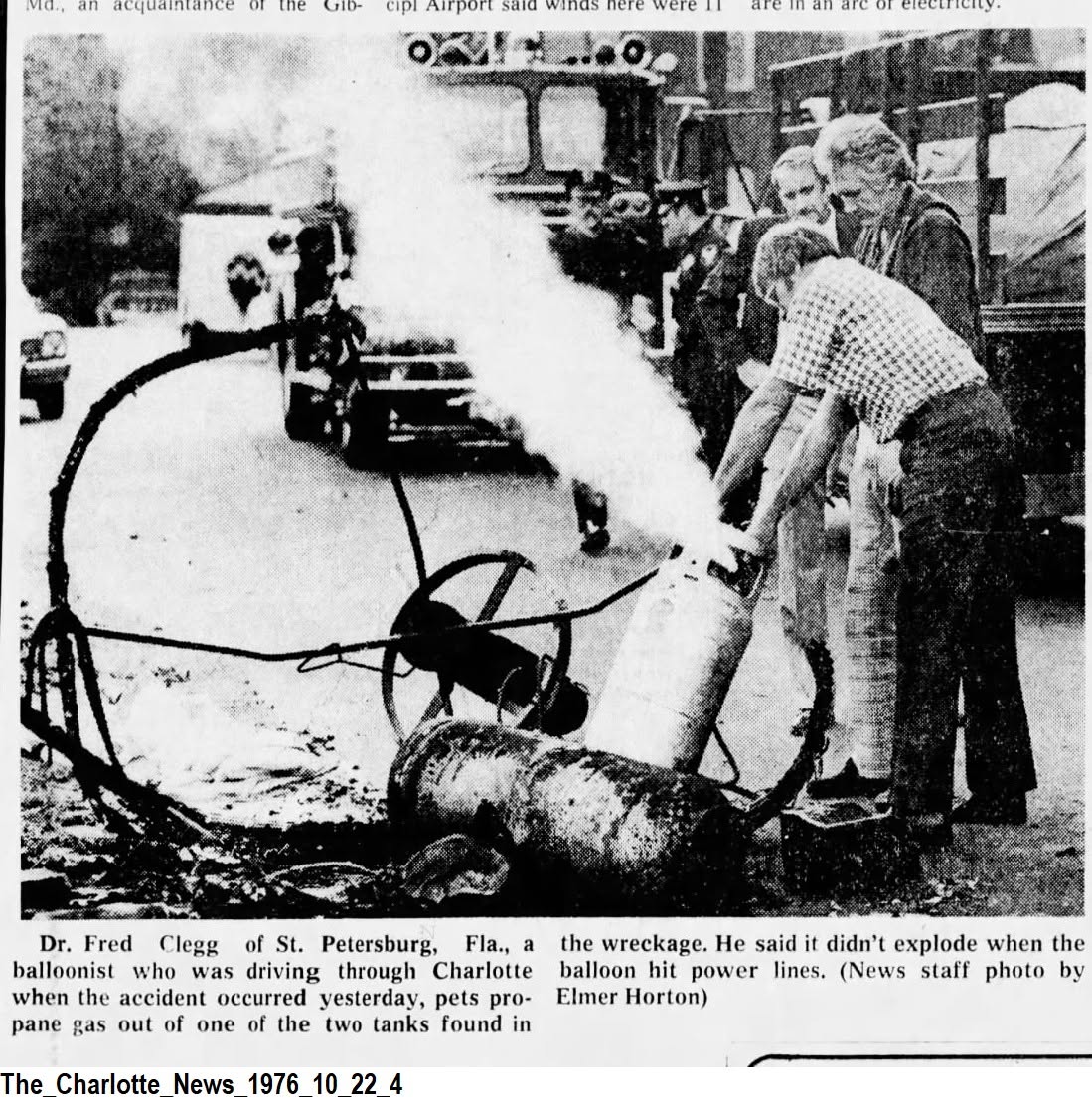
Representatives of the FAA later arrived on site. They transported the wreckage—“deflated nylon balloon, charred basket, metal frame, and two propane gas tanks”—to the FAA office at Douglas Municipal Airport. They would prepare a “findings-of-fact” report within 30 days, which would be forwarded to the National Transportation Safety Board (NTSB) in Washington, D.C.
Said one FAA representative the day after the accident, no licenses for free flight balloon operation was found in a “preliminary examination of the wreckage.”
The subsequent NTSB report listed weather as “unfavorable wind conditions” with wind velocity at 10 knots. The sky condition was clear, and visibility was unlimited. Probable cause was listed as “attempted operation [by pilot] with known deficiencies in equipment,” “attempted operation [by pilot] beyond experience/ability level,” and “unqualified person operated aircraft.” It noted that the balloon was “not modified for free flight” and no record was found of “balloon ratings” for either pilot.
Others opined on the wind conditions immediately after the crash, including three area balloonists contacted by the Charlotte News. They said, “they wouldn’t have gone up” on the day of the crash and “particularly in the middle of the day due to high winds.” The windspeeds that day were 11 miles per hour at noon, said a weatherman, and 9 miles per hour at 1:00 p.m. But “there could have been wind gusts in the downtown area because of a funnel effect created by the tall buildings there.”[3]
[3] Spend any amount of time in downtown Raleigh, and notably along Fayetteville Street, and you’ll observe that “funnel effect.”
As the Associated Press in the Salisbury Post reported on October 23, 1976, a family relative believed that the fatal flight may have been the first “free flight” that the Gibsons had ever attempted. Before that time, the Gibsons had always kept their balloon anchored to the ground when they went airborne.
Historical Perspective
The crash was believed to be the first hot-air balloon fatality in North Carolina history. According to the NTSB, eight people had died nationally in 16 balloon crashes in 1974. The year before, one person died in five balloon accidents. Between 1964 and 1972, there were 11 balloon accidents, four of which resulted in seven fatalities.
Escaped Death, Twice
One person who had planned to ride the balloon that day was Guy Henderson, the fair’s special events chairman. He had arranged with the Gibsons to bring their balloon to Charlotte. Business had kept Henderson at his office, so he postponed his ride until the Gibsons returned from what was their fatal flight. Two years earlier, on September 11, 1974, he escaped death after oversleeping in Charleston, SC, and missing his chance to board Eastern Airlines Flight 212. It crashed in Charlotte, killing 72 people.
Sources
Charlotte News and Salisbury Post clippings, October 22, 23, 1976, see this Google drive.