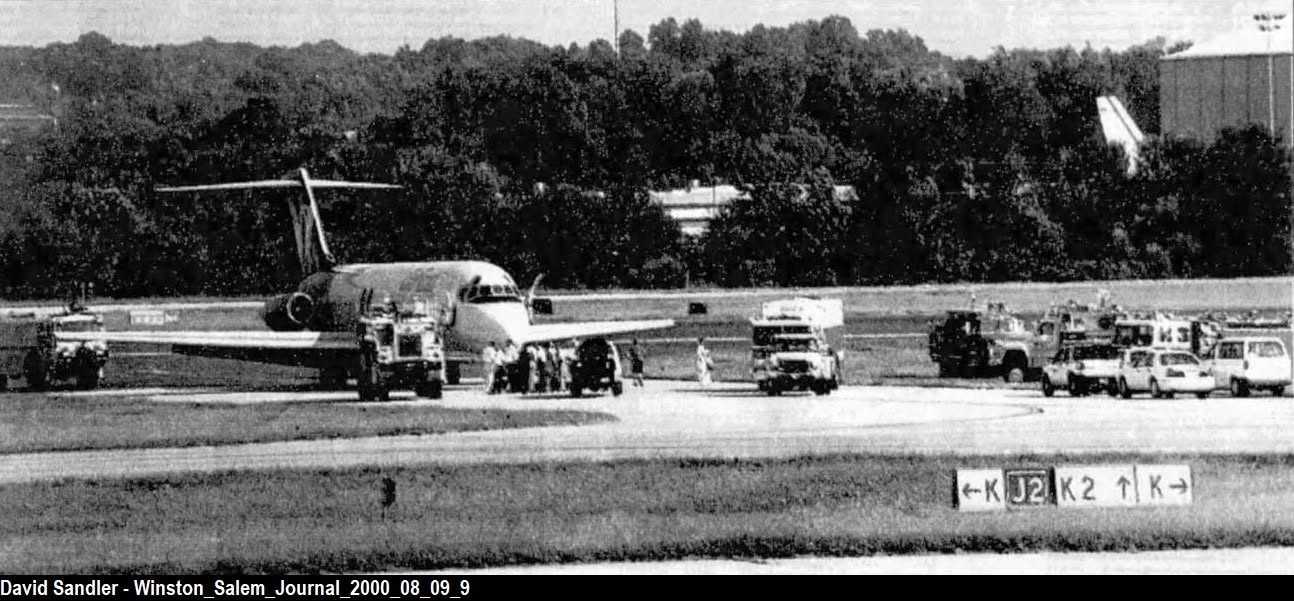
Looking back at the emergency landing of AirTran Airways Flight 913 on Tuesday, August 8, 2000.
About twenty minutes after the DC-9 departed Piedmont Triad International (PTI) Airport at ~3:15 p.m., the pilot reported thick smoke in the cabin.
The captain declared an emergency and requested permission to return to the airport. The jetliner was 15 miles into the flight. There were 62 souls aboard, including five crew members.
Said one passenger later in the next day’s Winston-Salem Journal, “I could see gray smoke in the air, smoke coming from the plane’s cockpit.” The passenger was sitting three rows from the door to the cockpit. And, as the plane was heading back to the airport, “the smoke got thicker and thicker.”
Another passenger recounted in the next day’s Greensboro News and Record that she “smelled a strong odor similar to burning rubber” and also saw “thick gray smoke in the front of the airplane.”
On the plane’s intercom system, the passengers were calmly told that the plane was returning to Greensboro. But neither the pilot nor the flight attendants said what was wrong.
After the pilot announced that their flight was returning to Greensboro, the flight attendants repeatedly shouted instructions to the passengers: bend over and keep their heads down.
The plane landed at ~3:45 p.m. The passengers and crew performed an emergency evacuation using the inflatable slides.
Emergency Response
Said the airport’s executive director, the emergency landing resulted in an Alert 2 response. They were “fairly common” at the airport, he told the News and Record. They occurred “between three and six times a month.”
But, he added, a plane that was forced to land and immediately evacuate was rare. “It’s been quite a while since we’ve had something like that,” he told the News and Record.
From pictures, the responding fire units included all of the airport’s apparatus, which included a pair of E-One Titan III crash trucks—Smokey 2 and Smokey 3, each 1500/1500/180—and a 1987 Ford/E-One R-500 rapid-intervention vehicle, Smokey 1. It carried 750/500/70 plus [goes here] pounds of dry chemical.
And it looked like at least two Guilford College Fire Department units were on scene, an engine and heavy rescue.
Minor Injuries
Reported newspapers, four AirTran employees—two men and two women—were transported to Moses Cone Hospital for smoke inhalation.
Plus one passenger transported to Wesley Long Community Hospital for a twisted knee, suffered during the evacuation. All of the injuries were minor and none required hospitalization.
The subsequent NTSB report, however, cited injuries as eight people from smoke inhalation and six people from the emergency evacuation.
Cause Determined
By the next day, investigators had determined the cause of the smoke that had filled the cockpit of the DC-9. An electrical fire had started in the dividing wall (or bulkhead) that separated the cabin and the cockpit.
The investigators found melted plastic parts and melted wiring around the wall, where circuit breakers and electrical wires were concentrated. The panel that burned was located directly behind the pilot’s chair.
The NTSB later stated that the probable cause was “A phase-to-phase arc in the left heat exchanger cooling fan relay, which ignited surrounding wire insulation and other combustible materials within the electrical power center panel. Contributing to the left heat exchanger fan relay malfunction was the unauthorized repair that was not to the manufacturer’s standards and the circuit breakers’ failure to recognize an arc-fault.”
Sources
Greensboro News and Record, August 9, 10, 2000
Winston-Salem Journal, August 9, 10, 2000
NTSB report via Aviation Safety Network