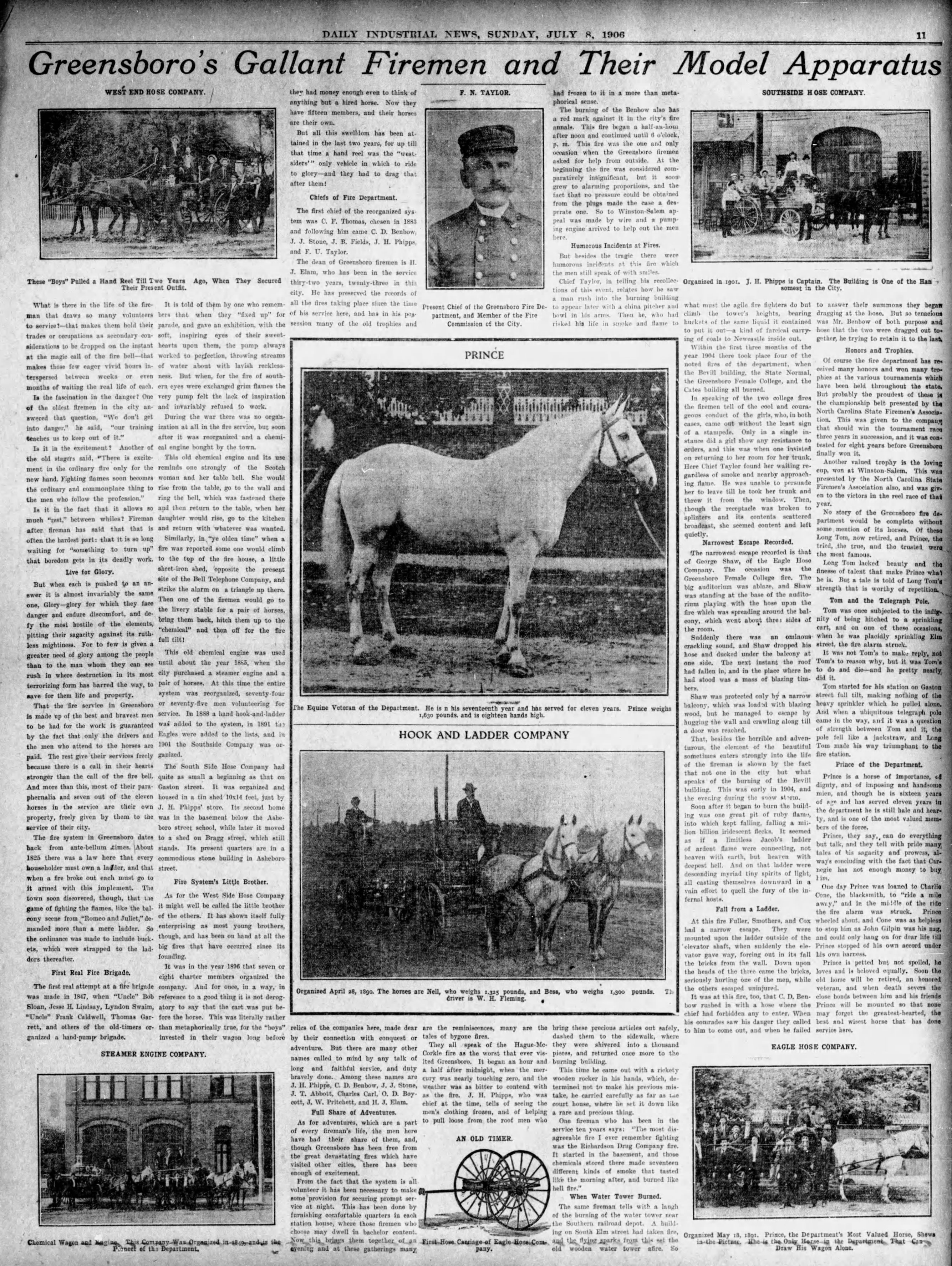
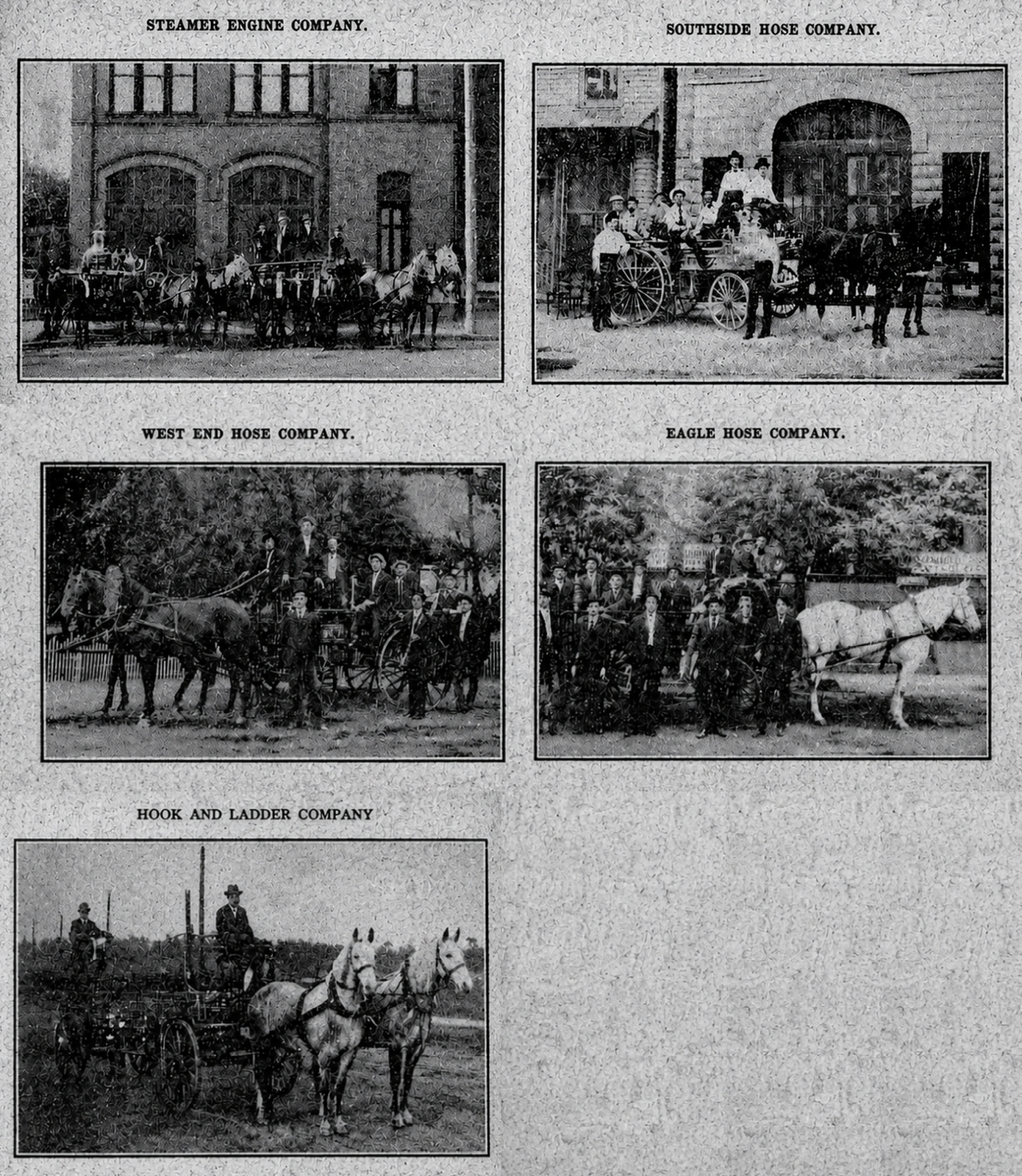
Presenting a full-page profile of the Greensboro Fire Department and their horse-drawn, volunteer fire companies in 1906.
Greensboro’s Gallant Firemen and Their Model Apparatus
Greensboro Daily News – July 8, 1906
What is there in the life of the fireman that draws so many volunteers to service?—that makes them hold their trades or occupations as secondary considerations to be dropped on the instant at the magic call of the fire bell—that makes those few eager vivid hours interspersed between weeks or even months of waiting the real life of each.
Is the fascination in the danger? One of the oldest firemen in the city answered that question, “We don’t get into danger,” he said, “our training teaches us to keep out of it.”
Is it in the excitement? Another of the old stagers said, “There is excitement in the ordinary fire only for the new hand. Fighting flames soon becomes the ordinary and commonplace thing to the men who follow the profession.”
Is it in the fact that it allows so much “rest” between whiles? Fireman after fireman has said that that is often the hardest part: that it is so long waiting for “something to turn up” that boredom gets in its deadly work.
Live for Glory.
But when each is pushed to an answer it is almost invariably the same one, Glory—glory for which they face danger and endure discomfort, and defy the most hostile of the elements, pitting their sagacity against its ruthless mightiness. For to few is given a greater need of glory among the people than to the man whom they can see rush in where destruction in its most terrorizing form has barred the way, to save for them life and property.
That the fire service in Greensboro is made up of the best and bravest men to be had for the work is guaranteed by the fact that only the drivers and the men who attend to the horses are paid. The rest give their services freely because there is a call in their hearts stronger than the call of the fire bell. And more than this, most of their paraphernalia and seven out of the eleven horses in the service are their own property, freely given by them to the service of their city.
The fire system in Greensboro dates back from ante-bellum times. About 1825 there was a law here that every householder must own a ladder, and that when a fire broke out each must go to it armed with this implement. The town soon discovered, though, that the game of fighting the flames, like the balcony scene from “Romeo and Juliet,” demanded more than a mere ladder. So the ordinance was made to include buckets, which were strapped to the ladders thereafter.
First Real Fire Brigade.
The first real attempt at a fire brigade was made in 1847, when “Uncle” Bob Sloan, Jesse H. Lindsay, Lyndon Swain, “Uncle” Frank Caldwell, Thomas Garrett, and others of the old-timers organized a hand-pump brigade.
It is told of them by one who remembers that when they “fixed up” for parade, and gave an exhibition, with the soft, inspiring eyes of their sweethearts upon them, the pump always worked to perfection, throwing streams of water about with lavish recklessness. But when, for the fire of southern eyes were exchanged grim flames the pump felt the lack of inspiration and invariably refused to work.
During the war there was no organization at all in the fire service, but soon after it was reorganized and a chemical engine bought by the town.
This old chemical engine and its use reminds one strongly of the Scotch woman and her table bell. She would rise from the table, go to the wall and ring the bell, which was fastened there and then return to the table, when her daughter would rise, go to the kitchen and return with whatever was wanted. Similarly, in “ye olden time” when a fire was reported some one would climb to the top of the fire house, a little sheet-iron shed, opposite the present site of the Bell Telephone Company, and strike the alarm on a triangle up there. Then one of the firemen would go to the livery stable for a pair of horses, bring them back, hitch them up to the “chemical” and then off for the fire full tilt!
This old chemical engine was used until about the year 1885, when the city purchased a steamer engine and a pair of horses. At this time the entire system was reorganized, seventy-four or seventy-five men volunteering for service. In 1888 a hand hook-and-ladder was added to the system, in 1891 the Eagles were added to the lists, and in 1901 the Southside Company was organized.
The South Side Hose Company had quite as small a beginning as that on Gaston street. It was organized and was in a tin shed 10 × 14 feet, just by J. H. Phipps’ store. Its second home was in the basement below the Asheboro street school, while later it moved to a shed on Bragg street, which still stands. Its present quarters are in a commodious stone building in Asheboro street.
Fire System’s Little Brother.
As for the West Side Hose Company it might well be called the little brother of the others. It has shown itself fully enterprising as most young brothers, though, and has been on hand at all the big fires that have occurred since its founding.
It was in the year 1896 that seven or eight charter members organized the company. And for once, in a way, in reference to a good thing it is not derogatory to say that the cart was put before the horse. This was literally rather than metaphorically true, for the “boys” invested in their wagon long before they had money enough even to think of anything but a hired horse. Now they have fifteen members, and their horses are their own.
But all this swelldom has been attained in the last two years, for up till that time a hand reel was the “west-siders'” only vehicle in which to ride to glory—and they had to drag that after them!
Chiefs of Fire Department.
The first chief of the reorganized system was C. F. Thomas, chosen in 1883, and following him came C. D. Benbow, J. J. Stone, J. B. Fields, J. H. Phipps, and F. U. Taylor.
The dean of Greensboro firemen is H. J. Elam, who has been in the service thirty-two years, twenty-three in this city. He has preserved the records of all the fires taking place since the time of his service here, and has in his possession many of the old trophies and relics of the companies here, made dear by their connection with conquest or adventure. But there are many other names called to mind by any talk of long and faithful service, and duty bravely done. Among these names are J. H. Phipps, C. D. Benbow, J. J. Stone, J. T. Abbott, Charles Carl, O. D. Boycott, J. W. Pritchett, and H. J. Elam.
Full Share of Adventures.
As for adventures, which are a part of every fireman’s life, the men here have had their share of them, and, though Greensboro has been free from the great devastating fires which have visited other cities, there has been enough of excitement.
From the fact that the system is all volunteer it has been necessary to make some provision for securing prompt service at night. This has been done by furnishing comfortable quarters in each station house, where those firemen who choose may dwell in bachelor content. Now this brings them together of an evening and at these gatherings many are the reminiscences, many are the tales of bygone fires.
They all speak of the Hague-McCorkle fire as the worst that ever visited Greensboro. It began an hour and a half after midnight, when the mercury was nearly touching zero, and the weather was as bitter to contend with as the fire. J. H. Phipps, who was chief at the time, tells of seeing the men’s clothing frozen, and of helping to pull loose from the roof men who had frozen to it in a more than metaphorical sense.
The burning of the Benbow also has a red mark against it in the city’s fire annals. This fire began a half-an-hour after noon and continued until 6 o’clock, p. m. This fire was the one and only occasion when the Greensboro firemen asked for help from outside. At the beginning the fire was considered comparatively insignificant, but it soon grew to alarming proportions, and the fact that no pressure could be obtained from the plugs made the case a desperate one. So to Winston-Salem appeal was made by wire and a pumping engine arrived to help out the men here.
Humorous Incidents at Fires.
But besides the tragic there were humorous incidents at this fire which the men still speak of with smiles.
Chief Taylor, in telling his recollections of this event, relates how he saw a man rush into the burning building to appear later with a china pitcher and bowl in his arms. Then he, who had risked his life in smoke and flame to bring these precious articles out safely, dashed them to the sidewalk, where they were shivered into a thousand pieces, and returned once more to the burning building.
This time he came out with a rickety wooden rocker in his hands, which, determined not to make his previous mistake, he carried carefully as far as the court house, where he set it down like a rare and precious thing.
One fireman who has been in the service ten years says: “The most disagreeable fire I ever remember fighting was the Richardson Drug Company fire. It started in the basement, and those chemicals stored there made seventeen different kinds of smoke that tasted like the morning after, and burned like hell fire.”
When Water Tower Burned.
The same fireman tells with a laugh of the burning of the water tower near the Southern railroad depot. A building on South Elm street had taken fire, and the flying sparks from this set the old wooden water tower afire.
Within the first three months of the year 1904 there took place four of the noted fires of the department, when the Bevill building, the State Normal, the Greensboro Female College, and the Cates building all burned.
In speaking of the two college fires the firemen tell of the cool and courageous conduct of the girls, who, in both cases, came out without the least sign of a stampede. Only in a single instance did a girl show any resistance to orders, and this was when one insisted on returning to her room for her trunk. Here Chief Taylor found her waiting regardless of smoke and nearby approaching flame. He was unable to persuade her to leave till he took her trunk and threw it from the window. Then, though the receptacle was broken to splinters and its contents scattered broadcast, she seemed content and left quietly.
Narrowest Escape Recorded.
The narrowest escape recorded is that of George Shaw, of the Eagle Hose Company. The occasion was the Greensboro Female College fire. The big auditorium was ablaze, and Shaw was standing at the base of the auditorium playing with the hose upon the fire which was spreading around the balcony, which went about three sides of the room.
Suddenly there was an ominous crackling sound, and Shaw dropped his hose and ducked under the balcony at one side. The next instant the roof had fallen in, and in the place where he had stood was a mass of blazing timbers.
Shaw was protected only by a narrow balcony, which was loaded with blazing wood, but he managed to escape by hugging the wall and crawling along till a door was reached.
That, besides the horrible and adventurous, the element of the beautiful sometimes enters strongly into the life of the fireman is shown by the fact that not one in the city but what speaks of the burning of the Bevill building. This was early in 1904, and the evening during the snow storm.
Soon after it began to burn the building was one great pit of ruby flame, into which kept falling, falling a million billion iridescent flecks. It seemed as if a limitless Jacob’s ladder of ardent flame were connecting, not heaven with earth, but heaven with deepest hell. And on that ladder were descending myriad tiny spirits of light, all casting themselves downward in a vain effort to quell the fury of the infernal hosts.
Fall from a Ladder.
At this fire Fuller, Smothers, and Cox had a narrow escape. They mounted upon the ladder outside of the elevator shaft, when suddenly the elevator gave way, forcing out in its fall the bricks from the wall. Down upon the heads of the three came the bricks, seriously hurting one of the men, while the others escaped uninjured.
It was at this fire, too, that C. D. Benbow rushed in with a hose where the chief had forbidden any to enter. When his comrades saw his danger they called to him to come out, and when he failed to answer their summons they began dragging at the hose. But so tenacious was Mr. Benbow of both purpose and hose that the two were dragged out together, he trying to retain it to the last.
Honors and Trophies.
Of course the fire department has received many honors and won many trophies at the various tournaments which have been held throughout the state. But probably the proudest of these is the championship belt presented by the North Carolina State Firemen’s Association. This was given to the company that should win the tournament race three years in succession, and it was contested for eight years before Greensboro finally won it.
Another valued trophy is the loving cup, won at Winston-Salem. This was presented by the North Carolina State Firemen’s Association also, and was given to the victors in the reel race of that year.
No story of the Greensboro fire department would be complete without some mention of its horses. Of these Long Tom, now retired, and Prince, the tried, the true, and the trusted, were the most famous.
Long Tom lacked beauty and the finesse of talent that make Prince what he is. But a tale is told of Long Tom’s strength that is worthy of repetition.
Tom and the Telegraph Pole.
Tom was once subjected to the indignity of being hitched to a sprinkling cart, and on one of these occasions, when he was placidly sprinkling Elm Street, the fire alarm struck.
It was not Tom’s to make reply, not Tom’s to reason why, but it was Tom’s to do and die—and he pretty nearly did it.
Tom started for his station on Gaston Street full tilt, making nothing of the heavy sprinkler which he pulled alone. And when a ubiquitous telegraph pole came in the way, and it was a question of strength between Tom and it, the pole fell like a jackstraw, and Long Tom made his way triumphant to the fire station.
Prince of the Department.
Prince is a horse of importance, of dignity, and of imposing and handsome mien, and though he is sixteen years of age and has served eleven years in the department he is still hale and hearty, and is one of the most valued members of the force.
Prince, they say, can do everything but talk, and they tell with pride many tales of his sagacity and prowess, always concluding with the fact that Carnegie has not enough money to buy him.
One day Prince was loaned to Charlie Cone, the blacksmith, to “ride a mile away,” and in the middle of the ride the fire alarm was struck. Prince wheeled about, and Cone was as helpless to stop him as John Gilpin was his nag, and could only hang on for dear life till Prince stopped of his own accord under his own harness.
Prince is petted but not spoiled; he loves and is beloved equally. Soon the old horse will be retired, an honored veteran, and when death severs the close bonds between him and his friends there will be mounted so that none may forget the greatest-hearted, the best and wisest horse that has done service here.