What’s the history of the “thin red line” design that’s used by the North Carolina Fallen Firefighters Foundation, and has spread far and wide with other usage? It originated at the Apex Fire Department in Wake County, NC.
Here’s an oral history of how it happened, from former Apex firefighter Jeff Silver and Apex Battalion Chief “Scooter” Carter.
Jeff:
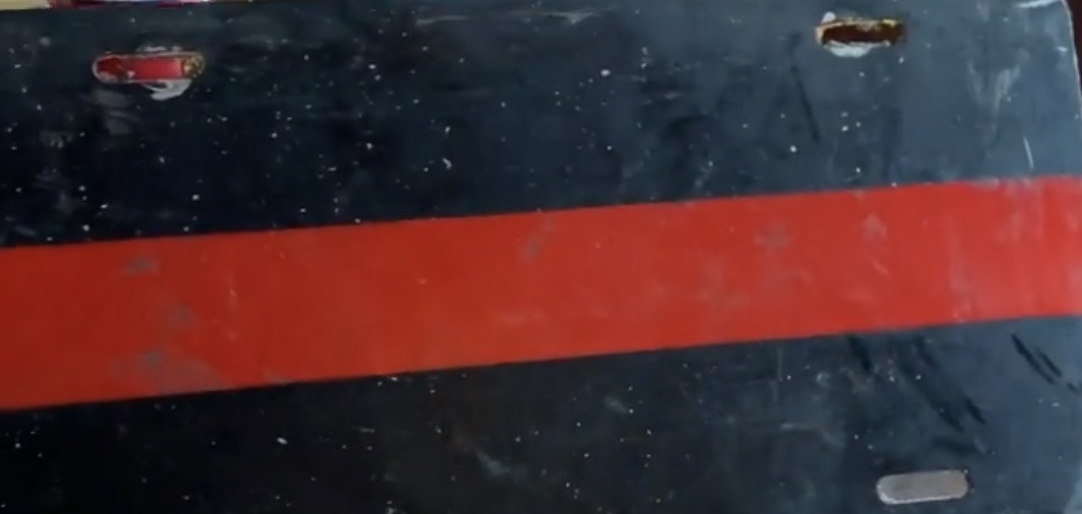
The “thin red line” was first designed around 1999 or 2000. It appeared on license plates designed by myself, Scooter, and another buddy. Back in the day, we would sit on the front apron at the firehouse on Salem Street in downtown Apex. Occasionally at night, the local police would also stop by and chat with us. One officer had a thin blue line license tag on the front of his patrol car. When asked what it meant, he said “it’s the line we walk as police, you wouldn’t get it”. So myself, Scooter, and another buddy each said to each other “Well, I guess if they have the blue line, we have the red line”. The rest is history. We made the license tags right there at the Apex FD work bench.
Scooter:
As Jeff said, we created the concept in 1999 or 2000. Below is a picture of my original license tag, which I still have hanging in my garage. We made the first batch using any tags we could find at stores–auto parts stores or Walmart or Kmart–and repainting them. Then we turned to a local sign shop and I had the first batch professionally made. I believe we had 50 made and we sold them friends at Apex, Cary, and Fairview fire departments. We branded the plates as the “Thin Red Line of Courage” and some sort text to accompany. It was printed on business cards and attached to each tag that we sold.
Scooter:
Several of us at Apex also worked part-time at Fairview and we were good friends with Paul Dunwell, who was their fire chief. He had just formed the North Carolina Fallen Firefighters Foundation and had just started working on creating a state memorial for fallen firefighters. Fun fact as a side note, the firefighters used as models for the first designs were all part-timers at Fairview, even one of the “thin red line” founders. Anyway, we proposed to Paul the idea of using the “thin red line” for NCFFF fundraising efforts. All we asked in return was recognition. As I recall, Paul also spoke with an attorney and tried to get a trademark or patent on the design, but he was told that the design was too generic.
Scooter:
What was the make-up of Apex FD at the time? We ran a single, 24-hour paid company out of Station 1, and had daytime staffing at Station 2. Both stations were also supported with heavy volunteer staffing. I was on duty the night that we produced the first tags. At night, all the volunteers would hang out with us. We would all sit in front of Station 1 for hours. We called it the Ramp Squad. We had lively discussions about fires, training, tactics, and life in general. And though AFD no longer has a volunteer program, the volunteer department was where most of us “older generation” got our start. We made lifelong friendships. (Insert Archie and Edith Bunker singing “Those Were The Days.)
Jeff:
Well said, Scooter! The good old days of the Ramp Squad, waiting for tones to drop for a fire or a pin-in wreck.
Screenshot