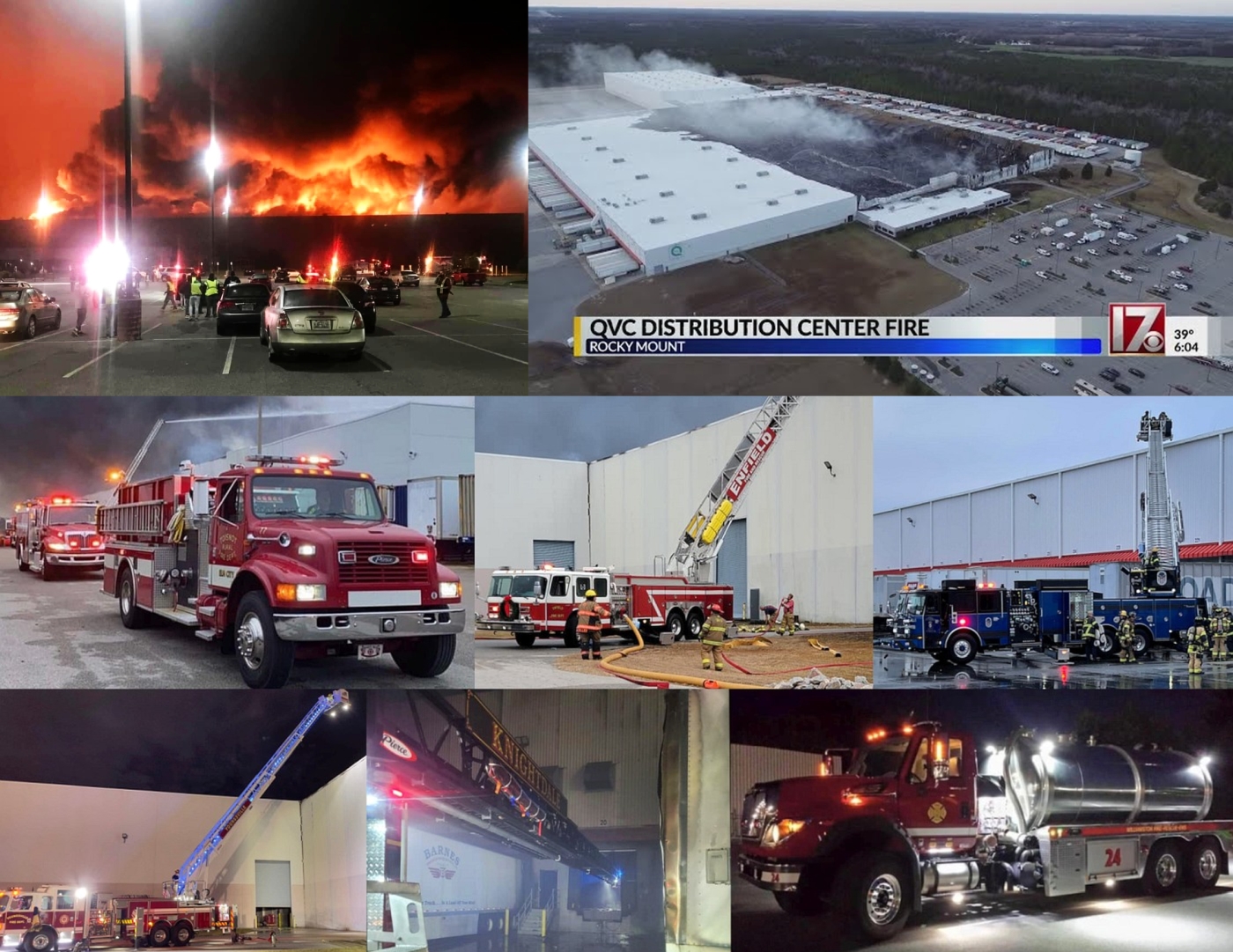
Top left photo courtesy Red Oak Community Fire Department. Top right photo, screen grab from CBS 17.
Shown in the middle and bottom row of photos are ladders from Enfield (Halifax), Winterville (Pitt), Youngsville (Franklin), and Knightdale (Wake). The two tankers are Toisnot (top) and Williamston (bottom). Pics via FB postings from their respective FDs, or affiliated agencies.
Introduction
This posting presents research notes about the QVC Distribution Center fire in Edgecombe County, NC, on December 18, 2021. The fire is both the largest structure fire by building size and fire loss in state history.
These notes are evolving and will likely be refined and perhaps expanded over the coming weeks and months.
Run Card
Fire departments and fire suppression agencies included:
- Ayden 4202 (Engine) – Pitt
- Bahama (Tanker 316) – Durham
- Bailey Tanker 87 – Nash
- Battleboro Engine? – Nash
- Bethany engine – Johnston
- Bunn – Franklin
- Bunyan (tanker) – Beaufort
- Cary (L1) – Wake
- Castalia – Tanker 77 – Nash
- Chocowinity (tanker) – Beaufort
- Clarks Neck 2504 (Tanker) – Pitt
- Cleveland engine – Johnston
- Conetoe – Edgecombe
- Coopers Truck 151, Tanker 15, Engine 152 – Nash
- Elm City – Wilson
- Enfield – Halifax
- Epsom (TA52) – Franklin
- Farmville 5302 (Engine) – Pitt
- Ferrells Tanker 135 – Nash
- Fountain 5407 (Pumper/Tanker) – Pitt
- Franklin County ES – Franklin
- Garner (Tanker 7) – Wake
- Hamilton Tanker 35 – Martin
- Heartsease – Edgecombe
- Jason – Greene
- Knightdale (L13) – Wake
- Lebanon (Tanker 515) – Durham
- Leggett – Edgecombe
- Lewis Community – Edgecombe
- Louisburg – Franklin
- Macclesfield – Edgecombe
- Middlesex Tanker 57 – Nash
- Nashville Truck 14 – Nash
- NC Forest Service
Resources included 2- 6000 gallon water tenders, 1- Helicopter, 2-Dozers, 2- UTVs, 2- large sprinklers, 14 personal handling rolls from command staff to equipment operation, plus pickups and Type 6 engines operated by assisting personnel. - Northeast (E2) – Wayne
- Northern Wake (E51) – Wake
- Oak City Fire Dept Tanker 45 – Martin
- Oakland (TA__ 9601) – Wayne
- Pactolus 2404 (Pumper/Tanker) – Pitt
- Pinetops – Edgecombe
- Pinetown (tanker) – Beaufort
- Pricetown (TA2) – Wayne
- Princeville – Edgecombe
- Red Oak 5108 (Ladder) – Pitt
- Red Oak Truck 125 – Nash
- Robersonville Tanker 54 – Martin
- Rocky Mount – Edgecombe
- Salem – Tanker 187 – Nash
- Saulston – Wayne
- Scotland Neck – Halifax
- Scuffleton (Tanker 4502) – Greene
- Seven Springs (E1 brush) – Wayne
- Sharp Point 5604 (Tanker) – Pitt
- Sharpsburg Truck 114, 116 – Nash
- Silver Lake (Tanker 92) – Wilson
- Simpson 3207 (Pumper/Tanker) – Pitt
- Snow Hill – Greene
- South Edgecombe – Edgecombe
- Speed – Edgecombe
- Tarboro – Edgecombe
- Toison (E77 ATV) – Wilson
- Wake Forest (L1 Tanker 3 Tanker 4) – Wake
- Wake New Hope (Tanker 10) – Wake
- West Edgecombe – Edgecombe
- West Mount Truck 4 – Nash
- Whitakers Truck 10 – Nash
- Williamston Tanker 24 – Martin
- Wilson (ladder) – Wilson
- Winterville (town) 1502 (Engine) 1508 (ladder) – Pitt
- Winterville Community 4107 (Pumper/Tanker) – Pitt
- Youngsville (L4 Tanker 247) – Franklin
Sources: Legeros Fire Line postings on Facebook. Specific citations TBD, search the page to find the postings.
Oral History
Notes from spoken remarks in the February 2026 episode of the Carolina Fire Watch podcast, from a conversation with host Brian Kelly speaking with Rocky Mount Assistant Fire Chief Jamey Cooke and NCDOI fire investigator Craig Jarman. These notes are based on auto-generated transcript.
Suppression
- Largest structure fire / fire loss in state history.
- Early into incident, RMFD received request for an aerial. Cook was a BC on duty and sent an aerial, a rescue company, a safety officer, and himself. RMFD had two BCs on duty, and Cook assigned himself, because he was familiar with the area and knew a bit about the facility.
- As he started en route, he soon saw a glow in the sky from several miles away. [The facility was 10 to 12 miles away from the nearest RMFD station.]
- At that time, most of the departments in the county had been called for mutual aid. They had also called Tarboro for an aerial.
- When Cook arrived, the structure was 75% involved, at about 45 minutes into the incident
- Interior operations had been performed. But by the time Cook arrived, it was all defensive operations
- Not long after Cook arrived they started having water supply issues. Within say 30 minutes of him arriving they started requesting resources from as far west as Wake County and farther east, notably for tankers
- They also had an influx of firefighters who initially self dispatched, but would have been called later anyway
- The tanker shuttle lasted around 36 hours
- Overall fire suppression didn’t settle down for 10 days
- With help from Emergency Management and the State Forestry Service, command post campus was set up including full size bathrooms, breakout rooms, and other resources
- They had multiple UTVs running around the facility because of the size of the complex
- Forestry brought two 6000 gallon water tankers
- Forestry also did water drops which had only recently been approved for the state forest service to perform water drops on top of a structure
- The Forestry Service started water drops on the second day, They were filling from a nearby pond Comm with the helicopter buckets holding almost 500 gallons dipping from a pond that was about 2 or three miles away
- 30 million gallons flowed in the first 24 hours
- For tanker shuttles, there were no ponds or rivers available for drafting, they were all too low, the result of a significant drought period, so water points were set 6 miles away from the fire scene, to get off of grid that was already taxed by the fire.
Investigation
- Early Saturday and into Sunday, they started bringing in partner agencies for the investigation. But they didn’t actually get into the building until Tuesday, they recall.
- On Monday, the decision was made to request an ATF national response.
- ATF responded with around 43 personnel.
- Lot of command buses and mobile command posts came to the scene.
- Total of 101 different agencies assisted. From Rocky Mount, they had 55 firefighters. And of the 101 agencies, there were 70 (or 73?) fire departments.
- Early on, it was determined that not everyone needed to work at the fire scene itself. Space at the convention center was procured and used by the investigation team (and other groups?).
- Command had to interact with dozens of interested parties: city, county, state officials, politicians, news media, attorneys, and private investigators. And about the lawyers, they were not just those hired by QVC, but others hired by the companies who were selling products through QVC.
- 5 million square-feet of burned area, plus one fatality.
- There are four cause types, accidental, natural, incendiary, or intentional.
- Cause was ruled as underdetermined, as they narrowed the cause down to two or three possibilities but could not put any more weight on one than the others.
- Side note, the label “arson investigator” is lately discouraged. “Fire investigator” is the better choice.
- Largest fire loss in state history.
- Investigation was joint effort between OSFM, DOI, SBI, ATF.
- Within a couple days, they had 150 fire investigators on site.
- Between firefighters and employees, over a hundred interviews conducted within the first 24 to 36 hours.
- Largest ATF national response for a fire in recent memory, they said.