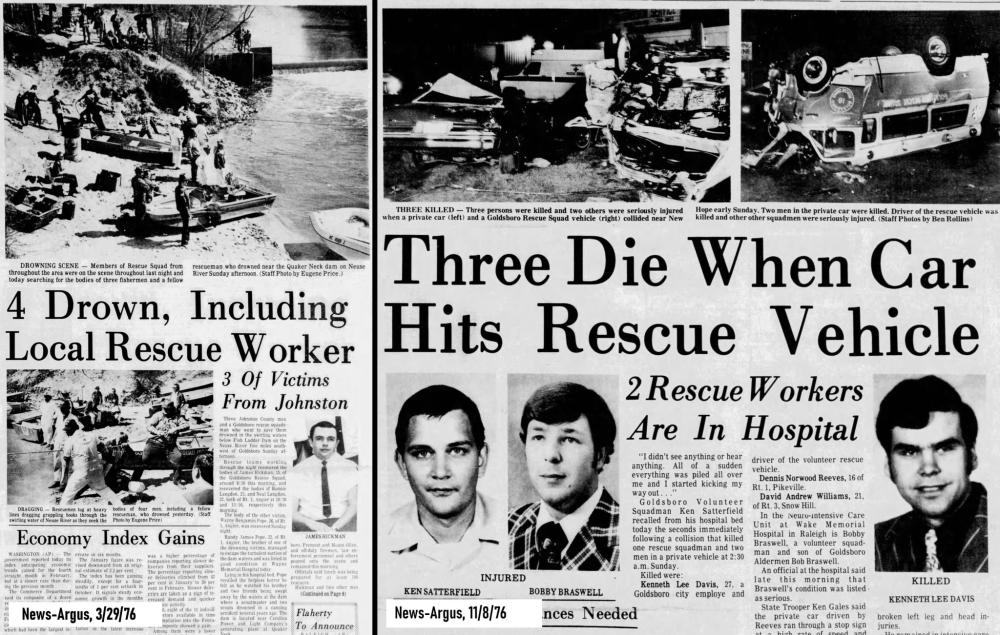
Durham Public Safety Program – 1970 to 1985

Contents

  • Introduction
  • Short Version
  • Long Version
  • Sources

Introduction

Presenting a timeline of the Durham Public Safety Officer program, which combined fire and police duties from 1970 to 1986. Collected from dozens of news articles during that time period. See below for source materials, including a larger collection of 1,300+ newspaper articles about DFD going back before the 1920s. Been cooking for a few weeks. And thank you to the Durham Morning Herald and Durham Sun for such detailed coverage of DFD over the decades. Made it easy, thanks to newspapers.com.

Short Version

  • 1965, Nov – Proposal to partially merge fire and police duties.  
  • 1965, Oct – Proposal rejected by council.
  • 1970, Oct – New proposal to merge fire and police.  
  • 1970, Nov – Council votes 11 to 1 to proceed with a partial merger. 
  • 1971, Apr – First PSO academy graduated.
  • 1971, May – First PS company activated at Station 5.
  • 1971, Sep – Second PS company activated at Station 7.
  • 1971, Sep – First PS director Jacob Jessup unexpectedly resigns after six months.
  • 1972, Jan – Third PS company activated at Station 6.
  • 1972, Jun – Fourth PS company activated at Station 4.
  • 1972, Jul – Firefighter work week reduced to 56 hours. New schedule on/off for 14 days, then off for seven. [When did third shift start?]
  • 1972, Sep – First aerial platform delivered, Snorkel for Station 1.
  • 1973, May – Fifth PS company activated at Station 3.
  • 1973, May – PS patrol cars are light blue by this time.
  • 1974, Nov – PS Station 8 activated, new building.
  • 1975, Mar – Council approved converting Station 3 to PS station. Was partial PS, partial fire by then.
  • 1977, Feb – PS Station 9 activated, new building completed last year.
  • 1977, May/Jun – Second aerial company added, Aerial 21.
  • 1977, Sep – New training center + shop building dedicated.
  • 1978, Jun – Total PS organization recommended, across all stations. Rejected by council.
  • 1978, Jun – New Station 10 ready for occupancy, but won’t open for at least a year, due to issues related to planned annexation.
  • 1978, Jun – Third aerial company added, Aerial 31.
  • 1979, Jan – Council approved creation of PS department with authority of fire and police. Also creates two large PS districts to manage the smaller PS districts.
  • 1980, May – Council voted to abolish fire and police chief positions. No replacements after each retires.
  • 1980, Dec – Police Chief retired.
  • 1983, Jun – Fire Chief retired.
  • 1983, Jul – Council considered changes to PSO program, including making Station 1 a combination fire and PS station.
  • 1984, Jun – PS Station 10 activated, but years after completion due to delayed annexation. Four PSOs assigned per shift.
  • 1984, Dec – Consultants hired to study PSO program and its effectiveness.
  • 1985, Mar – Study committee received report, recommends ending PSO program.
  • 1985, Jun – Council voted to end PSO program.
  • 1985, Jul – Interim fire and police chiefs named.
  • 1985, Aug – Phase 1 of transition started, 62 PSOs transferred to fire.
  • 1986, Jan – Phase 2 of transition started, 11 PSOs transferred to fire and other changes. PSOs still responding on Engines 80, 90, 100, plus PSOs still carry PPE in patrol cars.
  • 1986, Jan – First fire and police academies since PSO program graduate.
  • 1986, Jun – Separation of fire and police departments completed.

Long Version

The Proposals  – 1965 to 1970

1965, Nov 1 – Council received proposal from city manager to merge fire and police duties. Create combined fire-police companies, equipped with fire trucks and patrol cars. Personnel would work eight hour shifts and be more productive. “There just simply isn’t enough work that must be done at a fire station to require 24-hour-a-day duty, except for the need of having men available to respond in case of a fire.” Council asked to study the plan, which is used in around 50 cities, including Winston-Salem, where a fire-police program was started in the 1950s. [DMH, 11/2/65]

Continue reading ‘Durham Public Safety Program – 1970 to 1985’ »

Facebook Comments

History of the Second Engine at Durham Station 2

Let’s look at the history of a second engine at Durham Station 2. In 1928, was surveyed by the National Board of Fire Underwriters. Among the findings was that the city needed more fire stations. It noted that while fire companies were closed grouped for protection of the main mercantile and manufacturing districts, additional engine companies were needed in other areas of the city. For the next number of years, the city considered expanding the fire department.

In June 1934, a plan was announced to add an additional engine company, but house them at an existing fire station. Eight men would be hired and the company would be assigned one of two new Seagrave pumpers that had been ordered. Housed at Station 2 on West Main Street, the new company would be assigned a specific response area, and would also serve as a relief company, to assist other companies when “fighting stubborn and dangerous fires.”

On December 24, 1934, the Durham Sun reported that eight new firefighters started work that day. They were assigned to Station 2 and would man the new engine company. Was the new engine activated on that date? To be determined.

The new engine company was named Engine 5, as it was cited in the city directory for 1935 and later editions.

Continue reading ‘History of the Second Engine at Durham Station 2’ »

Facebook Comments

Block of Buildings Burns in Downtown Durham, July 1944

Morning history. Let’s take a deep dive into a major fire in the Bull City back in the city. See also comments for additional notes.

On Saturday night, July 8, 1944, one of the largest fires in downtown Durham’s history destroyed an entire block of buildings along “Tobacco Row.”

The first call was received at 9:12 p.m. at the corner of Morgan Street and Rigsbee, where a “blaze was engulfing the Big Four Warehouse,” reported the Durham Morning Herald on July 11.

Spread by a breeze, the flames were fanned across an alley to a frame dwelling that ignited and then spread to the Banner Warehouse. Fire soon spread to the rest of the buildings on the block.

Mutual aid was requested from Camp Butner, which at that time was a large department with eight fire stations. Other area departments also responded as soon as they heard about the fire on the radio.

Mutual Aid Arrived Continue reading ‘Block of Buildings Burns in Downtown Durham, July 1944’ »

Facebook Comments

Ladies Auxiliaries in Raleigh and Durham

Evening history. In the 1950s, both the Raleigh and Durham local chapters of the IAFF had ladies auxiliary organizations, formed by wives of the member firefighters. Here’s a bit of history about each.

Raleigh Ladies Auxiliary

Left is a scrapbook page from the Raleigh auxiliary in 1951, when Ladies Auxiliary 548 received its charter. There were forty-three original members. Their mission was to extend aid and sympathy to all firemen and their families. The Auxiliary performed many activities during the 1950s and 1960s, from charity projects to providing canteen service at major fires. They remained active into the late 1970s.

See page 32 of this centennial history document (PDF) for a bit more about the group, 

See also these digitized scrapbooks of the auxiliary, via DigitalNC. 

Durham Ladies Auxiliary

Right are a pair of articles about the Durham auxiliary, which was organized as early as May 1949. It was called the Ladies Auxiliary of the Durham Fire Fighter’s Association, as the Durham Sun on May 23, 1949, noted in an announcement of a meeting at the home of Mrs. Ruth Copley, 207 Hammond Street.

The group was active through at least February 1957, as shown in newspaper articles. They held monthly meetings at the homes of members, as well as special events such as Dutch suppers at a place called Little Acorn [?] and annual Christmas parties at fire stations.

It appears that they received their national character around June 1952, as the top right photo depicts. Shown is Mrs. H. S. Stephenson, vice president of the Raleigh chapter, presenting the charter to Mrs. J. A. Daniel and Mrs. A. L. Bryant, the vice president and president of the Durham chapter.

Bottom right is a photo of the new officers installed in January 1955, from a Durham Morning Herald story on January 31. Among the group’s accomplishments during the prior year were monthly charitable projects of personal or community service.

The year’s highlight was a clothing drive that they launched to help burned out families in the Durham area, with barrels [!] placed in all city fire stations to collection clothing dropped off by citizens. See comments for a larger view of the article that’s more readable.

Facebook Comments

Siloam Bridge Collapse – February 23, 1975

Updated: March 25, 2025, with additional clippings and artifacts added to the linked Google Drive. This is a blog version of a Facebook posting from February 2025. 

Here’s a short summary about the Siloam Bridge Collapse, that we learned about this week. 

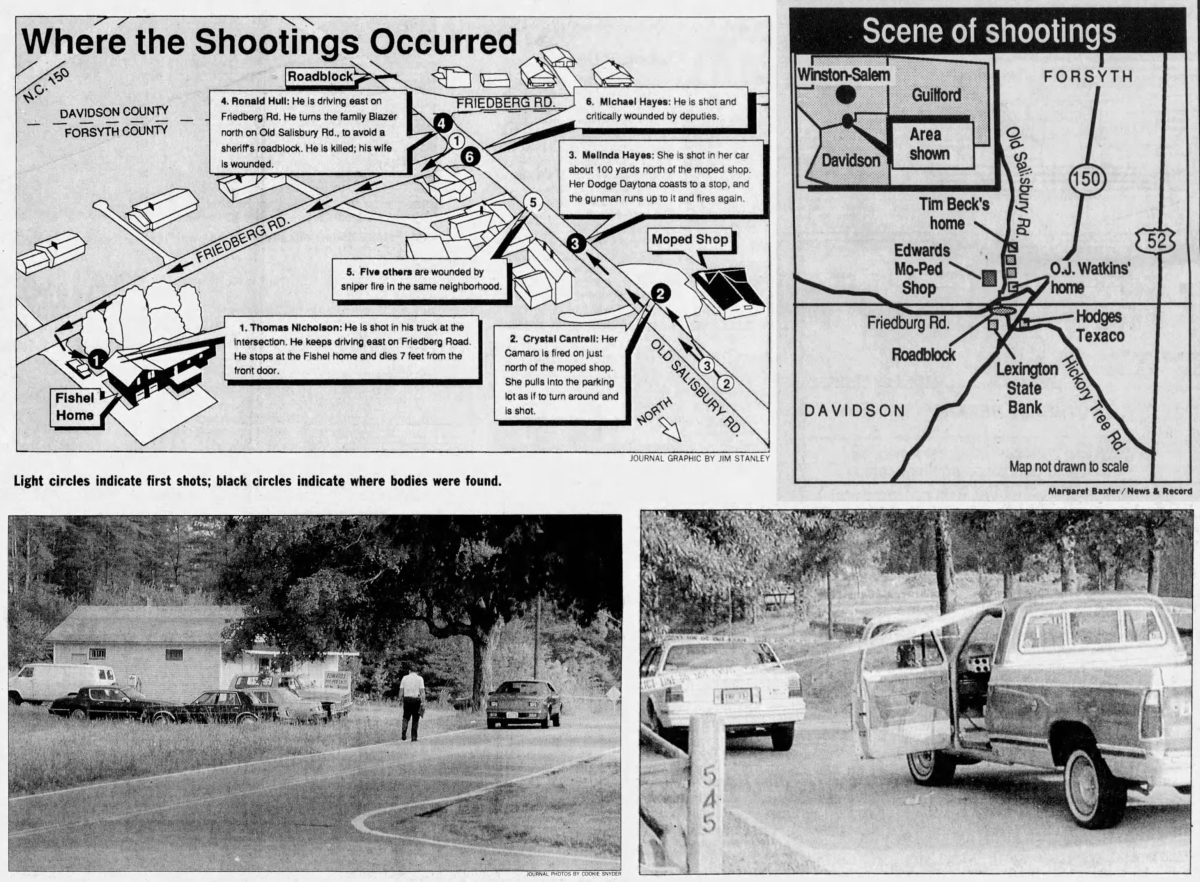
This happened on Sunday night, February 23, 1975, in Siloam, NC, on the border of Surry and Yadkin counties, in the community of Siloam. At about 9:25 p.m. in heavy fog, a car struck a supporting beam of the steel-truss bridge over the Yadkin River. The 387-foot long, 64-foot high single-lane bridge (built in 1938) buckled and collapsed.

Driver James T. Venable, 46, of Winston-Salem remembered “one second I was driving along and the next second I was flying through the air.” He didn’t remember hitting anything, reported the next day’s Winston-Salem Journal.

There were other vehicles on the bridge as well as others approaching, unaware of the collapse. A total of five automobiles, a pick-up truck, and a “Jeepster” went into the river. Four people were killed and sixteen injured, the newspaper reported.

The first emergency unit to arrive was from Fall Creek Volunteer Fire Department. Subsequent arriving agencies included Pilot Mountain Rescue Squad and recently formed Yadkin County Rescue Squad.  

Fire and rescue units from four counties responded over the course of the incident, from Surry, Yadkin, Stokes, and Forsyth.

That’s the a short summary. Read more below. 

More Information

Read newspaper articles, see incident reports and summaries, and other artifacts in this Google Drive folder.

See also these photos from the Winston-Salem Journal, in this retrospective.

Read another retrospective in this Abandoned, NC, blog posting

Facebook Comments

EMS Call Sign Changes

Belated posting. Adding here for the historical record. On September 20, 2024, Wake County EMS implemented changes to call signs as well as their staffing plan.

  • Nine new transport units were added, to help with coverage during high-demand periods during the day as well as assisting during shift change.
  • Three new shifts were created, to create staffing for the nine new transport units: eight-, ten-, and 14-hour shifts.
  • The calls signs for transport units were changed:
    • ALS ambulances – Medic 01 – Medic 99
    • BLS ambulances – EMS 01 – Medic 99
    • A unit will either be active as ALS (paramedic staffing) or BLS (EMT staffing). Both will never been in service with the same number at the same time.  
  • APP (Advanced Practice Paramedic) unit call signs were changed to the 900 series, e.g. Medic 901, Medic 902, etc. 

Facebook Comments

North Hills Shooting – January 17, 2025

Here are views and narrative notes from the Friday, January 17, 2025, shooting at North Hills. Sources are radio traffic (link below) and news reports.

Dispatched ~10:59 a.m. as active shooter at 4316 The Circle at North Hills Street. Initial dispatch for B4 B5 E16 E6 E9 ISO14 (fire) D3 D6 T1 M21 M44 M65 M78 M902 (EMS).

Incoming units staged both north and south of the location on Six Forks Road, including fire resources directed to Rowan Street for staging, beside nearby Fire Station 9.

No active shooter found. At 11:15 a.m., Raleigh Police issued public statements that there was no active shooter, and asked the public to stay away from the area.

Initial reports of up to three possible patients, and at different reported locations at a mixed-used shopping center/residential apartment complex, on two sides of Lassiter Mill Road at Six Forks Road.

Fire operations and unified command established at nearby Fire Station 9, a block away from the intersection. Police operations later established their command post at the Exxon service station, at the corner of Lassiter Mill at Six Forks.

EMS requested additional units, including four more ambulances. Special fire units to scene included chaplain, fire chief, operations chief, and Rehab 12.

Three shooting victims, one adult male deceased at scene, one adult male (alleged gunman) in critical condition with self-inflicted injury, and one adult male with non life-threatening conditions, per news reports.

From subsequent news reports, it sounds like police and possibly EMS and/or fire tactical rescue teams removed the first two victims from inside a restaurant, where the shooting occurred, and brought them outside and possibly all the way to the intersection of Six Forks and Dartmouth Roads, to a safer initial location for evaluation and treatment, in the event that there was still an active shooter on site.

Six Forks Road, Lassiter Mill Road, and the nearby I-440 ramp to Six Forks Road were closed for some hours, after the incident. At 2:45 p.m., Six Forks Road re-opened in front of the shopping center, per news reports.

Listen to radio traffic.

Screengrabs from WRAL video.

Run card included:

Fire
E9 E6 E16 B5 B4 ISO14
Division Chief 1
Rehab 12 (special called)
Chaplain
Operations Chief
Fire Chief

EMS
M65 M21 M78 M44 M11 M39 M30 M44 M15 M92
M902
D3 D6 D4 D1
EMS200

Facebook Comments

Two Alarms on The Lakes Drive

See more photos by Legeros

Two alarms were struck in north Raleigh on Tuesday, January 7, 2025. Battalion 5 was first-arriving at 6516 The Lakes Drive with fire showing through the roof of a three-story apartment building. She requested a second alarm on arrival. Ladder 15 and Engine 15 were next arriving. Engine 9 with water supply.

Fire found in attic/roof area, around HVAC equipment. Attacked using handlines both inside and roof-side. Quickly contained. Second alarm companies in staging soon released, except for one ladder.

Dispatched ~7:11 p.m. Controlled ~7:31 p.m. Some 20 residents were displaced from 12 apartments. Fire apparently started in a rooftop utility/mechanical space, reported the fire department.

Run Card

1st: E15 E4 E9 E16 L15 L4 R16 B5 B4 ISO14
WF: B1 DC1 INV1 A28
2nd: E19 E18 E22 L22 L6
EMS: M49 M53 M72 M909 D1 D5.
Add: Rehab 12 E17


Facebook Comments

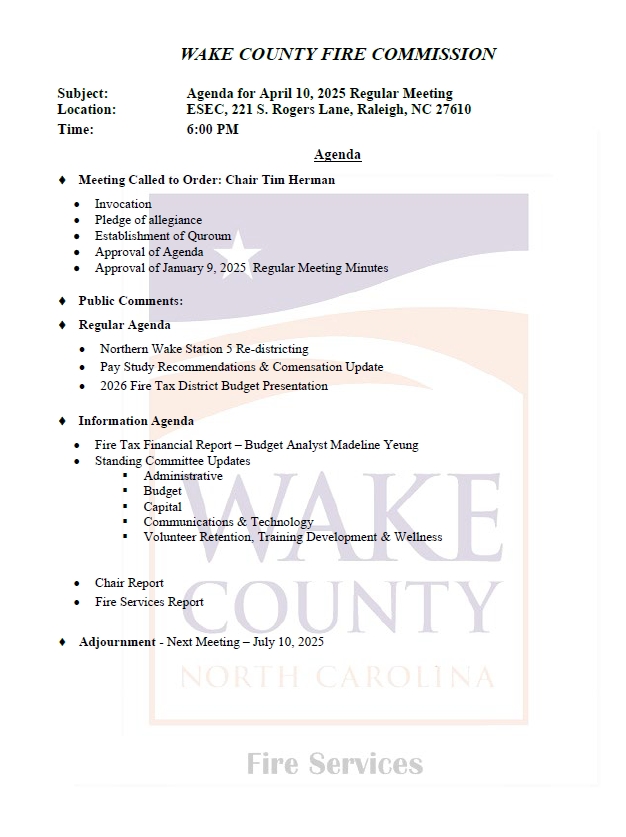
Wake County Fire Commission Meeting – January 9, 2025

The Wake County Fire Commission meets on Thursday, January 9, 2024, at 6:00 p.m., at the Wake County Emergency Services Education Center, 221 S. Rogers Lane, Raleigh, NC 27610.

View agenda and meeting documents.

Facebook Comments

Two Alarms on Polly Street

Listen to radio traffic | See photos from the Raleigh Professional Fire Fighters Association, in this Facebook posting.

Two alarms were struck at 3800 Polly Street on December 30, 2024. Dispatched about 10:07 p.m. Two-story apartment building with four units and 3,996 squre-feet. Built 1995, from tax records. Operated by a non-profit as transitional housing for families experiencing homelessness, it was later reported. 

Engine 12 first-arriving. Second alarm struck within a couple minutes. Fire found on first floor and extending to attic.  Controlled at 10:54 p.m.  No injuries reported. 

Run card included:
1st: E12 E21 E11 L1 L6 Sq7 R16 B2 B5 ISO14
W/F: A10 B3 DC1 INV1
2nd: E3 E9 E27 L15
Added: L4


Raleigh Professional Fire Fighters Association photo


Raleigh Professional Fire Fighters Association photo

Facebook Comments