Bald Head Island Major Fire – November 20, 2021

This is a blog version of a Facebook posting from June 17, 2025.

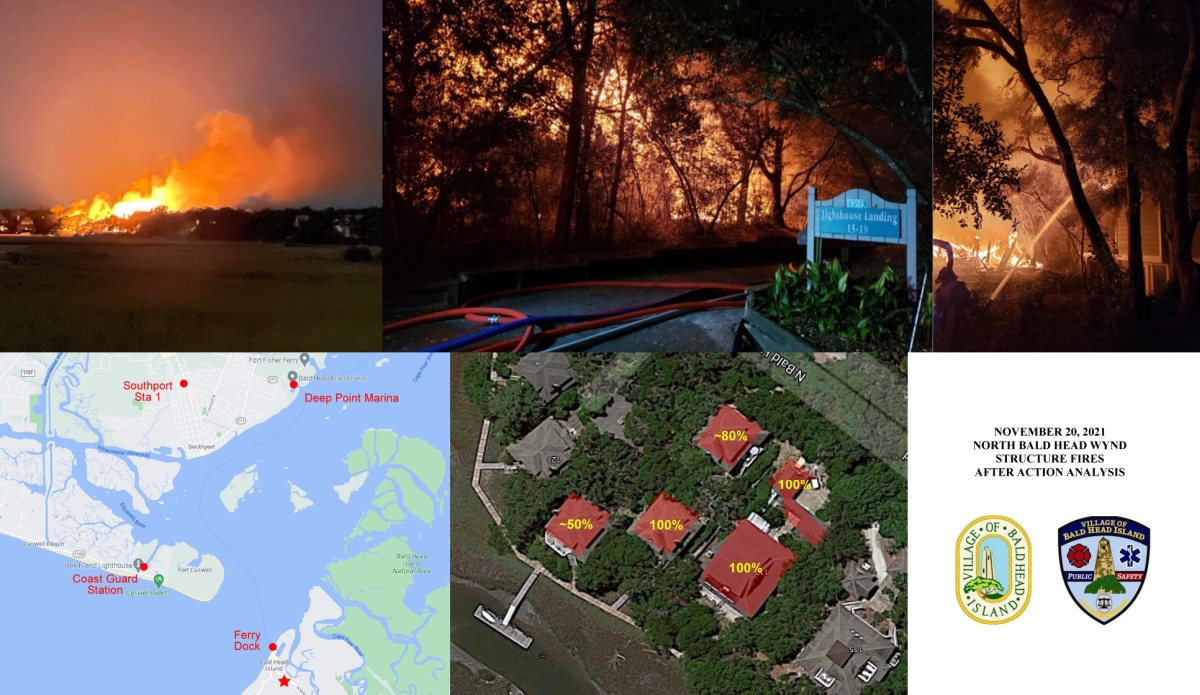
Looking back at the North Bald Head Wynd Fire AKA the Lighthouse Landing Fire, and which contributed to the reasons for purchasing the new apparatus. It occurred on Saturday night, November 20, 2021, and was one of the largest fire events in the history of Bald Head Island, NC.[1]

Here’s a new retrospective and recap, expanding upon our real-time postings during the incident and incorporating information contained in a third-party after-action analysis later conducted.

[1] Another major fire on September 30, 1993, destroyed 38 condo units. Here’s a prior posting about that incident.

Setting the Stage

Bald Head Island is located in south Brunswick County and is described by ChatGPT today as “a small, picturesque barrier island located at the southeastern tip of North Carolina, covering roughly 5.9 square miles, of which about two-thirds is land and the rest water. As of 2023, the year-round population is estimated at around 150 residents, though seasonal visitors significantly swell that number during summer months.”

“The community is known for its affluent and predominantly older demographic, with a median age over 69 and a high proportion of retirees. The island is accessible only by ferry [from Southport, 20 minutes] or private boat, and transportation is limited to golf carts, bicycles, and foot traffic, which helps preserve its quiet, car-free charm. The island includes a mix of residential areas, vacation homes, preserved maritime forests, and beaches.”

Continue reading ‘Bald Head Island Major Fire – November 20, 2021’ »

Facebook Comments

Bald Head Island Major Fire – September 30, 1993

This is a blog version of a Facebook Posting from May 4, 2020.


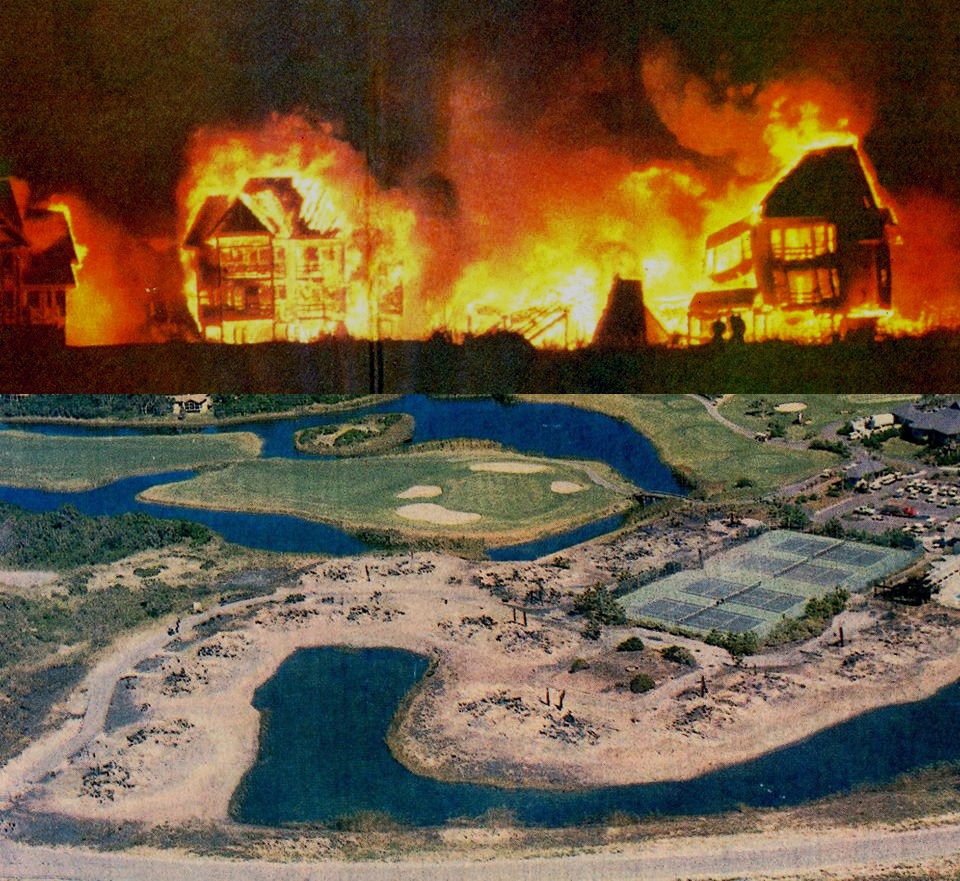
Photos by Bonny Banas (top) and [goes here] (bottom).

Looking back at the largest fire in the history of Bald Head Island in Brunswick County, NC. It destroyed ten buildings with 38 units at the Swan’s Quarter Condominiums on Wednesday night, September 30, 1993.

The fire was reported about 10:00 p.m. by vacationers renting one of the units, who saw flames through a skylight. By the time island firefighters arrived a few minutes later–the volunteers riding in golf carts, while others brought the island’s only fire truck–one of the buildings was ‘completely engulfed in flames’ and the flames had spread to a second building.

Additional firefighters from the mainland were brought to the island by the ferries Revenge and Adventure, that carried crews from Southport and Long Beach, and by the Coast Guard, crews from Yaupon Beach. Southport Rescue Squad members were also brought to the island, to assist Bald Head island medical personnel. 

Continue reading ‘Bald Head Island Major Fire – September 30, 1993’ »

Facebook Comments

Navy Jet Crash in Hertford – February 21, 1957

This is a blog version of a Facebook posting on June 15, 2025.

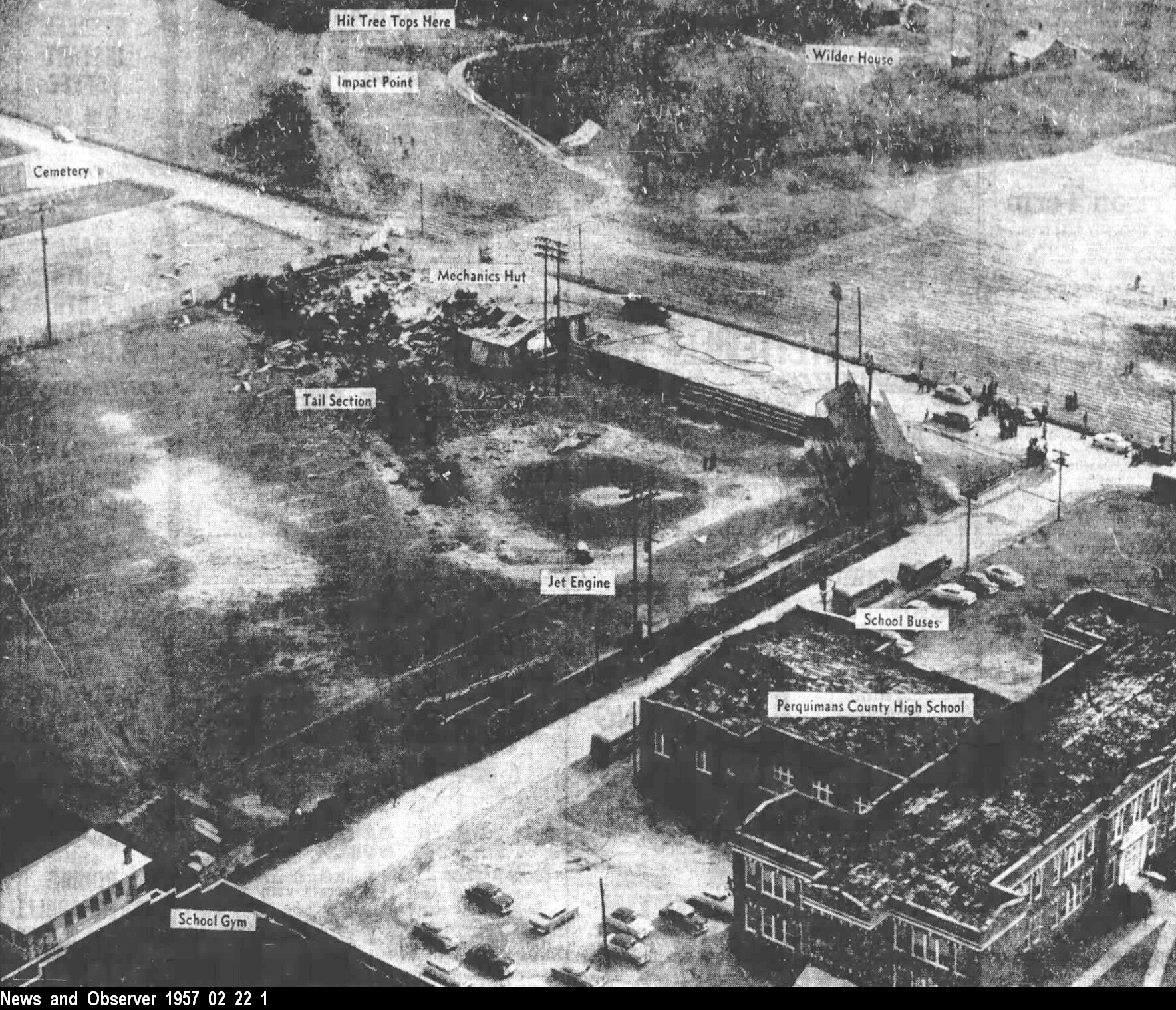
Looking back at the close call of all close calls, when a Navy jet fighter crashed within 200 yards of Perquimans County High School in Hertford, NC, on the morning of February 21, 1957. Two people were killed and a third person was injured.

Retrospective is below. Read a few newspaper clippings in this Google Drive folder.

Crippled Plane Plunged

Located on Highway 17 just south of downtown Hertford, the high school had an enrollment of 500 students. And just minutes after the crash, hundreds of students would have been on the baseball field for P.E. And just before the crash, 115 eight graders had been out on the field.

The McDonnell F3H-2 Demon jet fighter was based at the naval air station in Oceana, VA. Witnesses reported that the plane was heading directly for the school buildings on a relatively flat glide angle. It was also on fire. Early impressions were that the pilot was still in the cockpit, but officials later said that trim-tab settings may have caused the “flat glide” instead of a “sharp plunge.”

As the “crippled plane plunged toward the school area,” reported the next day’s Virginia Pilot, it sheared off the tops of small trees about 300 yards from the school’s garage building. It then struck a corn field, then struck a shallow hole, then bounced into the air, and finally crashed into the corner of the garage building.

Dead and Injured

Inside was chief county school mechanic J. Van Roach, 55, and his assistant Preston Morgan, 26. Roach stumbled out of the building, his clothes burning. Caretaker Raleigh Perry, from the cemetery next door, threw dirt onto Roach to extinguish the burning clothes. Morgan was blown out of the building and over the fence at the baseball field. Both suffered serious burns, and Roach died of his injuries at 7:55 p.m. that night. Morgan was reported in critical condition, with burns over 35 percent of his body.

The pilot was Ensign William W. Bell and his body was found the following night about five miles from the crash site, on the farm of Lee Winslow near New Hope, NC. His parachute had not opened.

The plane was attached to Fighter Squadron 82 at Oceana. It had left at 10:05 a.m. on a “routine training mission.” There had been no distress calls from the aircraft. Noted a retrospective in the Daily Advance on January 7, 2023, it had been making a run at targets at Naval Auxiliary Air Station Harvey Point.

Inside the School

Both students and faculty inside the school saw the crash. Said Science teacher Mrs. Joseph Nowell, “I saw the [plane’s jet engine] flying toward us and yelled ‘run, run’.” While eighth-grader Guy McCracken also saw the plane’s impact and told everyone “to hit the floor and that’s just what I did.” He recalled later “somebody [then] jumped on top of me and then we all scrambled out of the room.”

In his office on the opposite side of the building, Principal E. C. Woodard “felt a tremendous thud and the building shaking.” Leaving his office, he saw students coming down from the second floor, and returned to his office to signal the fire drill alarm. Said another teacher, “the school emptied in less than a minute.” Agreed Mrs. Nowell, “for the first time in a fire drill there was no confusion on the stairs. The kids came out fast and orderly.”

Emergency Response

The first crash report was called into the Coast Guard station at Elizabeth City at 10:58 a.m. Both the Navy and Marine Corps were immediately alerted. Continue reading ‘Navy Jet Crash in Hertford – February 21, 1957’ »

Facebook Comments

Quads in North Carolina

This is a blog version of a Facebook posting from September 28, 2023.


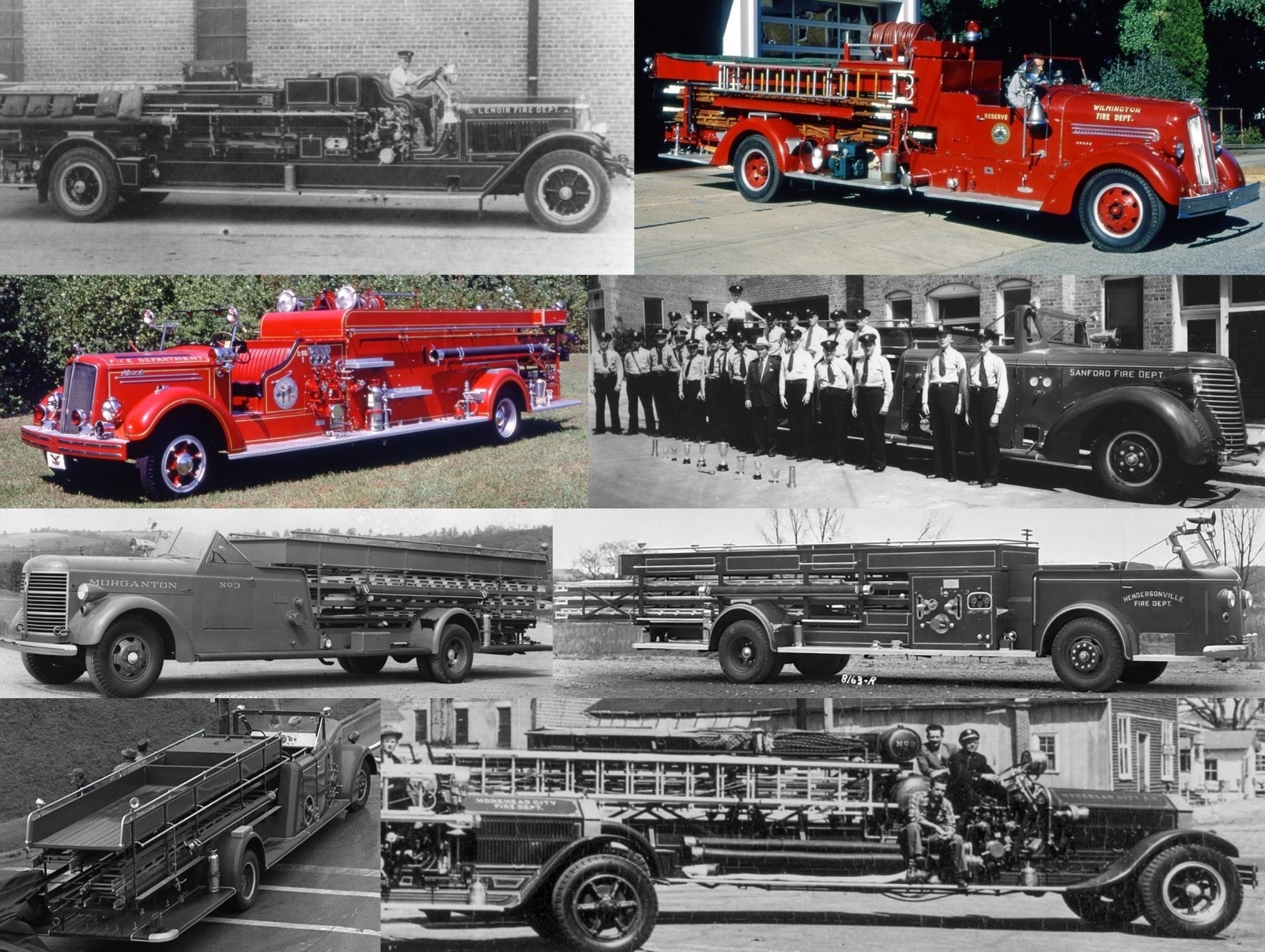
Shown are Hickory, Wilmington, Concord, Sanford, Morganton, Hendersonville, Henderson, and Morehead City.

Here’s a master list of quadruple combinations or quads that have served in North Carolina. 

Concord
1949 Mack 75, 750/250 – Reg #75-2-2349

Henderson 
1940 American LaFrance 575 CDO, ___/___ – Reg #L1215

Hendersonville 
1948 American LaFrance 700 Series quad, 750/[150?], model 775-QJO, reg#L-3451, shipped April 27, 1948

Lenoir
1934 American LaFrance Type 307, 750/___ – Reg #7513. Delivered July 1934.

Morehead City 
1928? American LaFrance, 1000/90 – Water tank possibly converted from chemical tank.

Morganton
1942 American LaFrance B-675-CDO quad, 750/150 – #L1880.

Sanford 
1939 American LaFrance 575 RDO, 750/100 – Reg #L-1090

Wilmington
1938 Seagrave, 750/___ – Reg #93140. Previously cited as 500 GPM. 

Not Quads But Service Trucks with Booster Systems

Charlotte
1949 American LaFrance 700, ___/___ – Reg #L3809
Truck 5 at Station 8, later Ladder 8 

Greensboro
1948 American LaFrance ALF 700-BSJO, ___/___ – Reg #L3712   

New Bern
1927 Seagrave had pump, no water tank.

Definition

Four things define a quad:

  • full set of ground ladders (208′ or greater)
  • booster tank* (100 gallons or greater)
  • full hose load (1,200′ of 2.5″)
  • rated pump of 500 GPM or greater.

*On older rigs, a chemical system qualified as a booster tank into the early 1930s. 

Facebook Comments

The History of Cecil’s Rig – Rescue Pull and Lift Frame

This is a blog version of a Facebook posting from June 8, 2025.

For today’s rescue history, let’s take a trip to Stanly County (NC) . The date is October 15, 1965. On that Friday night at 10:26 p.m., a 1963 Chevy Impala lost control on the curve at Pee Dee Avenue and Tenth Street in Albemarle.

It struck a utility pole and then a concrete wall, trapping two people in the car. Two others were ejected, and one of whom died at the scene, reported the next week’s newspaper.

The Stanly County Rescue Squad responded, and it took 45 minutes to free a passenger in the back seat. Because this was long before George Hurst’s famous tool was being used by rescue services.

Cecil Smith was one of the squad members who worked the extrication. He kept thinking about the time it took to free the victim from the car. There had to be a better way, he thought.

Set to Work in His Basement

Smith was a city policeman in Albemarle and thus answered most of the car accidents that the squad responded to. As recounted in the Stanly News and Press on April 3, 2005, “he set to work in his basement” to build a solution. And it only took about ten years to perfect.

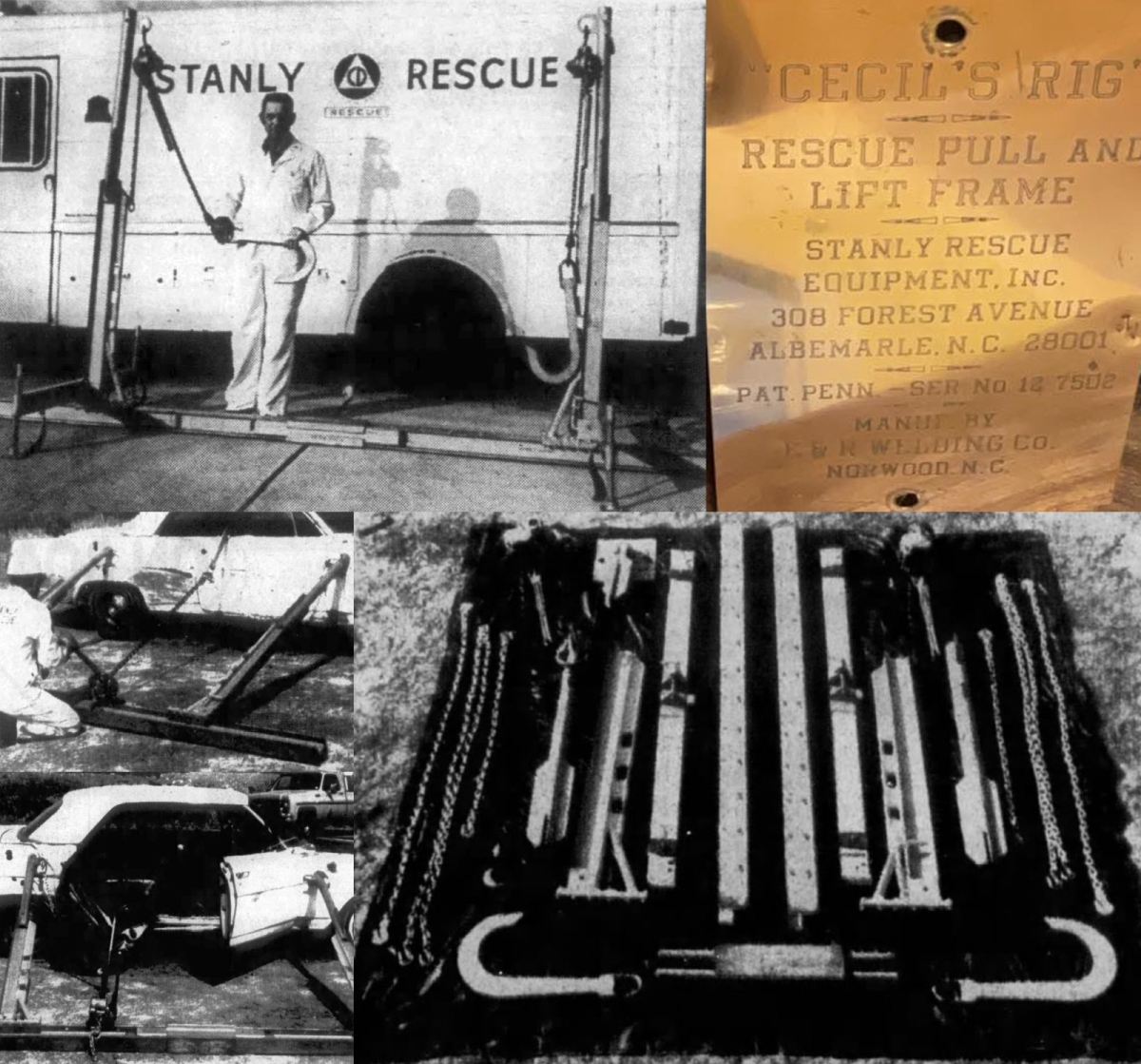
The resulting invention was a device that could pull a car door, quarter panel, or steering wheel. It could also open two doors at once—either front or rear doors—using a chain-pulled hook on one door, and a pass-through beam on the other door.

Later, he added a lift, to raise the end of a car, tractor, or other heavy object. He also designed his device to be portable. It was easily broken down into component parts.

The rescue tool became known as Cecil’s Rig. It had no motors, nor hydraulics. And Smith himself used it at least twenty times to save lives. It was widely used across Stanly and surrounding counties. And in places as far away as Pennsylvania.

Perfecting the Device Continue reading ‘The History of Cecil’s Rig – Rescue Pull and Lift Frame’ »

Facebook Comments

Norwood City Fire Department History

This is a blog version of a Facebook posting from June 8, 2025.

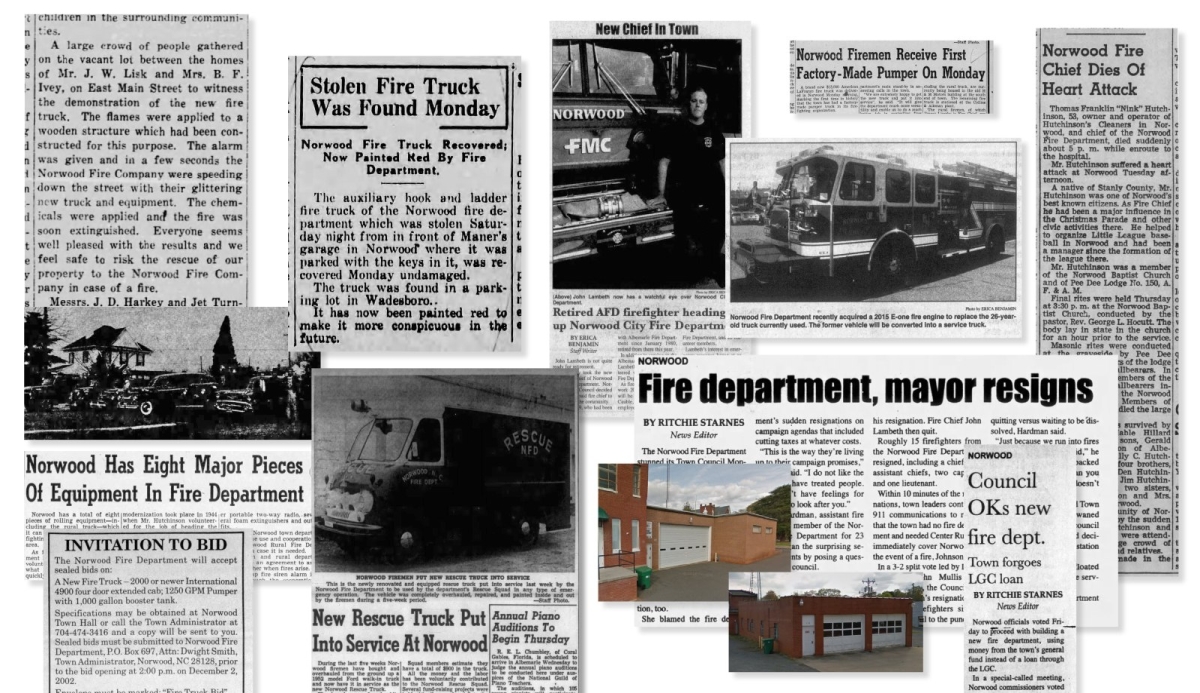
Looking back at the Norwood City Fire Department, that operated from the 1920s to 2016. Today, the Town of Norwood NC is protected by Center Rural Volunteer Fire and Rescue Department. Below are assorted milestones and other citations from the local newspaper. See source clippings and more in this Google Drive

Early Fire Protection

1922 – Town fire equipment consisted of a chemical tank and hand hose reels. [SNP, 3/4/58] The town population in 1920 was 1,221. [Wiki]

1924, Mar – First fire truck delivered. It was equipped with a chemical tank. [SNP, 3/11/24]

1925, Jun – Snapshot from Sanborn Maps. NFD had a volunteer chief and “no organized company.” Ford truck with two 35-gallon chemical tanks, 150-feet of one-inch hose attached to each tank. Two hand chemical extinguishers and one ladder. Plus 1000-feet of 2 1/2-inch hose. No alarm system, used church bells and mill whistles. Fire station was one-story building behind town jail (still standing!) on Allenton Avenue (today Campbell Street) and beside water tower.

Fire Department Reorganized Continue reading ‘Norwood City Fire Department History’ »

Facebook Comments

Asheville-Henderson Army Airfield Fire Department

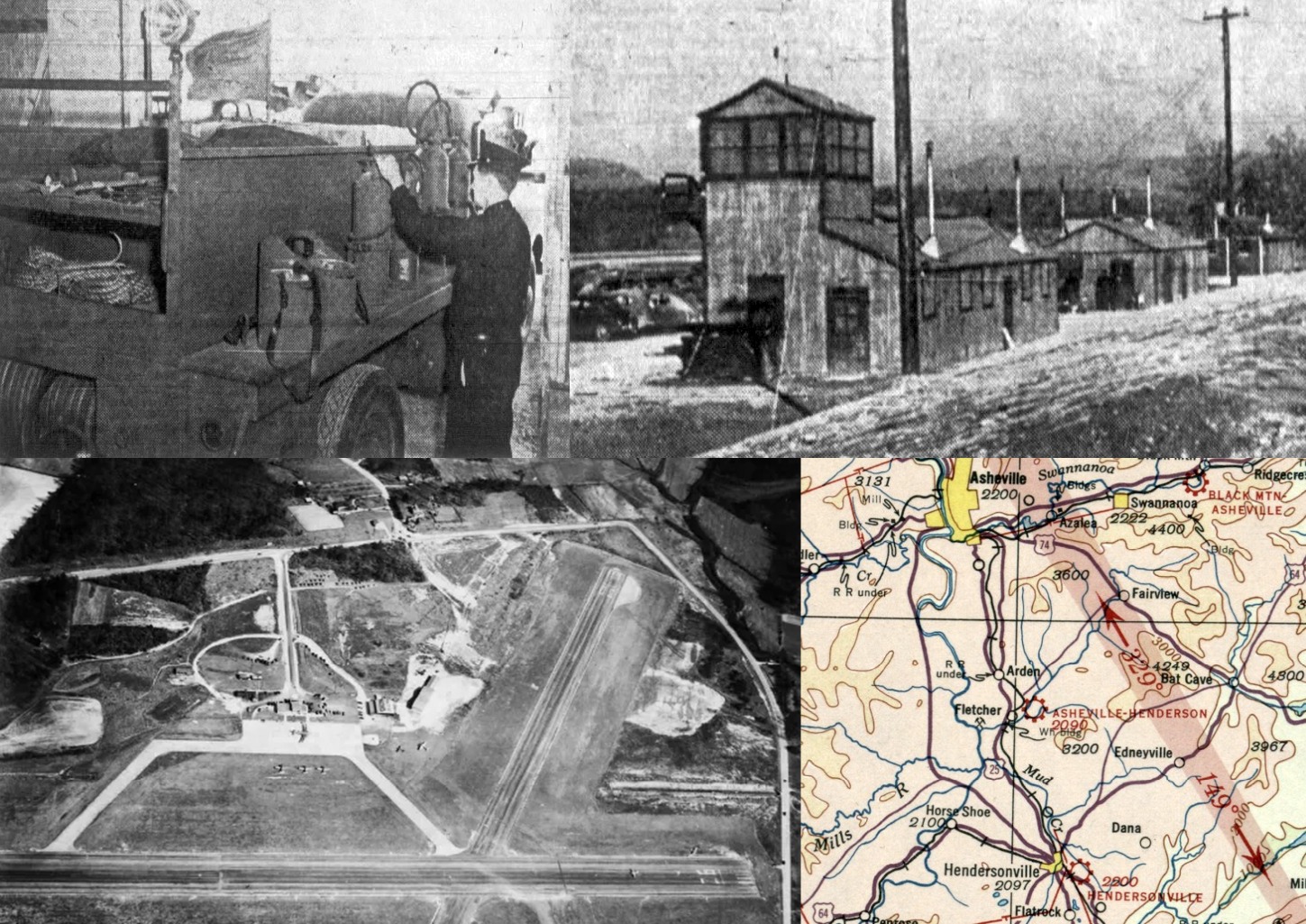
Morning airport history. From Western North Carolina, top left is a crash truck at Asheville-Henderson Army Airfield, a former airport that was located in Fletcher. Today, it’s the site of an industrial park.

AHAA opened as a civilian airfield in 1938 and was operated by the Army from 1943 to 1947. By the late 1950s, a larger airport for the area was sought and the Asheville Regional Airport opened in 1961, three miles to the west.

Continue reading ‘Asheville-Henderson Army Airfield Fire Department’ »

Facebook Comments

North Carolina Shipbuilding Company Fire Department

This is a blog version of a Facebook posting from May 24, 2025.

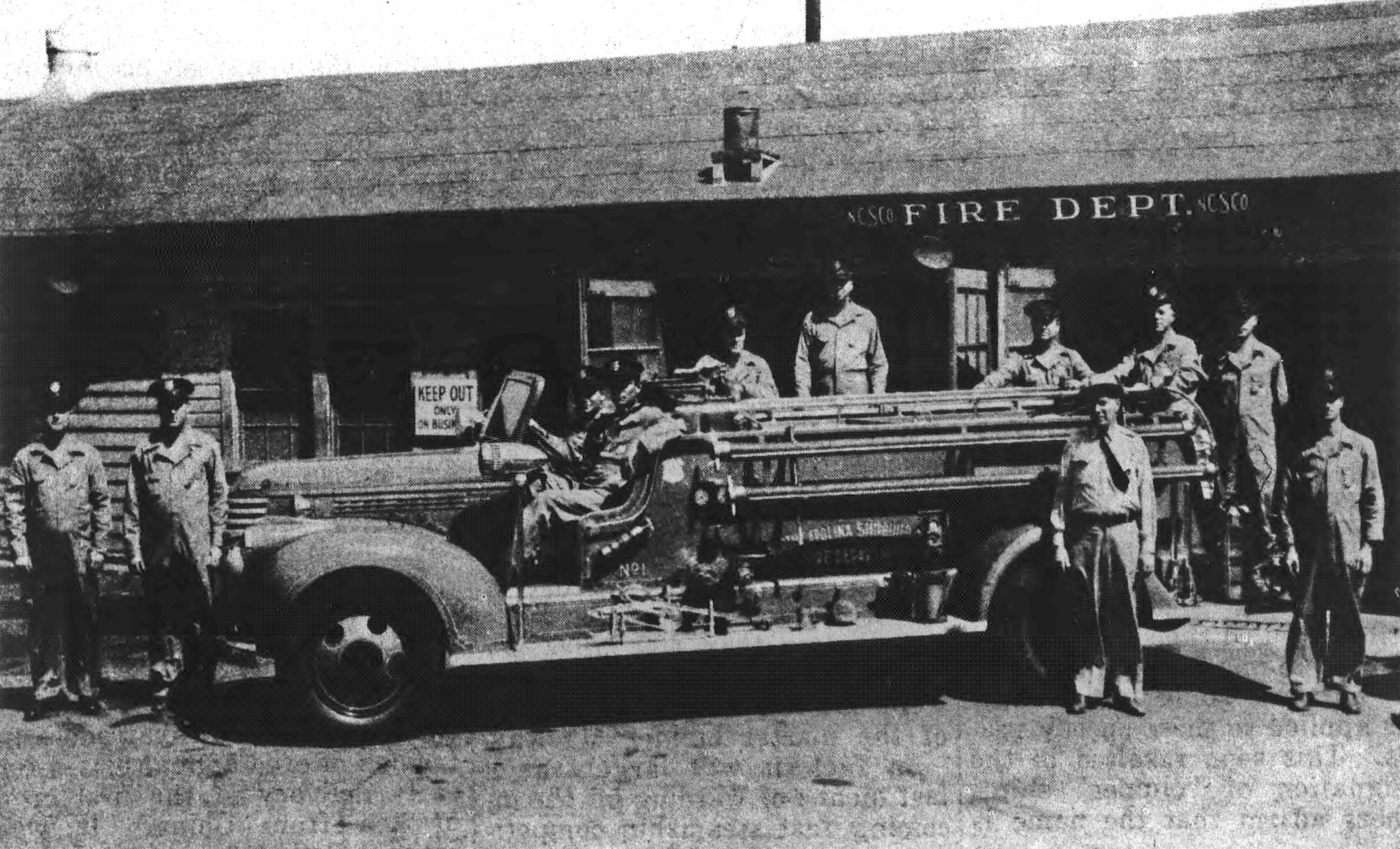
Let’s go back to World War II and and the North Carolina Shipbuilding Company, which was located at the current site of the state port. It built 243 ships from 1943 to 1946. They had their own fire department and at least one fire engine. Pictured area pair of news clippings from the North Carolina Shipbuilding newspaper.

Pictured Apparatus and Personnel

Continue reading ‘North Carolina Shipbuilding Company Fire Department’ »

Facebook Comments

B-52 Bomber Crash Near Goldsboro – January 24, 1961

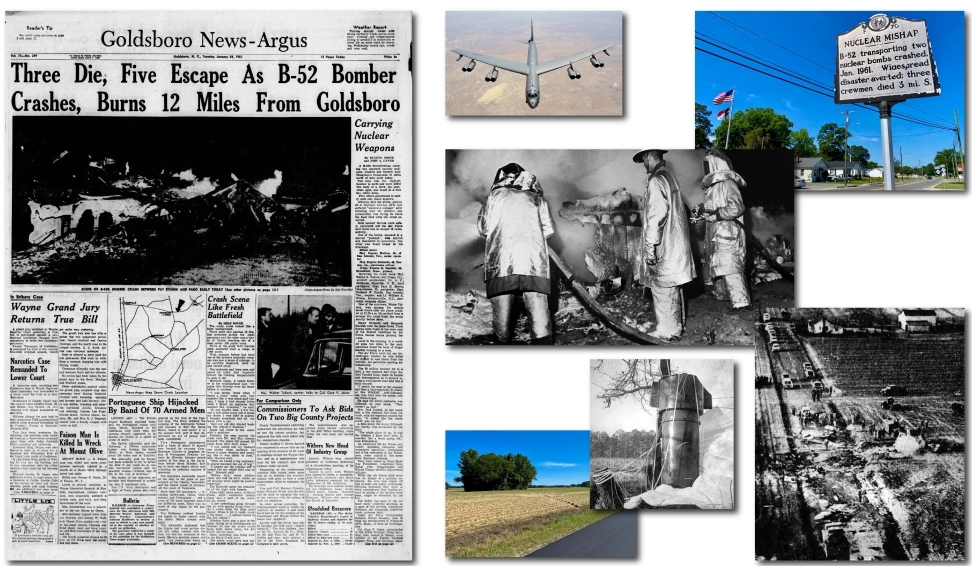
Looking back at the “broken arrow” B-52 bomber crash near Goldsboro (NC) on January 24, 1961. With period photos and news clippings, plus a visit to the crash site today.

At 12:15 a.m., a B-52G Stratofortress operated by the 424 1st Strategic Air Command Wing at Seymour Johnson Air Force Base and carrying two unarmed nuclear weapons crashed in the Faro community of rural Wayne County, 12 miles north of Goldsboro and the nearby base. Here’s that story. Continue reading ‘B-52 Bomber Crash Near Goldsboro – January 24, 1961’ »

Facebook Comments

Marine Ocean Terminal Sunny Point Fire Boats

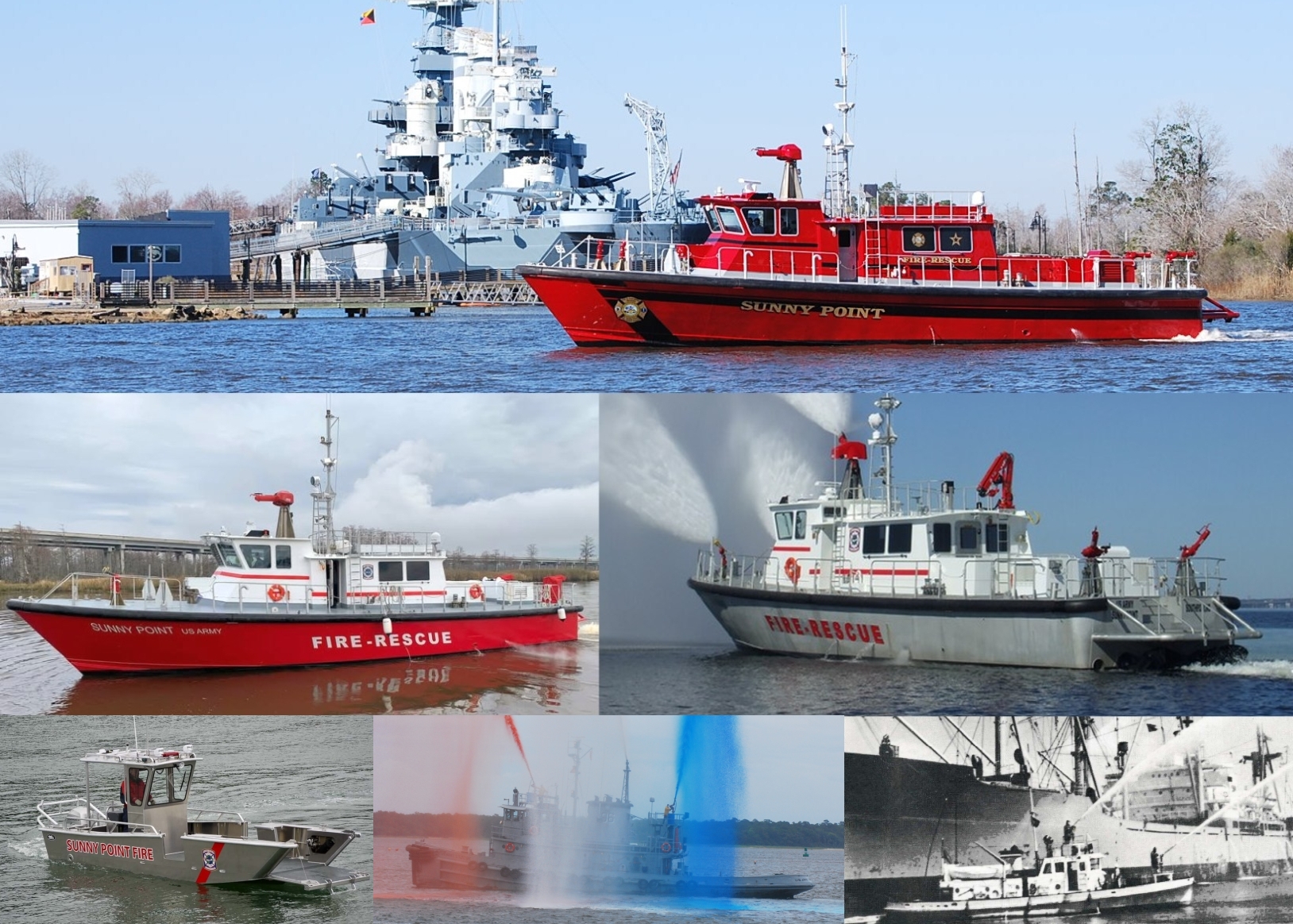
Photo credits: US Army 596th Transportation Brigade, Davis Diesel, Ray Hunt Design, Munson Boats, US Army, Hose & Nozzle Magazine.

Let’s look at the fire and rescue boats of Marine Ocean Terminal Sunny Point in Brunswick County. Three fireboats going back to the 1950s plus a small rescue boat in recent years. Were there others?

Current Fire Boat

2011 to present

Placed in service in September 2011 [Rocky Mount Telegram, 2/15/12], the terminal’s fire boat was built by Gladding-Hearn Shipbuilding in Somerset, MA. The 75-foot craft has a 3,750 GPM/150 PSI pump, powered by two 503 HP CAT engines. Separate 1600 HP CAT engines power the boat. Five monitors, including a remote-controlled deluge gun atop the wheelhouse. Jet propulsion. EMS-equipped cabin. Etc.

It was delivered with a knuckle-boom crane aft of the pilothouse on the bridge deck, but that might have been removed in recent years?

It’s had three sets of colors over the years. Early this year, it was repainted black over red. Top photo from this 596th Transportation Brigade Facebook posting in February 2025. It’s shown in white over red in a Davis Diesel photo from a Facebook posting in March 2021 It’s shown in white over grey in Ray Hunt Design photos from 2011.

See also this December 2011 story from Marine Link about the boat.

Small Rescue Boat

Their small rescue boat was built by Munson in [goes here]. It’s 24 feet long with an 8′ 6″ beam. Outfitted with a 48″ wide console T-top, 26″ wide side doors, 3″ tow post, motor guard/tow line guide, Whelen 17″ LED light bar, and two Go Light 2020 400,000 CP search lights with control pads.

Details and more pics on the builder’s web site.

The Valley Forge

Served TBD to 2011

The former fireboat was the firefighting tug Valley Forge LT-2096. Built in 1954, it was converted to a fire tug in the late 1990s, noted this Coastland Times story from May 2012. And which may refer to the rebuilt, listed below.

The 108-foot craft was rebuilt in 1997-2001 in Hythe, England. It upgraded from 4,000 GPM and a 1,200 HP main engine to 8,000 GPM plus 2,000 GPM of foam, and a 2,500 HP main engine, noted this USTCNS news release.

The tug was retired in September 2011. [Rocky Mount Telegram, 2/15/12] The tug was sold at government auction in February 2012 [ibid] and sold for $115,000 and purchased by the North Carolina Division of Marine Fisheries and subsequently stripped and sunk to help build an artificial reef off the coast of Hatteras Island on May 7, 2012. [Coastland Times, 5/23/21]

It’s pictured in a US Army photo from May 2010, see source article.

See also a photo from August 2011 in downtown Wilmington by Dave and Sara Matthews, as posted to Flickr.

Earlier Fire Boat

Served 1955 to TBD

Sunny Point military logistics center opened in 1955, after four years of construction. [Wiki] Reported a newspaper story on the October 29, 1955, dedication, the Transportation Corps provided a fleet of vehicles to the facility, including two fireboats. [N&O, 10/30/55] 

One of those fireboats is likely pictured circa January 1958, on the cover of Hose & Nozzle magazine in January 1958. Details about the boat are TBD.

The accompanying Hose & Nozzle article noted that the terminal had both a fireboat and a tug for floating fire protection. Plus two pumpers and a tanker, a forestry bulldozer, and two firefighting rail cars with pumps and tanks. Plus an extensive water system with mains, pumps, hose cabinets, and monitor towers.

See a digital version of the issue linked from this landing page.

Other History

By July 1969, a feature in the Raleigh News and Observer about the facility noted that the terminal had two firefighting tugs. [N&O, 7/6/69]
Facebook Comments