This beautiful picture was posted to SPAAMFAA on Facebook by Steve Loftin, from his collection, it's a 1959 American LaFrance 1000/300 open-cab pumper as Engine 5. See original posting.
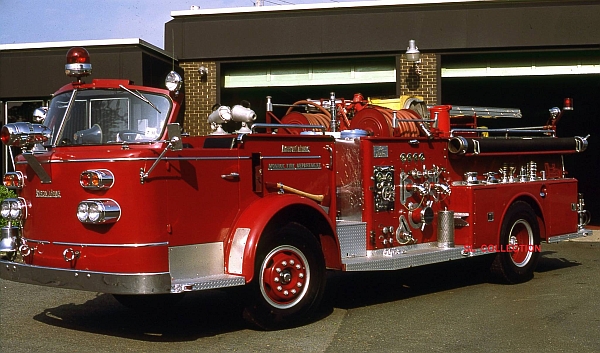
Courtesy Scott Loftin Collection
Facebook Comments
This beautiful picture was posted to SPAAMFAA on Facebook by Steve Loftin, from his collection, it's a 1959 American LaFrance 1000/300 open-cab pumper as Engine 5. See original posting.
Courtesy Scott Loftin Collection
The Raleigh Fire Museum tweeted about this the other week. Let’s examine more closely in this blog posting. This is a vintage “rules and regulations” booklet from the early twentieth century. It was donated to the museum by a retired member of the department.
View the booklet in this photo gallery or download PDF version.
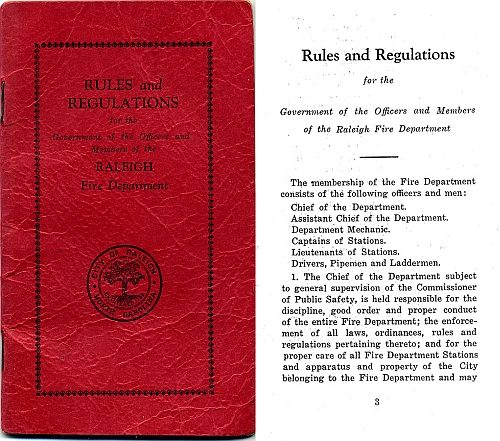
Look familiar? We’ve blogged before about a similar booklet from the Charlotte Fire Department. We’ll compare both in a bit. First, let’s look more closely at the Raleigh booklet:
“Rules and Regulations for the Government of the Officers and Members of the Raleigh Fire Department.”
Size
Measures about four inches wide by six inches high.
Date
Guessing 1920s or 1930s, but could be as late as late 1940s. Page 3 references the Commissioner of Public Safety. The city was governed by a Board of Commissioners until July 1, 1947. Thus the booklet is no older than that. There are also six pages of alarm box locations in the back of the booklet. They include streets in locations annexed between 1930 and 1949, such as the “far ends” of Glenwood Avenue as well as Whitaker Mill. Thus the booklet can be reasonably dated as between 1930 and 1947.
Page 23 references “appointees”. Fire department members were appointed positions until March 1, 1935, when they were granted civil service protection. Does that further narrow the scope of this document? Possibly. Was the verb “hired” used after that date, or were new member said to be “appointed” (as now based on competitive hiring). And/or, once that change was made, were all documents updated with revised language? Was this booklet updated or older terminology left in place. (Such as “hose carts” that are cited in the booklet and despite a couple decades since the horse-drawn era.)
Contents
Observations and Amusements
Fire Alarm [Signal] Codes
How did those work?
Where were the radios?
How long were the alarm boxes used?
Comparing Charlotte and Raleigh Booklets
Here’s a blog post from 2009, feature a similar booklet from the Charlotte Fire Department. Gets me thinking that such booklets were perhaps replicated among urban fire departments. Maybe with help from the IAFF? Some observations:
| Charlotte | Raleigh | |
| Date | 1940 | Early 1930s? |
| Total Rules | 112 | 100 |
| Apartment Houses | yes | no |
| Hotels | yes | no |
| Alarm Boxes | yes | yes |
| Alarm Box Signals | no | yes |
| Street Directory | yes | no |
| Total Pages | ~60 | 33 |
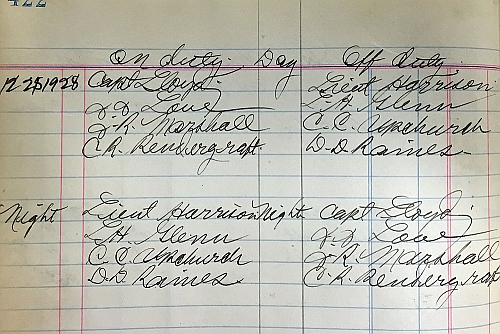
Presented by the Raleigh Fire Museum, the men and women of the Raleigh Fire Department who stood watch on December 25, in select years between 1928 and 1996. Log book excepts. View the photo album, or see same via their Facebook posting.
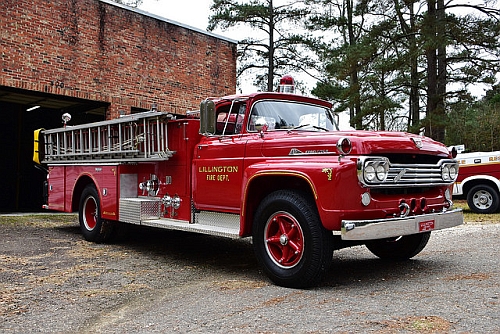
Last week Lee Wilson paid a visit to Lillington, to photographer their two antique (and well-preserved) antique engines. The older one is a 1928 GMC/American LaFrance Type 99 triple combination, #G-125. (Shipped on June 27, 1928, says the Peckham database.) The newer one is a 1961 Ford/Seagrave pumper. (Model? Specs?) Both are housed in the former Lillington Rescue Squad building. (The squad was chartered in 1968, say state corporation records. They operated through the 1970s, we’re told. The corporation dissolved in 1995.) Such beautiful trucks. See more photos from Lee.
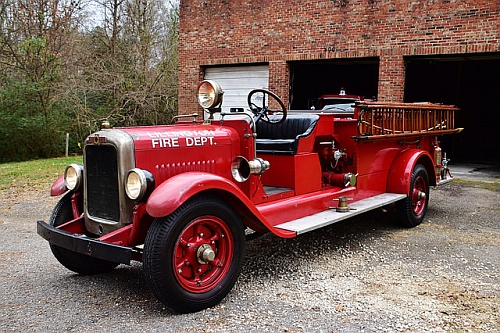
 Lee Wilson photos
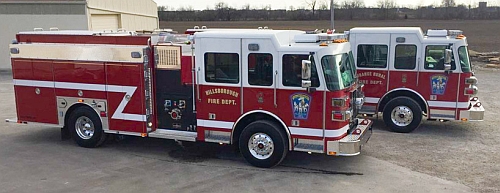
Orange Rural Fire Department in Hillsborough has received a pair of 2015 Sutphen Monarch pumper-tankers, 1500/1000. They were delivered on Friday, December 18. Notes this town press release, they cost $480,00 each. One was purchased by the town and is lettered for Hillsborough Fire Department. The other was purchased by Orange Rural, which is the private fire department that is contracted by the town. (The contract requires the town to provide one engine and one ladder for operation by ORFD.)
The "town truck" replaces a 1996 KME pumper, 1500/750. The "rural truck" replaces a KME engine (model year?) that overturned in January. See blog posting about that incident. See more photos on the ORFD Facebook page, as well as some from Lee Wilson last week. See also our ongoing updates about the history of HFD and ORFD. Still doing some research there.
Courtesy Orange Rural Fire Department
We covered the future plans (prospective or otherwise) of Cary and Apex in their respective prior postings. Let's look at the city and see what they're cooking for the next five years...
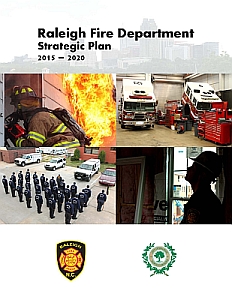
The Raleigh Fire Department recently produced a five-year strategic planning document. A copy has been posted to the RFD newsletter [archive] site and accompanies an article about the plan in the fall 2015 issue. The plan was created by a thirty-two member planning committee during a series of meetings this summer. It was developed with inputs gathered from a stakeholder survey in May 2015.
Five goals are outlined in the Strategic Plan: promoting workforce excellence, adjusting operational and support staffing levels, strengthening functionality and condition of infrastructure, automating business systems, and enhancing public communication. The thirty-four page document concludes with appendix materials.
Read the strategic plan (PDF)
Let's look closely at staffing, apparatus, and facility objectives through 2020:
Staffing
Apparatus
Facilities
Technology
Notes
Welcome to the new version of Legeros Fire Blog. Effective January 1, 2016, the original blog site has been retired. It will remain active as an archives location. This new blog has some neat new features, including Facebook comments available per posting. Thanks your patience as deployment is concluded, and any remaining construction items are completed. Please update your bookmarks and web links to the new address: www.legeros.com/blog.
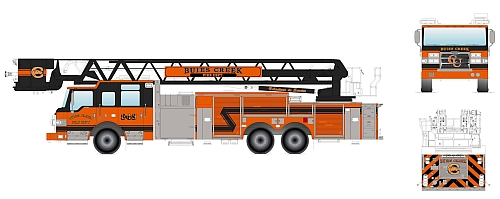
The Buies Creek Fire Department has ordered an black-over-orange Pierce Arrow XT (though the drawing shows a Velocity) aerial platform, notes this Facebook posting from Atlantic Emergency Solutions. The truck will equipped with a 1500 GPM pump, 300 gallon water tank, and 100-foot platform. The colors are those of the Campbell University Fighting Camels. This is the first truck in the department’s history to be painted in the University’s colors. Very cool and you know the next question. What other orange fire engines are operating in the Carolinas? It’ll replace a 1987 Pierce Arrow rear-mount platform, formerly operated by the town of Cary.
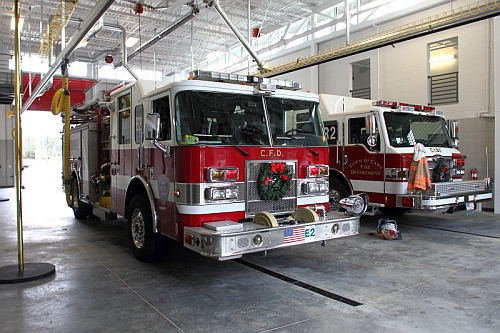
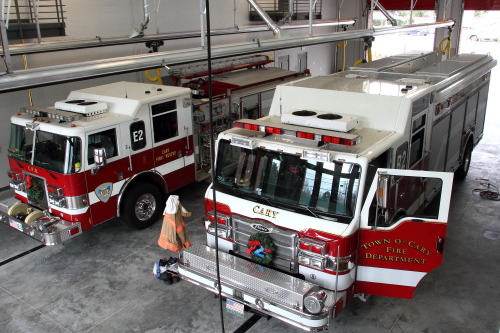
The town of Cary opened a new fire station on Monday. The personnel of Engine 2 and Rescue 2 reported for duty at the newly completed Station 2 at 601 E. Chatham Street. They were transported to old Station 2 at 875 SE Maynard Road, and brought the apparatus to the new facility. Those are a 2006 Pierce Dash pumper and a 2012 Pierce Velocity walk-around heavy rescue. The 13,395 square-foot facility is a two-story structure and the town's second fire station with a pole. Or poles, plural. It's also their second station with accordion-style (also called bi-parting) bay doors. (They open fast. Within seconds.) Including land, design, and construction, the new fire station cost about $5.5M. A dedication ceremony is planned for Friday, December 18, at 11:30 a.m. [Read the press release.]
Upon the relocation of Engine 2 and Rescue 2 yesterday morning, old Station 2 became Station 9. The legacy facility will house Engine 9 until a permanent home is constructed at 1427 Walnut Street. The property is located at the corner of Walnut Street and Nottingham Drive. There's an abandoned church on the site, which the fire department has been using for occasional training. There's been $750,000 funded for the project thus far. Engine 9 was placed in service with Engine 6, relocated from Station 6 at 3609 Ten-Ten Road. Same is a 2003 Pierce Dash pumper that will be re-lettered when new decals arrive. Also yesterday morning, Ladder 6 was renamed Engine 6. They'll operating as a quint company with their 2008 Pierce Velocity aerial ladder. Additionally, Rescue 4 was moved to Station 6. Now Rescue 6, they operate the town's second 2012 Pierce Velocity rescue, which is identical to Rescue 2. What's the status of future fire facilities and apparatus in Cary? Good question! Looking at the town's budget documents, there's a ten-year CIP listing from a year ago. It's available on this page. Highlights include:
What's their current status? We'll ask around on Friday, at the dedication ceremony. Readers may have inputs as well. Also need a check on the makes/models/years of the apparatus listed above. See photos from Mike Legeros and Lee Wilson. Read prior blog postings about Station 2:
The opening of Cary’s new fire station this week gets me thinking. How many newly constructed fire stations have opened in Raleigh and Wake County? Let’s take a look…
Criteria:
Answer:
At least 122.
Details below. See Mike’s Wake County station register(PDF) for more information.
|
Apex |
4 |
Excludes 1927 municipal building, not purpose-built with fire station space. |
|
Bay Leaf |
4 |
Excludes Lynn Rd., not built for BLFD Excludes original station on Six Forks Rd., space inside commercial structure. |
|
Cary |
13 |
Excludes other earlier facilities likely not purpose-built, such as Public Utilities building used in 1960s for temporary housing of original service ladder truck. |
|
Durham Highway |
3 |
|
|
Eastern Wake |
See Knightdale. |
|
Fairgrounds |
2 |
|
|
Fairview |
3 |
|
|
Falls |
Station excluded from list, community building not purpose-built as fire station. |
|
|
Fuquay-Varina |
5 |
Possibly another earlier purpose-built FVFD or Fuquay Springs FD structure(s) or two. |
|
Garner |
5 |
Exclude original station on Garner Rd., former used-car garage. |
|
Holly Springs |
4 |
Excludes temporary station on Thomasmill Rd., space in commercial building. Exclude Sta 3 on Friendship Rd., rented house. |
|
Hopkins |
1 |
Fowler Rd. (1977?) |
|
Knightdale |
2 |
Excludes:
|
|
Morrisville |
4 |
Excludes:
|
|
New Hope |
2 |
Exclude original station on New Hope Rd., rented space inside existing structure. |
|
Raleigh |
41 |
Excludes:
|
|
RDU |
3 |
Excludes Multipurpose Building #3 used in 1980s, presuming not-purpose built to include fire department (but correct me if wrong). |
|
Rolesville |
2 |
Excludes original station on S. Main St., part of service station. |
|
Six Forks |
3 |
Exclude original station on Six Forks Rd., converted barn. |
|
Stony Hill |
4 |
|
|
Swift Creek |
2 |
|
|
Wake Forest |
7 |
Excludes:
|
|
Wake Forest #2 |
1 |
N. Taylor St. Presuming purpose-built for fire department. |
|
Wendell |
4 |
Plus three hoses houses, circa 1920s. Unsure if purpose-built or adapted. One of these may have served as the fire station through the 1950s. Excludes Hollybrook Rd., where Fourth Street station was relocated brick-by-brick in early 1960s. |
|
Western Boulevard |
Both original structures excluded, as neither was purpose-built for fire department. First was space in service station, second was loaned chicken shack. |
|
|
Western Wake |
See Fairgrounds. |
|
|
Yrac |
1 |
E. Durham Rd. (1966) Excludes original structure, which was rented structure not purpose-built for fire department. |
|
Zebulon |
2 |
Plus three hose houses circa early 1920s. Unsure if purpose-built or adapted. One of these was likely expanded into the fire station that served through the 1950s. |