This is a blog version of a Facebook posting from June 8, 2025.
For today’s rescue history, let’s take a trip to Stanly County (NC) . The date is October 15, 1965. On that Friday night at 10:26 p.m., a 1963 Chevy Impala lost control on the curve at Pee Dee Avenue and Tenth Street in Albemarle.
It struck a utility pole and then a concrete wall, trapping two people in the car. Two others were ejected, and one of whom died at the scene, reported the next week’s newspaper.
The Stanly County Rescue Squad responded, and it took 45 minutes to free a passenger in the back seat. Because this was long before George Hurst’s famous tool was being used by rescue services.
Cecil Smith was one of the squad members who worked the extrication. He kept thinking about the time it took to free the victim from the car. There had to be a better way, he thought.
Set to Work in His Basement
Smith was a city policeman in Albemarle and thus answered most of the car accidents that the squad responded to. As recounted in the Stanly News and Press on April 3, 2005, “he set to work in his basement” to build a solution. And it only took about ten years to perfect.
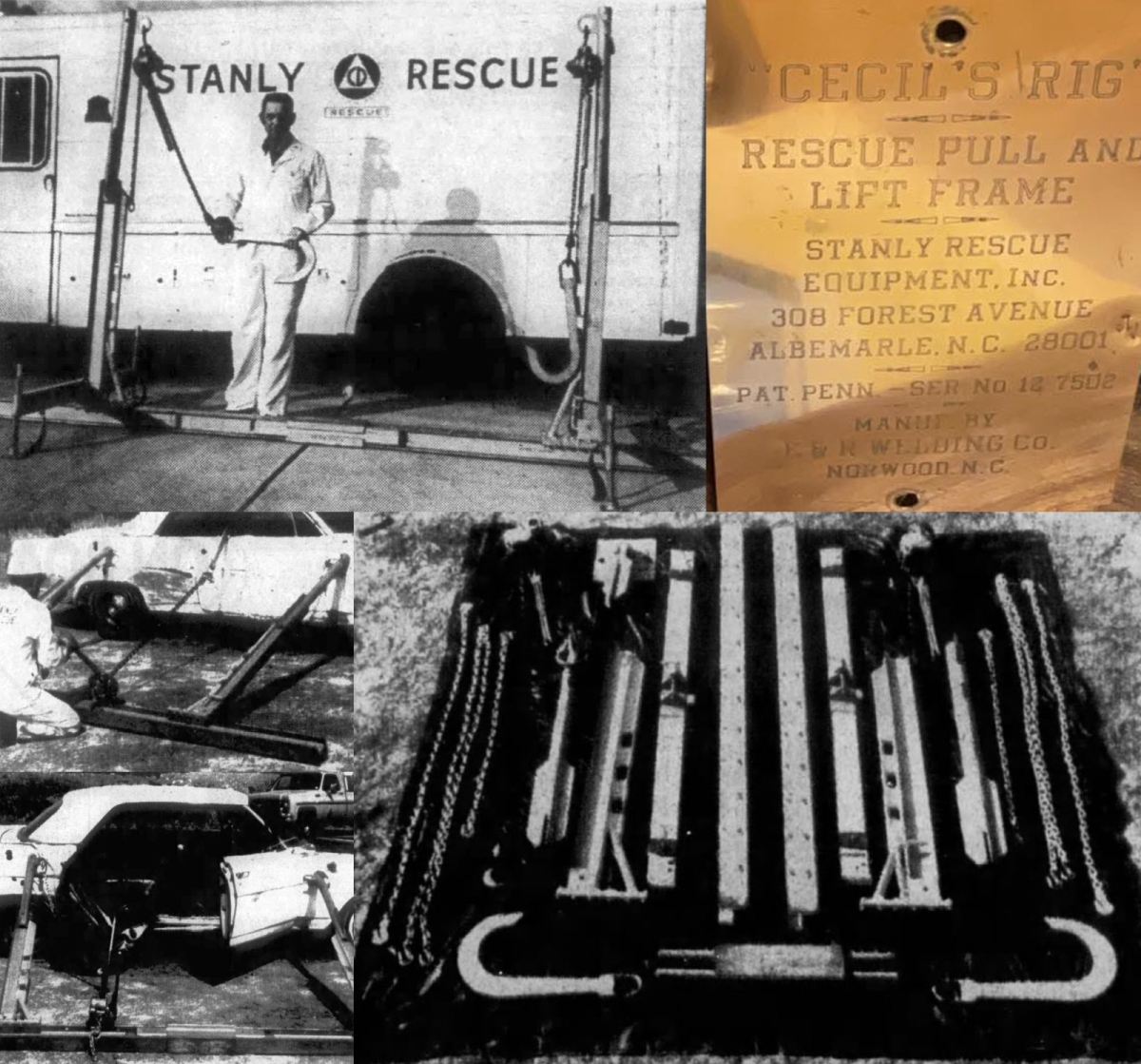
The resulting invention was a device that could pull a car door, quarter panel, or steering wheel. It could also open two doors at once—either front or rear doors—using a chain-pulled hook on one door, and a pass-through beam on the other door.
Later, he added a lift, to raise the end of a car, tractor, or other heavy object. He also designed his device to be portable. It was easily broken down into component parts.
The rescue tool became known as Cecil’s Rig. It had no motors, nor hydraulics. And Smith himself used it at least twenty times to save lives. It was widely used across Stanly and surrounding counties. And in places as far away as Pennsylvania.
Perfecting the Device Continue reading ‘The History of Cecil’s Rig – Rescue Pull and Lift Frame’ »