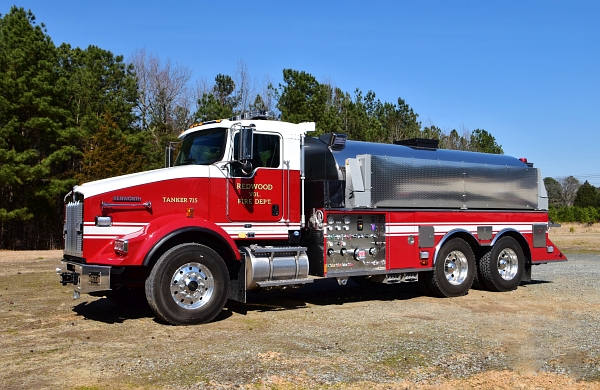
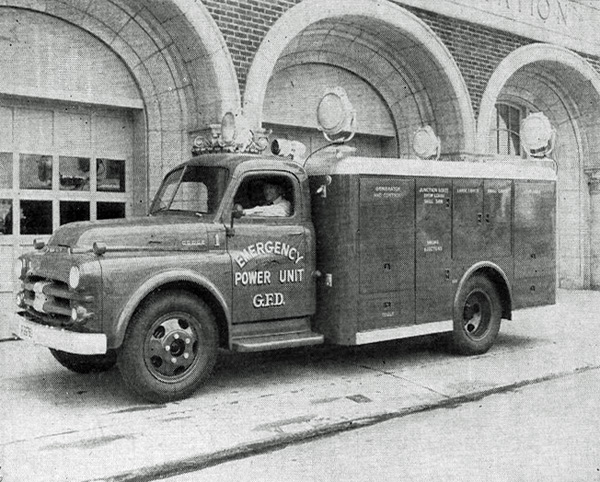
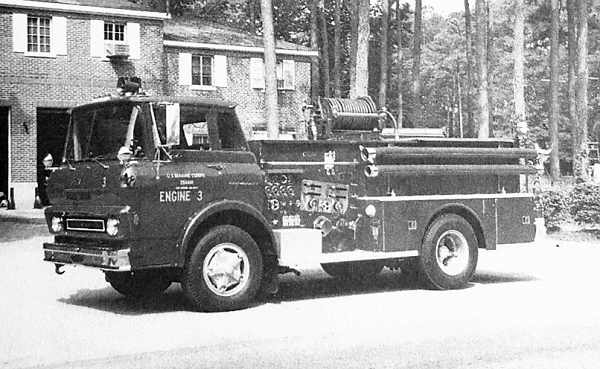
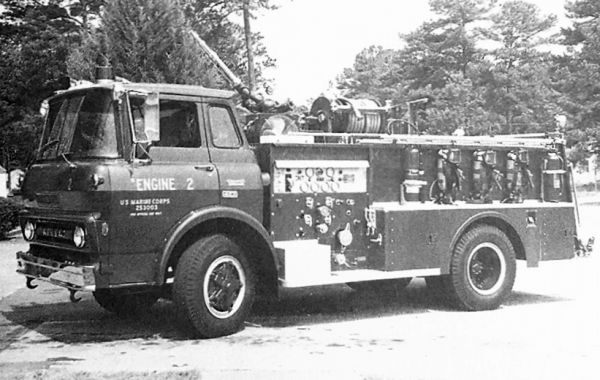
Here’s something neat. Picture of a picture of Charlotte’s three Snorkels in profile, with a wee bit of digital perspective correction. Posted to the Snorkel Aerial Fire Trucks group on Facebook, and cited as found on the Interstate Emergency Vehicles Inc. web site.
Shown left to right are:
Ladder 18 – 1986 Pierce Arrow, 1000/200/85′
Ladder 16 – 1986 Pierce Arrow, 1000/200/85′
Ladder 1 – 1984 Duplex/Grumman, 100/300/80′
Source for apparatus information is my Charlotte FD fleet listing, from www.legeros.com/history/fleets. Wonder when they were each retired?
This is the first in a series of blog postings about Wake County EMS, and their celebration this year of their 40th anniversary. More coming soon, including a new ambulance revealed this week with retro green-over-white markings!
Let’s begin with a three-minute video featuring original Wake County EMS Director Russell Capps talking about the origins of the organization.
Capps talks about the first ambulances from Swab Wagon Company, the first members, and the original EMS stations:
Placed In Service
Wake County EMS was placed in service on August 15, 1976. They responded to nineteen calls that day, with four 1976 Dodge/Swab ambulances and a Dodge station wagon Supervisor’s vehicle housed at two stations: 201 W. McDowell Street (Station 1) and the Wake County Home at 513 E. Whitaker Mill Road (Station 2).
The staff consisted of Capps, Chief Supervisor Jesse Glenn (formerly a Raleigh firefighter, who rode rescue), Secretary Pauline Wood, Billing Officer Callie Johnson, and twenty-four Emergency Medical Technicians across three shifts. They’d been hired by mid-July and field-trained for another month.
On August 13, 1976, the new personnel of Wake County EMS were sworn-in at a ceremony at the county courthouse. Two days later, they began running calls.
As today, their service was fee-based. They charged patients $35 to transport from any point in the county to any hospital. The phone number for their service (as well as fire and police) was 829-1911.
They served Raleigh and northwestern Wake County, with the remainder of the county covered by volunteer rescue squads in Apex, Cary, Fuquay-Varina, Garner, Knightdale, Wake Forest, Wendell, and Zebulon.
Later Directors, Later Career For Capps
Capps was the first Director followed by Gerald Brown (1980-2000), Joseph Zalkin (2000-2002 as interim), Barry Britt (2002-2004), Chris Colangelo (2004-2005 as interim), Skip Kirkwood (2005-2008, though he continued as EMS Chief until 2013), Brent Myers (2008-2015), Chris Colangelo again (2015 as interim), and the newly installed Jose Cabanas (2016).
He was also the county Director of Emergency Preparedness and the Fire Marshal, a position he’d held since 1971.
After leaving the county, his career continued as a Natural Hazards Planner with the state from 1987 to 1993 and as a member of the North Carolina General Assembly from 1994 to 2006.
Wait, you ask, who have served as Wake County Medical Directors? They’ve included Douglas Hammer, Jack Larson, Jeff Top, Ben Graves, Donald Vaugh, Brent Myers, Jeff Williams, and Jose Cabanas. Doctors, that is.
Short History of Local Ambulance Service
The first emergency ambulance providers in Raleigh (and Wake County) were funeral homes. In 1953, the Raleigh Fire Department formed a rescue squad, and also provided emergency ambulance service as needed. In 1962, the first county rescue squad was formed in Wendell.
By the 1960s, funeral homes were the primary providers in Raleigh. But in 1965, six of seven funeral homes in Raleigh ceased this service. Ambulance Service of Raleigh (later renamed Beacon) began operation that year.
In 1968, Beacon began receiving a county subsidy for providing emergency ambulance service in the city, and in county areas where funeral homes weren’t serving.
Ambulance service in Raleigh was also provided by Overby Funeral Home and, as needed, the Raleigh (Fire Department) Emergency Rescue Squad.
In 1976, the primary provider for Raleigh residents was Beacon. They were backed up by the fire department’s two rescue trucks. Each Beacon ambulance and Raleigh rescue unit was staffed with at least one EMT, as required by a new state law for ambulance personnel.
That year, County Commissioners discussed options for improving ambulance service, including creating a city-county ambulance service, creating a county-operated service or renewing their contract with Beacon. On April 20, 1976, they voted to create a county-financed ambulance service for Raleigh and northwestern Wake County.
The rest, as they say, history.
More History at Your Finger Tips
Learn more about Wake County EMS history on a pair of web sites developed by Chief of Community Outreach Jeff Hammerstein and local emergency services historian Mike Legeros (that’s me!):
Bought this one on eBay. Color slide of a train derailment in downtown Raleigh. Slide says April 1961. Don’t have additional details just yet. Hadn’t heard of such incident, in fact. (I’ve found notable ones in 1907, 1943, and 1979.) Will consult microfilm copies of the News & Observer and Raleigh Times at my next opportunity.
Picture was probably taken from the old Boylan Street bridge, the metal one that was closed in 1978. (See Library of Congress pictures of same.) In the upper-right corner of the picture is the old Martin Street Viaduct. That was probably demolished circa 1982, when the new Boylan Street bridge was built. (Read blog archives posting.)
The railroad is the Seaboard Air Line. The photographer is not known.
Click to enlarge the picture, plus a few closer views:
Imagine my surprise at receiving this newspaper excerpt last week, from the Asheville Citizen of all places. Issue date February 17, 1896. From a fellow fire historian.
Previously on the History Show, we cited either “spring 1896” or “January-February 1896” as the timeframe for the opening of Raleigh’s original Headquarters Fire Station.
Located at 112 W. Morgan Street, the two-story, three-bay engine house served both the volunteer and career fire departments. It operated until 1941, when the property was sold to the state, for a planned addition to the adjacent Revenue Building. Read the full history.
You’ve probably seen this one before. Heck, maybe you have one! First time for me, on a firefighter’s helmet in Hillsborough, at a training exercise on Saturday. #EasilyAmused
Wake County EMS is unveiling a “retro ambulance” this week, in a press conference at Station 1 downtown:
Thursday, February 18 10:00 a.m. EMS Station 1 120 W. Davie St., Raleigh
The new ambulance has “old school” colors and graphics, to commemorate the 40th anniversary of Wake County EMS. The event will include remarks from county officials, and any number of current and former members. (Please help spread the word. And wear green if you’ve got it!)
Also, mark your calendar for Thursday, October August 4 [date correction!], at 7:00 p.m., at Fletcher Opera Theater downtown. That’s the date for a full program celebrating the 40th Anniversary of Wake County EMS.
We’ll have pictures of the new rig, details about the truck and anniversary, and some historical perspectives, all after the reveal on Thursday. Watch this space!
Have lately been learning more about America’s atomic history. Visited the National Atomic Testing Museum in Las Vegas last year (see those photos). Tooled around Los Alamos, White Sands, and other New Mexico historical sites in September (and those photos).
Listened to the audio version of an engrossing Area 51 history over the holidays. (Good stuff, though a little kooky in places.) Recently watched the Peter Kuran documentary film from 1995 Trinity and Beyond. (Also engrossing, but requires a bit of familiarity with the subject matter.)
National Atomic Testing Museum, Mike Legeros photo
Thus my interest was entirely piqued by this story, that I happened upon in reddit. Posted on Imaging Resource. Written in 2013 by Tim Barribeau: “Not-so-secret atomic tests: Why the photographic film industry knew what the American public didn’t.” Read the article.
So get this. In 1946, customers of Kodak started complaining about “foggy film.” The company investigated and found radioactive corn as the cause. See, their packing materials included corn husks from Indiana. And said husks were contaminated with a radioactive isotope. What the heck?!
Turns out those farms were exposed to fallout from the Trinity Test in New Mexico in 1945. That was the world’s first atmospheric atomic bomb explosion. That and other tests of the time were top secret. Kodak kept mum about its findings, but did they complain up the chain. Then threatened to sue. The government responded by agreeing to provide Kodak and other film companies with information about the tests. So they could protect their products.
The government didn’t share that information with the general public, of course. And decades later, this produced outraged responses in a Senate hearing in 1998. To be expected.
Read the Imaging Resource article, which is fascinating. And include such eye-raising details as a current program by the National Cancer Institute, that helps people identify if they were exposed to radiation from the tests of the 1940s through 1960s. (The last atmospheric tests in the states were conducted in 1963.)
U.S. atomic testing fallout exposure map (1951-1962)
Remember our posting about the Amcel Propulsion Company Fire Brigade in Buncombe County, from August 2014? We talked about their history which included a 1942 International/American LaFrance engine that originally served Scottdale, PA.
This week, a reader shared a vintage photo of the Scottdale Fire Department, including the later Amcel engine. It’s a picture of a picture and with a bit of digital perspective correction. Don’t know the date.
Though I usually use Twitter for these, let’s blog about this one this morning. Dump truck versus house in Harnett County. Happened in the 4500 block of Highway 210, near Angier, near the schools. Car collided with truck which collided with building.
Says this WTVD story, the structure suffered such heavy damage it will likely be condemned. Driver #2 (truck) transported with non-life threatening injuries. Driver #1 (car) charged. Occupant(s) were not present. Guessing they were not non-plussed upon their return.Really want some stats on these types of incidents. Seems like they happen every couple days, around our metro area.
Bakertown Volunteer Fire Department volunteer firefighter James “Jim” R. Varnell, 53, died at the fire station on Webb Lake Road in Elm City on Tuesday. He was attending training and became ill as he was preparing to depart.
His fellow firefighters quickly came to his aid and performed basic life-support measures. As additional resources arrived, advanced life-support was provided and he was transported to the hospital. He died at the hospital. Source: USFA firefighter fatality report.
Firefighter Varnell was an active member of BVFD for nearly twenty-two years. He also served as a volunteer EMT with Elm City EMS for many years. He’s survived by his wife and two daughters.
His funeral service will be conducted on Saturday at 2:00 p.m. at Wilbanks Christian Church, 6128 N.C. 42 E., Elm City. Burial fill follow at Evergreen Memorial Park in Wilson. The family will receive friends on Friday from 6:00 p.m. to 8:00 p.m. at Joyner’s Funeral Home, 4100 Raleigh Road Pkwy., Wilson, and other times at the home. [Read the complete obituary.]