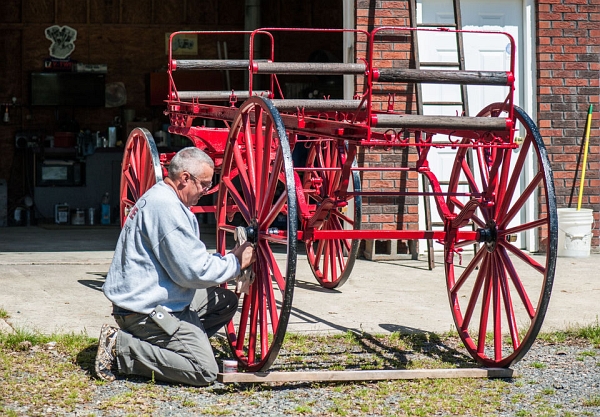
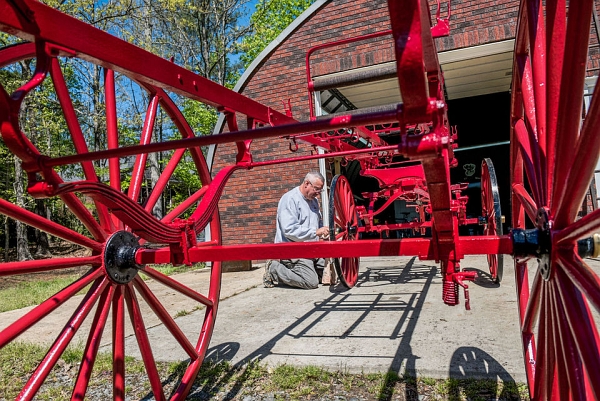
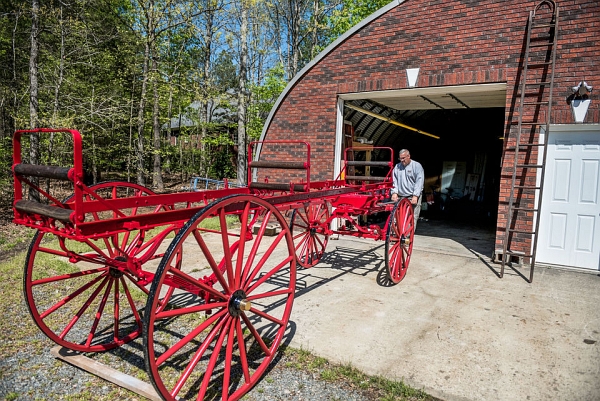
The Concord Fire Department will display a restored hand-drawn ladder wagon this weekend, at the Pennzoil Charlotte AutoFair at the Charlotte Motor Speedway. As this Independent Tribute story (thanks Josh!) by Erin Kidd reports, the 129-year-old wagon was used by the Concord Hook and Ladder Company in 1887.
That was a company of black firefighters who organized that year, and the first formal fire company in the city. The wagon carried wooden ladders, pike poles, and axes. The department acquired the wagon from a local family, and Concord Fire Captain Allen Smith has been restoring the thing for the last two years.
Here’s a nice history of CFD, from their official web site.
In December, we blogged about construction starting on Apex Public Safety 5, along with a few other AFD project plans.
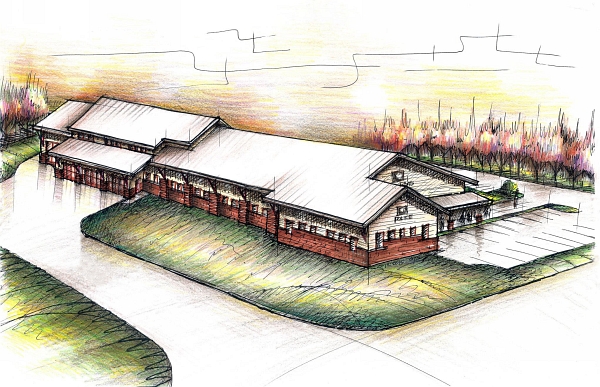
Located at 2050 Kelly Road, the 16,500 square-foot facility will house twelve firefighters, two paramedics, and the Community Services division of the police department.
It’s planned for completion in late summer. Here’s a drawing of the building, from project plans posted to town’s Public Facilities Projects page [link expired]. Looks sharp!
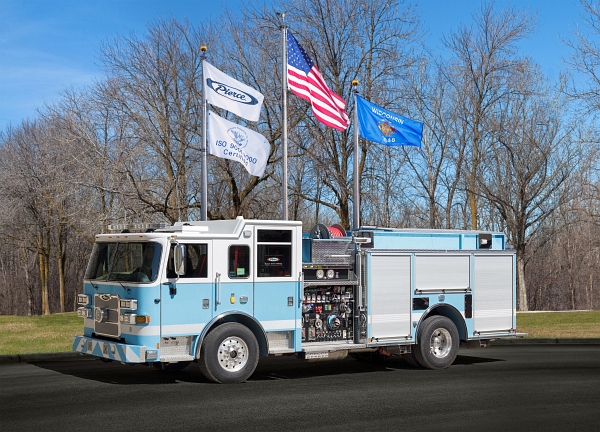
Factory photo of Chapel Hill’s new Engine 31, 2016 Pierce Arrow XT pumper, 1500/500. See larger versions via Pierce on Flickr. This only the second Pierce for the college town, after a 2012 Pierce Arrow XT, 1500/500, which is Engine 33.
Who has built the rest of their fire apparatus over the years and decades. From my historical fleet listings, here are some stats:
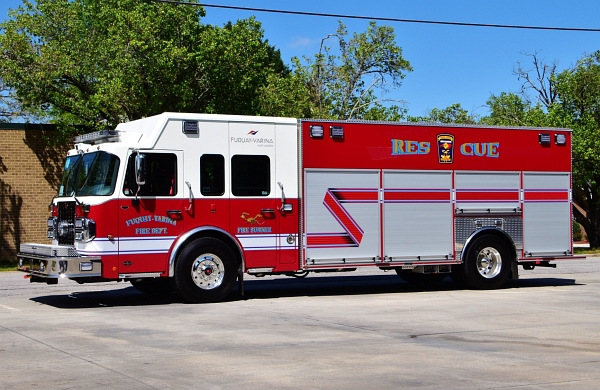
As photographed by Lee Wilson, the Fuquay-Varina Fire Department received their new rescue on Tuesday. Their new Rescue 1 is a 2016 Spartan MetroStar. It replaces a 1995 Freightliner/S&S, which will be sold. See more photos from Lee.
How many custom-cab rescues does that make in Wake County, these days? Here’s the list: Apex, Cary x4, Durham Highway, Fairview, Fuquay-Varina, Hopkins, Morrisville, New Hope, Raleigh x2, Stony Hill, Swift Creek, Wendell, and Western Wake.
They’ve indexed USAAF and USAF reports from 1918 to 1955, though with gaps in 1948-49, and 1952-55. Their database contains (by my count) 1,725 records where State = North Carolina. From those, fifty-one took place in the Raleigh-Durham-Chapel Hill area. (That’s by eyeballing the results.)
They also sell copies of the reports, which can be ordered from their site. Might have look into that! (They’re also looking for volunteers, to read microfilm and enter data.) See the table below.
Notes:
After September 18, 1947, the Air Force split from the Army. Thus the records after that date are non-Army, and thus the January 2, 1953, crash of an Army transport plane in Morrisville isn’t listed.
Now that’s a great title for a conference talk, isn’t?
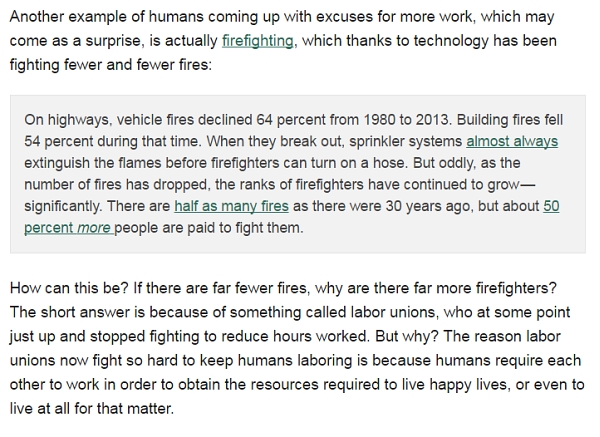
Saw the below statements in a Huffington Post piece on the subject of “universal basic income.” It imagines a visitor to our planet trying to make sense of how humans spend their time, and notably with regard to work, the pursuit of income, and advancements impacting both.
This excerpt contains an increasingly popular line of layman thought: if there are far fewer fires, why are there far more firefighters? And says Mr. Blogger, that might be the top marketing challenge in today’s fire service.
How would you answer this one? Either as written (which includes labor unions as a factor) or at any more generalized level?
Second question, does the fire service need more marketing these days, to better inform both the general public and more educated thinkers? What would be your approach? Please discuss!
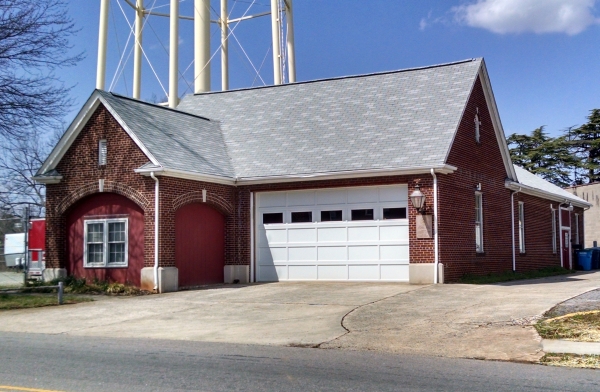
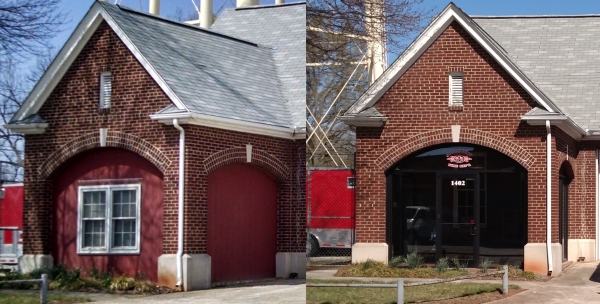
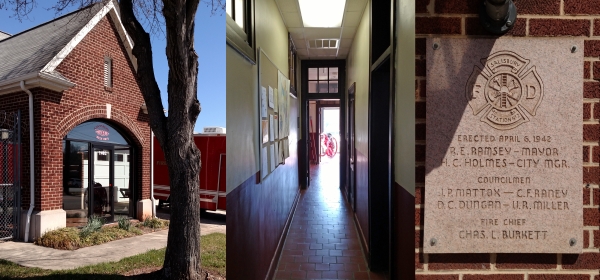
The Salisbury Fire Department last year re-activated their historic Old Station 2 at 1402 S. Main Street. The 1942 engine house was renovated and restored by firefighters, after being vacated by the city s Landscaping and Parks and Recreation departments. Let s chat with Salisbury Fire Chief Bob Parnell about the building (now named Station 5), its restoration, and some other things.
Old Station 2 before the renovation – SFD photo
Q: Chief, when was the Main Street station vacated? A: The fire station was closed in 1980, when Station 2 was relocated to 2312 S. Main Street. The city was growing fast on the southwest side, and we needed a faster response time.
Q: What happened to old Station 2 A: It remained vacant for several years. Then the city’s Purchasing department thought about selling the property, and instead retained and renovated the building as a new office.
Q: Then Parks and Recreation moved in? A: Correct. Purchasing later left the building, and Landscaping and Parks and Recreation moved in.
Q: What did the fire department think of the building s reuse? A: We stayed interested in what was happening. This was a piece of our history, and we even entertain ideas about getting the building back, at some later point in time.
Q: Which happened in late 2014. A: Yes, in the fall of that year, the building was again vacated. We took over the structure and began renovations.
SFD photo
Q: Tell me about the work. A: Renovations took place between October 2014 and January 2015. Save for electrical and plumbing, firefighters did all the work. They removed walls and partitions added since 1980. They did painting and a significant amount of clean-up.
Q: Describe the interior of the structure, which is a one-story brick building with 2,280 square-feet on about a third-acre lot. What was the original layout? A: It originally contained a Captain s office, bunk room, day room, single bathroom with single shower head, a kitchenette that isn t big enough for a table, a storage room, and a double-wide apparatus bay measuring 24 by 70 feet.
Q: And a front porch! A: Which was enclosed in 1980 to add an office. There’s also a coal chute in the basement, which is original to the building.
SFD photos
Q: What s the current layout, post-renovation? A: We added two offices for our Training Officer and our Logistics Officer. They ve been relocated to what s now called Station 5. We re planning to move one our ladder companies there, but we have to add a sprinkler system to the building. We also have to raise the bay doors. They re currently ten feet high and we need twelve feet of clearance. We ll also have to modify the ceilings a bit as well.
Q: Why move a ladder there? A: The station s in a great central location, and it ll improve response times for that company.
Q: When will that happen? A: We re expecting funding for the sprinkler system and other components in the FY16-17 budget.
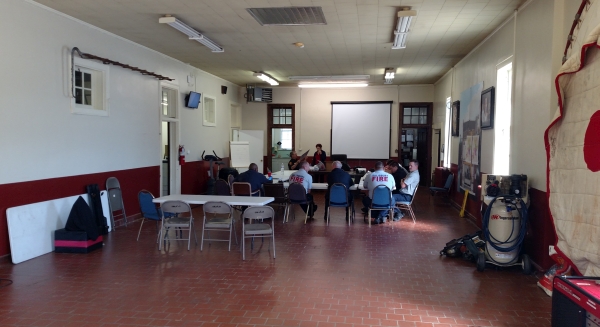
Q: What s the bay used for, right now? A: Squad 5 is there. That s our unstaffed rescue/haz-mat support vehicle, a 1985 Ford L8000/4Guys walk-in rescue. We also use the space for training, meetings, and other functions.
SFD photo
Q: Did you formally re-dedicate Station 5, when it opened in January 2015? A: We plan to re-dedicate when we move the ladder company to the quarters.
Q: What s the reaction been by the crews to the new old station? A: The fire guys and gals are very positive about it. They re taking good care of it, much like they would a national treasure.
Q: What can you tell me about the early history of Station 2? A: It opened on April 6, 1942, back when Salisbury Fire Department was a combination of career and volunteer members. We had two stations with American LaFrance pumpers, a 1941 ALF mid-mount aerial, and an older ALF city service truck that also carried hose. There was a Gamewell system and somewhere around 50 alarm boxes. We had a bell on the tower of Station 1, which was replaced in the 1940s by an electric horn.
[ Editor s note: The model years for those were 1924, 1930, and 1939 pumpers, and a 1924 service truck. They d add an ALF pumper in 1948, then a pair of Seagrave pumpers in 1954, and an International/Howe in 1956. They also had a Dodge rescue truck by 1950. ]
SFD photo
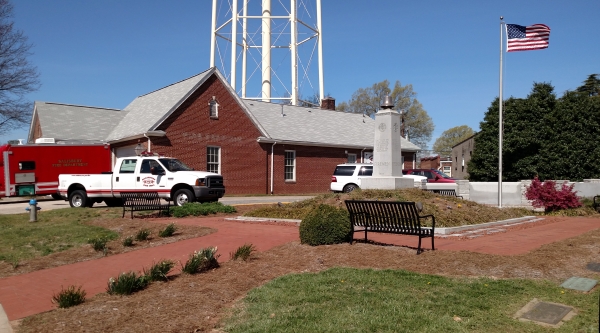
Q: There s a firefighter s memorial next door to Station 2. Tell me about that. A: The memorial was built in the same year as the station, in 1941. It was designed to commemorate the four fire departments in Rowan County at the time: Salisbury, Spencer, East Spencer and the now gone Spencer Shops Fire Department. The original marker still stands and lists those departments, one on each side.
Q: Then it was expanded to memorialize September 11, 2001? A: Yes. With additions completed by September 11, 2002. There a large Maltese cross of granite cobblestones with a 50-foot flag pole in the center. That honors the 343 fallen FDNY members on 9/11. Also added was a walk of honor around the original memorial, and a memorial wall that lists all the Rowan County departments in service in 2001. Listed there, beneath the department names, are the local fallen firefighters: four from Salisbury (Jenkins, Isler, Monroe and Cross) and one from Locke (Shue).
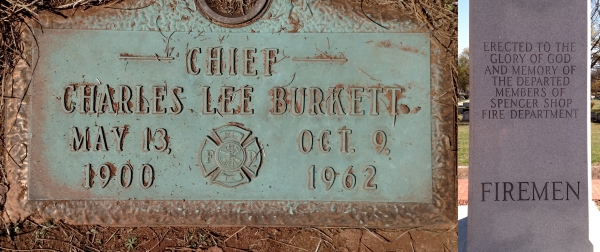
Q: Beside the memorial is the Firefighter s Cemetery. Tell me about that? A: It s located in the city s Chestnut Hills Cemetery, with plots reserved for firefighters and their family. Buried there include Fire Chief Charles Burkett (1937 to 1962), the City s first full-time paid fire chief, and other fire officers. Chief Burkett was well known around the state.
SFD photos
Q: Chestnut Hill rings a bell. There once was a fire company located there. A: That was an unincorporated community just south of downtown. They had a fire company that you told us about!
Q: They were named Southside and appear in tournament accounts of the North Carolina State Firemen s Association. They competed and won as early as 1907 and as late as 1912. The name Southside Reel Company was listed in the 1914 conference proceedings, and were listed with the Salisbury Fire Department in proceedings from 1915. From other NCSFA records, the Fire Chief and Assistant Chief in 1911 were G. C. Kluttz and J. G. Reeves, respectively. And in 1912, they had one company with fifteen men. A: And as you ve told me, they might ve merged with the Salisbury Fire Department, but we don t know for sure.
Thanks Chief!
Take a Video Tour
Last year, the Salisbury Post published a profile of the station project. Read that story, or watch this companion video:
[ Updated with more info. on the truck’s history. ]
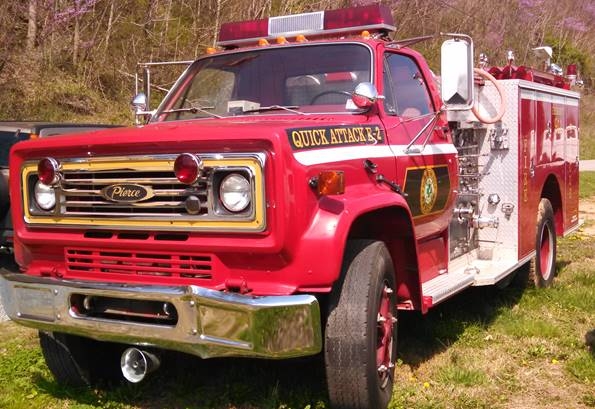
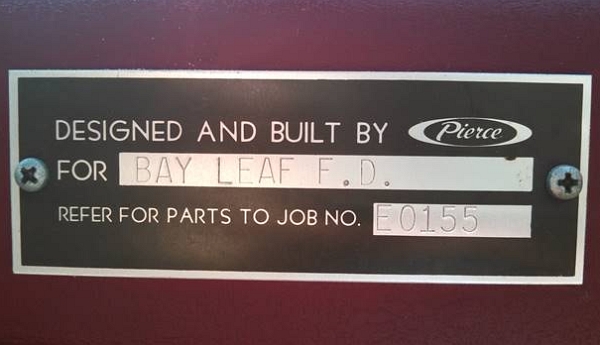
From a reader, this former Bay Leaf midi pumper was found in Erwin, TN. Former Unicio FD Engine 3, 1979 Chevrolet C-70/Pierce, 400/400. E0155. (Thanks Micah, for the specs!)
Another reader (via our Facebook page) tells that the truck was bought by Fire Chief D. Rogers, a former BLFD firefighter and officer. This was their first-out rig for many years. (Thanks Michael!)
Here’s a blog archives posting from 2014 on the subject of midi pumpers, with pictures of rigs that served Wilmington and Greensboro.
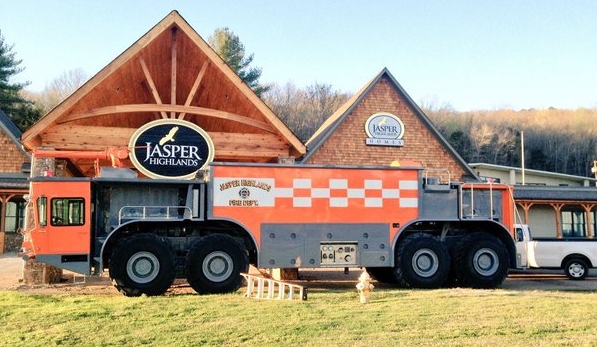
Would you believe an Oshkosh M-23 (rare civilian version of the legendary P-15) as a tanker for a Tennessee resort community?
This story from the Times Free Press has been making the rounds. There’s a development called Jasper Highlights in Marion County, TN. The area was previously covered by the Foster Falls FD, but last summer, they voted to remove the property from the district. Reason? Too far from the fire station. Would take twenty-minutes for a fire truck to reach location. (The community comprises over 8,893 acres, or 13.9 square miles, with twenty-six homes completed or under construction.)
No problem, said owner/developer John “Thunder” Thomas. He’s acquired and equipped three fire engines for their community and organized fifteen volunteer firefighters (including himself). They’ve even ask the elementary schools in three counties to help name the trucks. Cash awards will be donated to the schools that received the most votes. (Cost of the trucks and equipment was $300,000.)
Above is the full fleet: a new/newish Freightliner pumper/tanker, an older Mack CF pumper, and an orange-over-gray Oshkosh P-15 crash truck. Wow! The latter is their tanker. (And marketing attraction.) Specs on that monster? Weighs 65 tons. Carries 6,100 gallons of water, plus 515 gallons of foam. Twin diesel engines, twin 1250 GPM pumps. Length 45 feet, width 10 feet, height 14 feet. (For a while, its military counterpart the P-15 was listed in the Guinness Book of World’s Records as the most powerful fire engine.)
The rig was most recently stationed in Fort Hood, TX. And how the heck did they transport the thing to a mountain community? Check your maps. Sits right alongside Interstate 24.
It’s airport week at Blog Central! Time for some time travel…
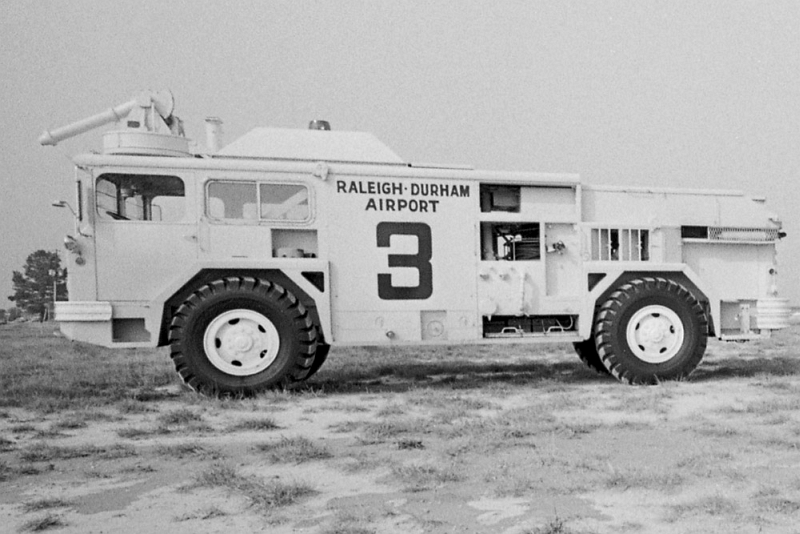
Raleigh-Durham International Airport has operated four Walter crash trucks in its day, the first being a 1959 Class 1500 that was acquired some time around 1970. Below is the closest we have to a posed photo of the thing. Click to enlarge:
News & Observer photo
About This Truck
Based on new research, this truck was acquired around 1970 or abouts. It wasn’t on the roster in 1970, and had disappeared from the roster by 1980. Yours Truly (cough, cough) had cited in his decade-ago timeline (lately updated) that the truck was delivered new. Wrong. Though there was a civilian version created around 1960, the turret configuration is different. This one’s an ex-military rig. Thanks MarkRedman, for that info.
Then what’s the story?
In 1969, the airport received a new International/Ansul dry-chemical rig. This raised the airport’s fire rating briefly, and then an Eastern DC-8 landed. Guess that was the largest jet to date, and they needed even more firefighting capabilities. The article said that ideas were being “kicked around” on how to raise the rating again.
By 1970, the airport master plan said that construction was underway of a 5,000 gallon, tractor-drawn foam generator. Was it ever built and/or delivered? Thinking not. Then a couple years later, a new 1973 Walter CB3000 crash was delivered. Where does the 1959 Walter fit into this?
Thinking that the 1959 truck was bought a bit before the 1973 truck. That would’ve immediately expanded their ARFF capacity until funds were available and construction was finished on the 1973 truck. (Hey, sounds good to me!)
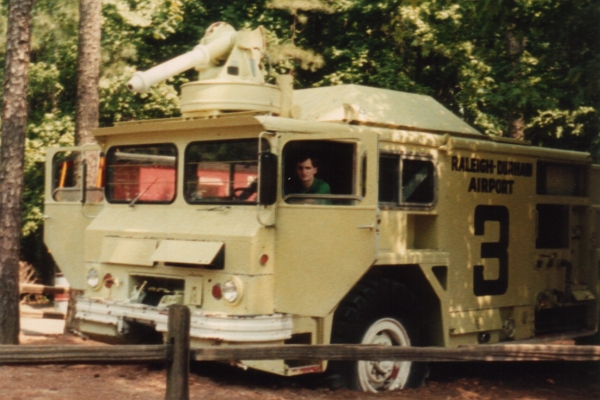
The 1959 truck operated until 1977, when a second new Walter rig was delivered. (Thanks Dale Johnson, for digging through your memory banks on this one.) It was retired and (immediately? later?) moved to the Durham Museum of Life and Science, where it sat outdoors as an attraction. It’s pictured here in 1985, with our friend (and military/ARFF historian) Pete Brock in the front seat:
Pete Brock photo
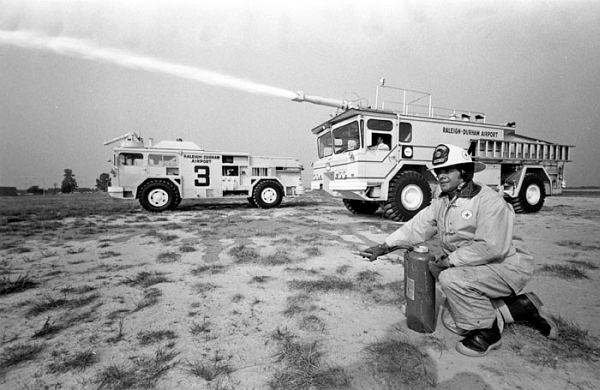
Wider Shot
The above image appears in this News & Observer photo from 1976, cropped from a larger image also showing the airport’s 1973 Walter CB3000, and Fire Chief Terry Edmundson. See more historical photos.
News & Observer photo
About The Class 1500
Military fire historian Ted Heinbuch (who runs Fire Trucks at War and its accompanying Facebook group) has written an excellent capsule history of the Class 1500. Read that excellent document (PDF). The truck was developed by the Army Corps of Engineers beginning in 1954, to “meet the challenges associated with new types of weapons, missile installations, and the increased use of aircraft at Army airfields.” Production started in 1959.
The 4×4 truck was powered by an eight-cylinder, 300 HP gas engine. The 1500 GPM two-stage pump powered a roof turret, two one-inch booster lines, and discharges for the 1000 feet of 2 1/2-inch hose and 100 feet of 1 3/4-inch hose it carried. Aboard were 950 gallons of water and 250 gallons of foam. Other features included a 20,000 pound winch. There were a total of 136 trucks produced for the Army.
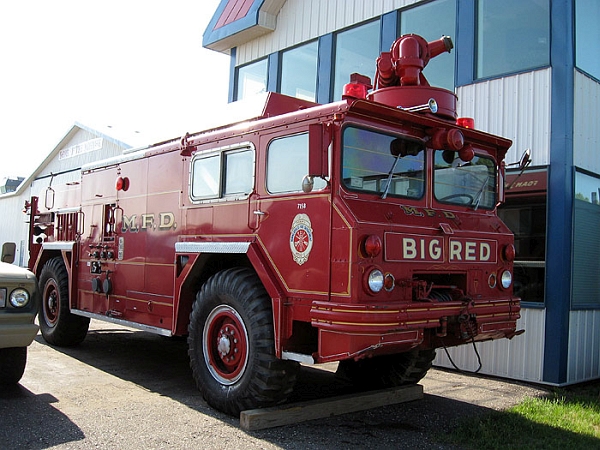
Here are some walk-around photos of a Class 1500 that served Minneapolis, MN, taken by Yours Truly some years ago at an air museum in Anoka, MN.
Mike Legeros photo
And a Trailer!
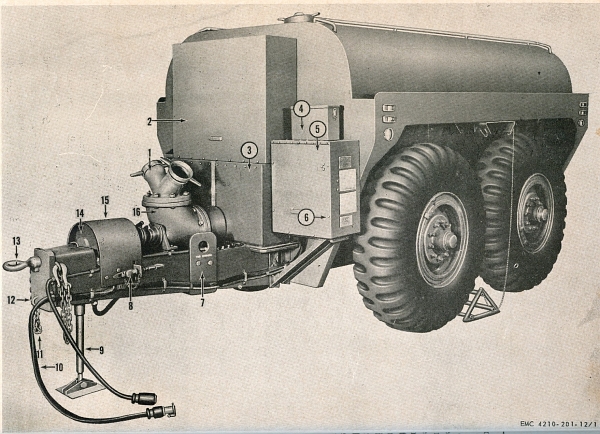
Heinbuch also includes information about the Sabre Fire Fighting Trailer, designed to be towed behind the Class 1500. It carried 2,000 gallons of water in a baffled tank, and was equipped with a 1500 GPM electric water pump. There was also a gas-fired heating unit for cold climates, that circulated warm water and air. The trailer road on flotation-type military tires, as did the crash truck. Eight of these were produced.
How cool is this thing?
Ted Heinbuch photo, via Fire Trucks at War on Facebook