https://legeros.com/history/library/
Let’s add a vintage manual to our ever-expanding digital history library. The original Jaws of Life and their 32-page manual, undated. Maybe… late 1970s or early 1980s?

https://legeros.com/history/library/
Let’s add a vintage manual to our ever-expanding digital history library. The original Jaws of Life and their 32-page manual, undated. Maybe… late 1970s or early 1980s?

This is a blog version of a Facebook posting, about details and units at a four-alarm explosion and fire in Charlotte. The narrative has been updated a bit, from the original posting.
Charlotte Observer photo
Four alarms were struck at a house explosion on Charlotte on Tuesday, July 3.
The incident was dispatched just before 2:00 p.m. as a reported explosion with fire at 11812 James Jack Lane. Tax records list the location as a two-story, single-family residential structure with 8,830 square-feet.
First arriving Ladder 32 found the structure destroyed, with a large debris field and a section of fire. Second alarm was requested, as were additional alarms for manpower and technical rescue assistance.
Two occupants were inside the structure at the time of the explosion: one deceased on scene, one with serious injuries. The latter was extricated after two and a half hours, and airlifted to the hospital. The deceased victim was located about seven hours after the explosion, by USAR personnel.
A number of firefighters were also treated for dehydration: seven treated on scene with IVs, and one transported to local hospital. Crews were working in 100+ degree heat.
Two people treated for minor injuries in neighboring homes. The adjoining homes also sustained damage. The primary cause of the explosion was identified as interior natural gas leak.
Google for news stories, photos/videos.
Run Card
Alarm Levels
Additional
City coverage from Harrisburg FD, Concord FD, Matthews FD, and Pleasant Valley FD (SC).
Plus MEDIC response that included several ambulances, supervisors, and a mass casualty bus.
Readers can add, edit, expand as desired.
The Wake County EMS System has a new numbering system for their ambulances. Now based on geographic district and shift configuration.
Among the notable changes:
The transition started around 9:00 p.m. on Sunday and finished around 10:00 a.m. on Monday, July 1.
Map

Numbering Old and New
Note: SE = Special Event
| District / Geo | Station | Old | New | |
| 1 – Downtown | DWN | District 1 | ||
| DWN | EMS 1 | EMS 10 | ||
| GLS | EMS 11 | EMS 17 | (day) | |
| CRL | EMS 13 | EMS 18 | (peak) | |
| WML | EMS 2 | EMS 12 | ||
| NCS | EMS 8 | EMS 11 | ||
| NCS | EMS 39 | EMS 19 | (peak) | |
| 2 – SW | FRV | District 2 | ||
| FRV | EMS 21 | EMS 21 | ||
| HLT | EMS 14 | EMS 24 | ||
| HLT | EMS 37 | EMS 29 | (day) | |
| FUQ | EMS 9 | EMS 23 | ||
| HSP | EMS 17 | EMS 22 | ||
| HSW | EMS 32 | EMS 28 | (peak) | |
| APM | EMS 20 | EMS 20 | ||
| 3 – NE | DRN | District 3 | ||
| DRN | EMS 15 | EMS 31 | ||
| MNC | EMS 5 | EMS 30 | ||
| MNC | EMS 36 | EMS 37 | (day) | |
| NHP | EMS30 | EMS 38 | (day) | |
| SHL | EMS 12 | EMS 33 | ||
| WFM | EMS 10 | EMS 32 | ||
| WFS | EMS 33 | EMS 39 | (peak) | |
| 4 – NW | SFM | District 4 | ||
| SFM | EMS 6 | EMS 41 | ||
| SFM | EMS 38 | EMS 48 | (peak) | |
| NHL | EMS 3 | EMS 40 | ||
| FRG | EMS 4 | EMS 44 | ||
| FRG | EMS 25 | EMS 1 | (SE) | |
| RDU | EMS 34 | EMS 43 | ||
| PLV | EMS 35 | EMS 49 | (peak) | |
| SFN | EMS 22 | EMS 42 | ||
|
5- West |
CRM | District 5 | ||
| CRM | EMS 51 | EMS 50 | ||
| CRM | EMS 55 | EMS 59 | (peak) | |
| CRM | EMS 56 (SE) | EMS 5 | (SE) | |
| CRM | EMS 57 (SE) | EMS 7 | (SE) | |
| CRN | EMS 53 | EMS 58 | (peak) | |
| CRW | EMS 52 | EMS 51 | ||
| MRV | EMS 54 | EMS 52 | ||
| 6 – East | WEN | District 6 | ||
| WEN | EMS 61 | EMS 62 | ||
| WEN | EMS 66 | EMS 69 | (peak) | |
| WEN | EMS 67 | EMS 67 | (day) | |
| ZEB | EMS 65 | EMS 63 | ||
| RVM | EMS 64 | EMS 64 | ||
| RVM | EMS 69 (SE) | EMS 6 | (SE) | |
| KDS | EMS 62 | EMS 60 | ||
| KDM | EMS 63 | EMS 61 | ||
| BTC | EMS 68 | EMS 68 | (peak) | |
| 7 – South |
GRE | District 7 | ||
| GRE | EMS 19 | EMS 72 | ||
| GRM | EMS 18 | EMS 71 | ||
| GRS | EMS 16 | EMS 70 | ||
| ERL | EMS 7 | EMS 73 | ||
| ERL | EMS 28 | EMS 2 | (SE) | |
| ERL | EMS 29 | EMS 3 | (SE) | |
| SAG | EMS 31 | EMS 79 | ||
| 9 – APP Units | ESEC | DIST 9 | ||
| HSP | Medic 91 | |||
| KDM | Medic 92 | |||
| SHL | Medic 93 | |||
| WML | Medic 94 | |||
| SFM | Medic 95 | |||
| ESEC | Medic 96 | |||
The summer edition of the now twice-yearly Raleigh Fire Department Newsletter has been published. The issue includes an interview with the Fire Marshal, an update on facility projects, a list of all retirements, promotions, and passings since the last issue, and more.
View the newsletter at https://raleighfirenews.org.

What’s happening with the city’s fire department construction projects? Here’s your summer update…
Station 6 – Construction continues on rebuilding Station 6 on Fairview Road. Concrete masonry unit walls are finished on the first story, and construction continues upward with the second-floor slab placed. Planned completion January 2020.
The 1949 engine house was closed in May 2017, and Engine 6 was relocated to Station 5. Project progress has been slower in all phases, alas. During site prep, there was fuel contamination from an underground storage tank, as well as unsuitable soils for compaction and structure.
And as the walls have started going up, the pace is slower due to the very small site size, which adds a limit to on-site materials and activities at any time. See photos | read blog post.
Station 11 – Renovations to Station 11 on Glen Eden Road are well-underway. Ladder 2 relocated to Station 25 on October 27, and Station 11 was vacated on December 5, when Engine 7 relocated to Station 7.
Renovations started in February, after demolition of the apparatus bay. The new, expanded bay structure has been completed, and interior work has started. Planned completion November 2019. See photos | read blog post.
Station 14 – Site work is nearly finished on new Station 14 on Harden Road. Sediment monitoring is nearing completion for the back fill of the retaining wall and footers and under-slab utilities should begin in July 2019.
Nearly identical to newly completed Station 12, it will replace a 3616 square-foot, 1974 engine house on Lake Boone Trail, with a 17,000 square-foot facility. See photos | read blog post.
Station 22 – The relocation of Station 22 on Durant Road is underway. Engine 22 and Ladder 5 were relocated to temporary quarters on February 5, 2019, at the Falls of Neuse water plant and Station 25 respectively. Haz-Mat 4, the decon unit, was also moved to Station 25.
Demolition of the vacated fire station was done in March and April. The new station will be erected at 10050 Durant Road.
Currently in design and plan review, facility is estimated to begin construction in the spring of 2020. The design team has to submit documents to the Board of Adjustment in August 2019 for final determination on multiple requested variances. See photos | read blog post.
Other updates:
New Station 1/HQ – Still planned for South Street between Dawson and McDowell street. The planned site is currently used as a vendor lot for the convention center. The city is in the process of purchasing nearby land as a replacement site for the vendor lot. Design of the new facility will commence in the fall of 2019, upon the closing of the South Street site.
Renovating Station 15 – Design development complete and renovation construction documents being prepared for potential bid in the fall of 2019. Targeting construction to begin upon the completion of Station 11 renovations, and moving Engine 11 and Ladder 2 (at Station 15) back to their quarters. This is the latest in a multi-year project to update legacy fire stations, after Station 5 and Station 2.
New Training Center, Phase 1 – Land acquisition and preliminary services have been funded for FY20. That’s the first part of the Phase 1 development, which is funded in FY20 and beyond. Planned site in the Battle Bridge Road area.
Plans for relocating Station 3 (Rock Quarry Road) and new Station 13 (Ronald Drive) have been pushed out. They’ll be funded in a future coming budget year.
https://www.legeros.com/
Added my digital history library. Have had for a couple years. Bought on eBay. List originally saved by Eric A. Sprenger (“Mr. Seagrave”), then shared by Ken Soderbeck. Original date unknown.
Scan of second-generation (or more) photocopy. Close as we’ll get to a Seagrave delivery list, I guess.
How many were delivered to North Carolina? See this blog post, from 2016: https://legeros.com/blog/seagrave-deliveries-in-north-carolina-1906-to-1951.
Found another firefighter fatality of yore, from an account in Daniel Bartholf’s new book “History of Firefighter in New Bern, North Carolina.” Here’s the story, from the book and newspaper accounts, copied from the state library in downtown Raleigh.
On February 26, 1951, a New Bern Fire Department engine overturned while en route to a grass. The driver, Robert Glenn Broadstreet Jr., was pinned beneath the truck. “Observers in the vicinity,” reported newspaper accounts, rushed to the scene, rescued the driver, and took him and the other firemen to the hospital.
Broadstreet was conscious and “apparently suffering no ill effects other than cuts” when he arrived at Craven County Hospital. During the night, however, he suffered a cerebral hemorrhage and entered a coma.
Three volunteer firemen were also aboard, and all suffered injuries and were also taken to the hospital: A. A. Kafer, with a fractured elbow and broken ankle; Clyde Smith, with shock; and Tim Connor, with no serious injury.
On Saturday, March 3, he underwent surgery to remove a blood clot on his brain. The operation was performed by a neurosurgeon who flew in from Winston-Salem. The three-hour operation was “regarded a success.”
Broadstreet was a new driver, who had started on February 15, noted the news story. This was his “fourth run.” The apparatus, described as “the old International,” responded from a fire at Askew Cleaners. It overturned while making the turn from Highway 17 onto Chattawka Lane, the reported location of the grass fire.
Broadstreet died from his injuries twelve years later, on January 5, 1963. He was 35 years old. He died at Craven County Hospital. Noted his obituary, he had “been ailing” from the 1951 accident. He was buried at New Bern Memorial Cemetery on Sunday, January 6, following funeral services at Pollock Chapel.
His death certificate lists “convolution” due to “severe brain injury” years ago as the cause.
The “old International” had its equipment all removed and was “carried to the city yard.” Except… NBFD didn’t have an International pumper on the roster! Mystery there, for someone to solve…
Supporting docs are below. Click to enlarge:
New book alert!
History of Firefighting in New Bern, North Carolina – Colonial Days to the 21st Century has been published. The author is Daniel Bartholf, a 45-year veteran of the volunteer fire service (NY, NC, WV) and a member of the staff at the New Bern Firemen’s Museum. His bio is below.
The softcover book measures 8.5 by 11 inches and has 234 pages. There are some 200+ images (by my count), and numerous, glorious pictures of NBFD in the days before motor apparatus. The book is self-published.
Paging Through
Here’s a video preview of the book, paging backwards through the chapters:
Table of Contents
Here’s the table of contents:
Ordering Information
The book is sold on Amazon and Barnes and Noble, for starters. The retail price is $29.99. Copies can be obtained from the author himself. Contact wxman232@yahoo.com.
Bartholf will also be attending the fire truck festival at the North Carolina Transportation Museum in Spencer, NC, on Saturday, June 22. He’ll have a table in the Back Shop.
About The Author
Daniel Bartholf is a 45-year veteran of the volunteer fire service, serving mainly in several departments in New York state, but also in North Carolina and West Virginia. He has held positions of Fire Chief, Assistant Chief, Captain and Lieutenant, and was certified as a Level II Firefighter.
In addition, he was certified as a Hazmat Technician, was a member of the Onondaga County (Syracuse) Underwater Recovery Team (SCUBA), and wrote articles for Fire Chief, Firehouse, and Engine Engine! (official publication of SPAAMFAA) magazines.
He was employed as a meteorologist with the National Weather Service for 35 years and served in offices in Buffalo, Albany, Syracuse, Newport (NC), and Charleston (WV).
Dan holds a Bachelor of Science Degree in Meteorology from the State University of New York at Oneonta, and a Masters Degree in Public Administration and Emergency Management from Jacksonville (FL) State University.
Antique acquisition alert!
The Wake Forest Fire Department has re-acquired their old 1947 Chevrolet 6000/Southern pumper[1]. It was delivered in 1948, and replaced a 1934 Chevrolet pumper, which was given to the town’s second fire department, Wake Forest Fire Department #2.
They were an all-black department, that operated separately from WFFD. And were one of the few all-black fire departments in our state, in modern times.[2]
See pics of this truck, plus a couple historical images, at https://www.flickr.com/photos/legeros/albums/72157709108683743
Moved in 1953
In 1953, the town received another Chevrolet pumper with front-mounted pump, that one a 1951 model year and built by American, according to Legeros.[3]
Upon the 1953 delivery of the 1951 pumper, the 1947 pumper was moved to Wake Forest Fire Department #2. And their 1934 pumper was sold to the town of Sanford, and eventually ended up in a small town near Spartanburg, SC.
And was still in service in South Carolina of February 1972, records Legeros at https://legeros.com/ralwake/wake/history/wake-forest.shtml.
Photo courtesy Wake Forest Birthplace Society
Then What Happened?
How long did Wake Forest Fire Department#2 operate their 1947 pumper? Good question! Based on these later photos, WFFD #2 also operated the 1951 Chevy pumper, which also had a front-mounted pump.
The picture on the right is dated January 1977. By that time, the Wake Forest Fire Department had upgraded their pumpers a couple times. Most likely, the 1951 Chevy pumper was transferred to WFFD #2. Did they keep the 1947 Chevy pumper on the roster? Good question.
The department disbanded in 1982, with its few remaining members merging with WFFD. The 1947 Chevy pumper eventually ended in the hands of a private owner, in Broadway, NC. It returned home this month.
Recall that Wake Forest Fire Department recently acquired another earlier engine, the original rural fire truck. That 1942 Chevrolet with a home-built body was returned in 2016. It’s presently undergoing a restoration. See pics of that truck at https://www.flickr.com/photos/legeros/sets/72157673628037806.
About Southern
Southern Fire Apparatus was located in Roanoke, VA, and operated by fire equipment dealer Charles E. Baker, who built a number of motor apparatus in the 1930s and 1940s, notes Walter M. P. McCall in his book “Illustrated Encyclopedia of American Fire Engine Manufacturers.”
[1] Legeros previously recorded the builder as American Fire Apparatus, with a 500 GPM pump by Barton, and a 500 gallon tank. That information is incorrect. The truck has a name plate from “Southern by Chas. E. Baker – Roanoke, VA” which includes the serial number “583”.
[2] Other all-black fire departments in modern times included Warrenton FD and Soul City FD. There were also many black fire companies back in the day, both in big cities in the 1950s and 1960s, and across the state in the early 1900s and mid- and late 1800s. Learn more on this page of Early Black Firefighter history: https://legeros.com/history/ebf
[3] Okay, Legeros was wrong about the builder of the 1947 Chevy. Is he also wrong about the builder of the 1951 Chevy? Good question. He hasn’t dug into his source records (yet) to check. Southern Fire Apparatus, noted above, operated only through the 1940s, says Mr. McCall. And American Fire Apparatus did build a couple other trucks for departments in Wake County, including Rolesville FD and Six Forks FD.
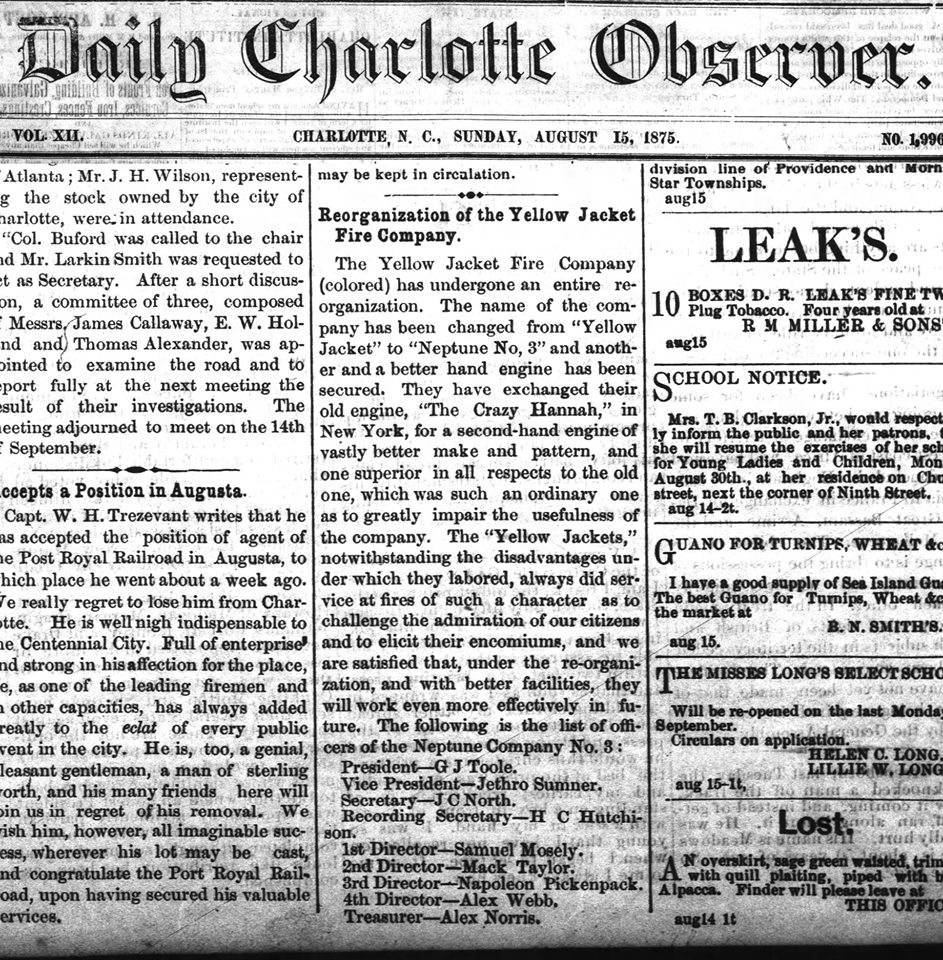
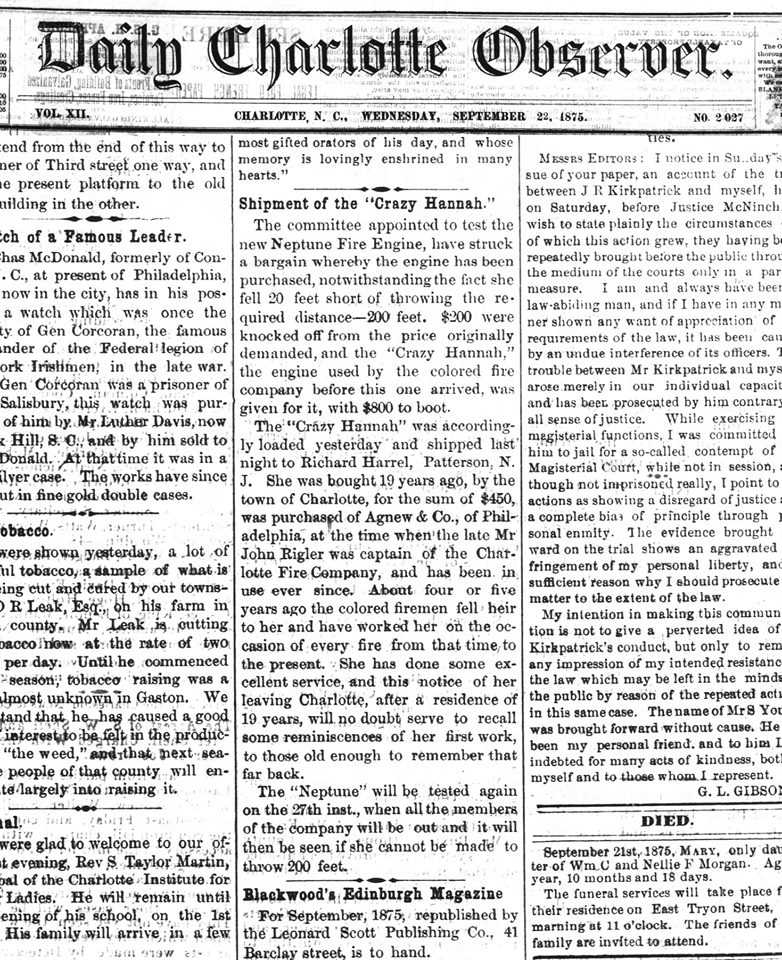
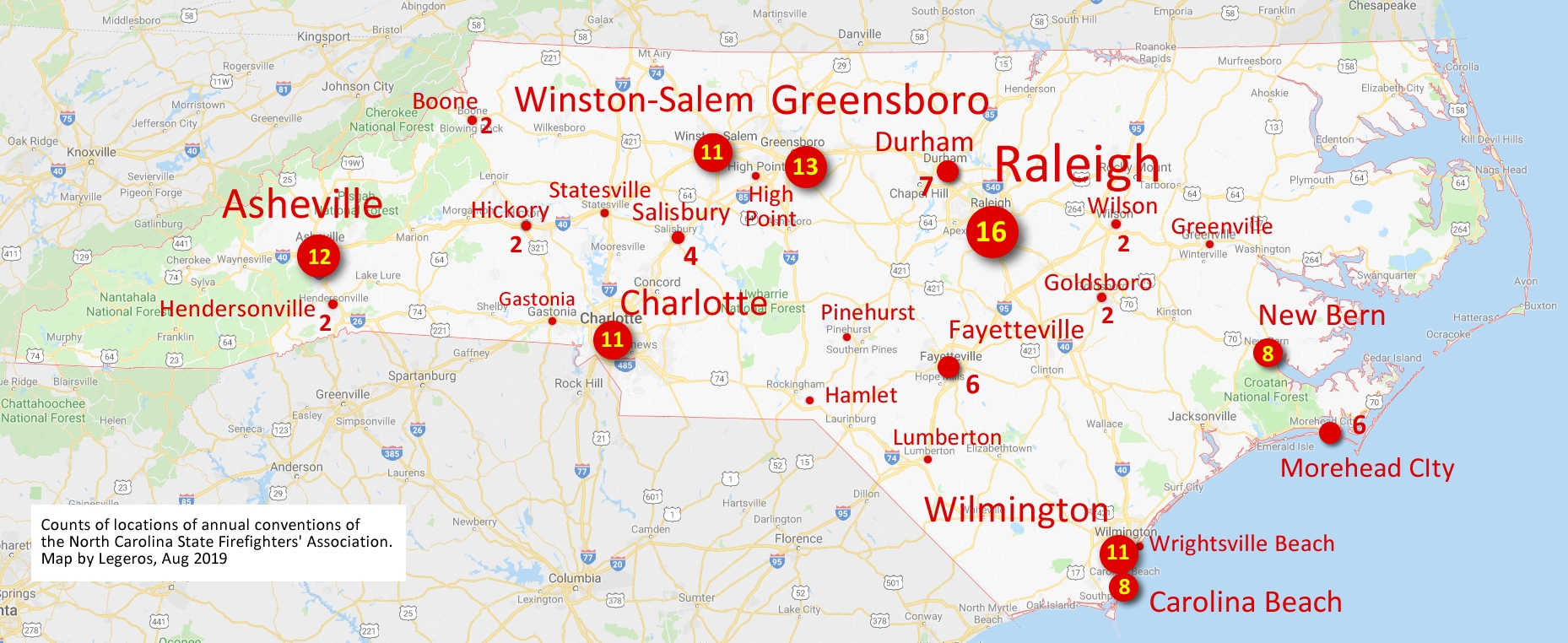
There’s a new source of digitized proceedings of the early conferences of the North Carolina State Firemen’s Association.
The Internet Archive (archive.org) has digitized a portion of the proceedings in the North Carolina Collection at the University of North Carolina. The direct links are listed below, and each year’s proceedings is fully-searchable. There are also a range of download formats.
Completed:
Pending:
The proceedings are available at archive.org. Search on “firemen’s convention” [with apostrophe].
Legeros has also created digital versions of the 1896 to 1903 proceedings, using a book scanning camera at Wilson Library at UNC. They’re a little rougher.
He’s combined the Internet Archive versions with his versions, and merged everything together. Those and other digital NCSFA (and NCVFA) proceedings are available at www.legeros.com/history/fa/proceedings.