Wake County EMS System Family Tree – Updated

With the coming closure of Apex EMS on June 30, 2018, here’s an updated version of my Wake County EMS System family tree. Includes numerous nips ‘n’ tucks as well, and a couple added notes about recent milestones. 

Visualizes the origins of local ambulance and rescue services, from the original funeral home providers, to the community volunteer rescue squads, and to the current paramedic service providers. Now down to three. 

View as JPG (6.6 MB)  | View as PDF (6.6 MB) 

See more charts.

2018-06-20-chart

Facebook Comments

Long Beach, Yaupon Beach, Oak Island, Southport – History Notes

Last updated 7:00 a.m., July 25

This posting is undergoing updates, with clarifications on the coming current changes, and as additional historical perspectives are added.

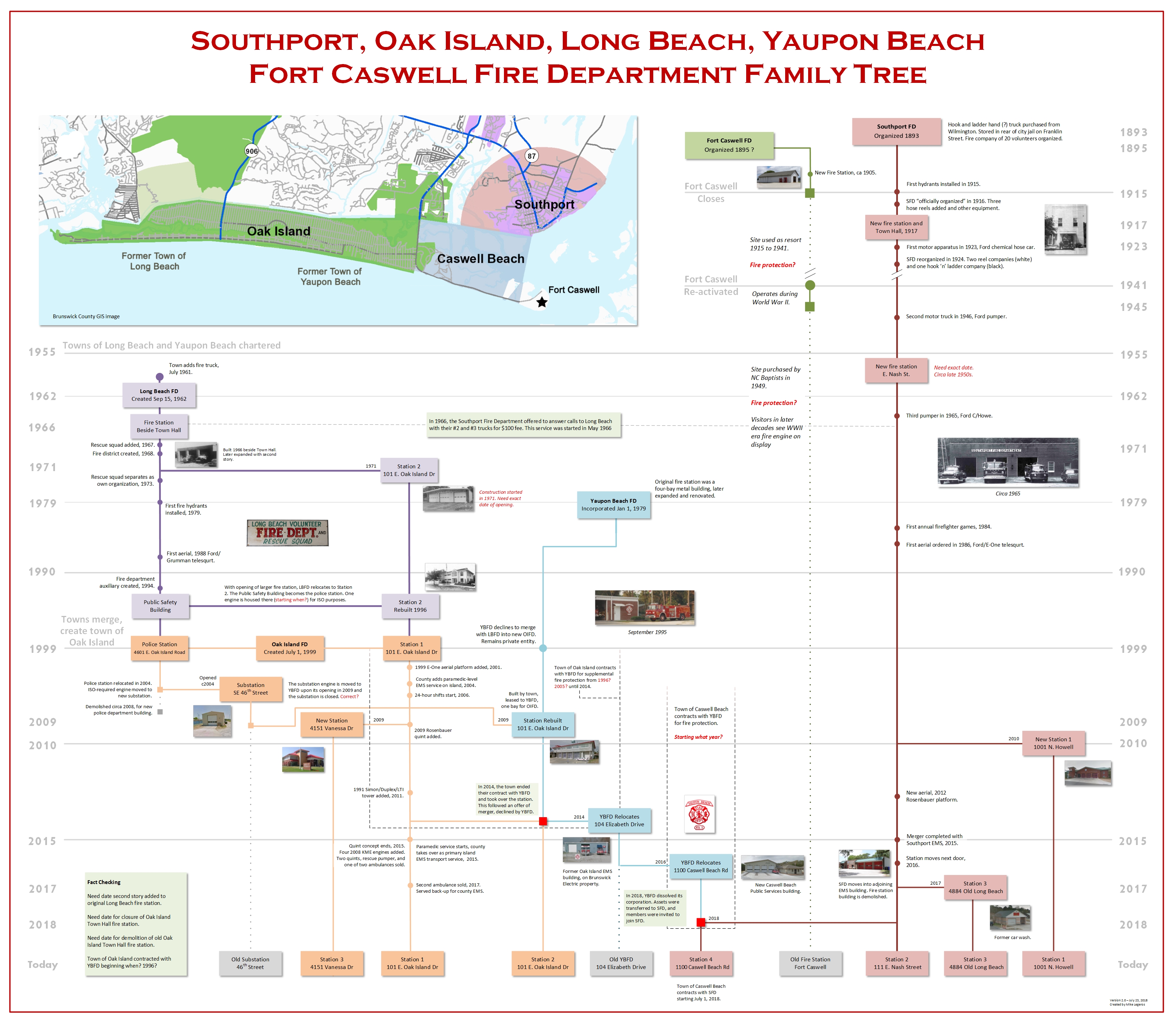
News out of Brunswick County. Yaupon Beach Fire Department is dissolving, and transferring their assets to Southport Fire Department. Members of YBFD are also joining SFD. [ Previously reported as a merger of YBFD into SFD. ]

Starting July 1, 2018, the town of Caswell Beach will contract with the town of Southport for fire protection. The beach town had long-contracted with the private Yaupon Beach FD, who occupies a town-provided public services building.

Here’s a WWAY story about the coming changes, though they refer to Yaupon Beach FD as Caswell Beach FD. 

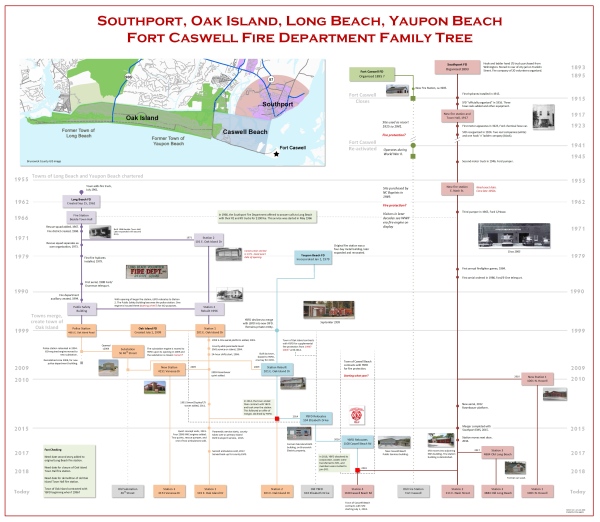
What’s the historical perspective of YBFD, Caswell Beach, and its neighboring fire department on Oak Island? Here are some notes that Mr. Blogger has compiled and collectively revised, with assistance from readers on this Facebook thread

Click to enlarge:

2018-06-19-map

Historical Perspective

1950-1969

  • 1954 – Long Beach destroyed in Hurricane Hazel.
    • Only five of 357 buildings survive.
  • 1955 – Town of Long Beach incorporated.
  • 1955 – Town of Yaupon Beach incorporated.
  • 1961, July – Town of Long Beach has a fire truck, and is operational.
    • Six-wheeled military surplus tanker bought as surplus from Cherry Point.
    • Carries 1200 gallons, with two pumps, including new low-volume, high-pressure pump.
    • They add hoses, ladders, axes, etc. Town also had 550 gallon, trailer-mounted water tank.
    • Housed in garage adjacent to the 1960 town hall building.
  • 1962, Sep 15 – Town ordinance for creating Long Beach Volunteer Fire Department.
    • Organized by town manager with twelve volunteers.
      • Formal training began on July 23 (1962?) in Southport.
  • 1966, Oct –  LBFD fire station completed. Construction took two years.
  • 1967, Feb – Long Beach awards bid for new fire truck to C.W. Williams of Rocky Mount.
    • Will replace “ancient truck” from Sanford, which is being returned to Sanford.
  • 1968, Jul 20 – Long Beach adopts fire district resolution, named Tranquil Harbor Fire District 1.”

1970-1989 Continue reading ‘Long Beach, Yaupon Beach, Oak Island, Southport – History Notes’ »

Facebook Comments

The Perils of Historical Shorthand

Learned a good lesson the other day.

I’ve long-used shorthand, for noting the concept of “one year or the next year.” For example, writing “the fire truck was a 1950 or 1951 Ford” as “the fire truck was a 1950-51 Ford.”

No problem, right? But watch what happens here:

  • 1950 – The fire department was organized.
  • 1951 – The fire engine was purchased.
  • 1951-52 – The fire station was built.

The third line can mean either (a.) “the fire station was built in 1951 or 1952” or (b.) “the fire station was built during the years 1951 and 1952.” And that, my friends, is a problem.

Interpret Carefully – Be Explicit

As a self-taught historian, I’ve been making things up as I go, and learning best practices by the examples of others, and my own experiences along the way.

One of the most important points is interpretation. Assume nothing. Interpret carefully. And, as I learned this in this example, explicitly state what you are stating, versus relying upon your own shorthand.

In the future I will be paying much closer attention to this.

Do I need to go back and revise all manner of materials? Probably not. It’s too time prohibitive to begin with. 

In some cases, my shorthand works fine. If I’m listing, say, the model years of vehicles, saying 1950-51 works fine. But in a narrative context, as in the second example, it’s a potential point of confusion.

Lesson learned.

Facebook Comments

Monroe Fire Company No. 1 – Constitution and By-Laws

For your Saturday reading pleasure, a vintage document from Monroe, NC. 

Constitution and by-laws of Monroe Fire Company No. 1.

Undated, probably from early 1900s. Scanned from physical copy at Wilson Library at NC, part of the North Carolina Collection. Call number  Cp971.90 M75m1 

Read the document (PDF, 2 MB)

2018-06-09-mfd

Facebook Comments

Fraternity Fires in Chapel Hill – 1909 to 2001

This posting was originally posted on Facebook, on the Chapel Hill Fire Department Retirees & History page.

Every part of a community is invariably impacted by fire. And as the clock is turned back, toward simpler times with fewer priorities on life safety and fire prevention, the numbers of destructive blazes invariably rise.

Here’s a list of the major fraternity fires at the University of North Carolina in Chapel Hill, over the last century. The list tragically culminates in the town’s and campus’ deadliest fire in 1996, when five college students died in a morning fire at Phi Gamma Delta.

2018-06-08-chfd

Today, there are 29 fraternities at UNC, says the web. This list of 25 fires represents 18 different fraternities. (And sororities as well? There may be one or more in there. )

Excluded are many, many, smaller fires at these and other Greek houses. Plus any other major fires that Mr. Blogger hasn’t yet discovered in his research..

What were the life safety milestones, over these periods? What sort of fire protection systems were added, as the decades passed? Good question. May update later, with more information.

By decade, the numbers are:

  • 1900s – 1 
  • 1910s – 1
  • 1920s – 4
  • 1930s – 1
  • 1940s – 1
  • 1950s – 2
  • 1960s – 3
  • 1970s – 4
  • 1980s – 1
  • 1990s – 1
  • 2000s – 1

List of Fires

1909, June 2 – Alpha Tau Omega – Destroyed – DTH, Jun 5, 1909

1919, Jan 8 – Three houses: Sigma Alpha Epsilon, Pi Kappa Phi, Sigma Nu. Alarm ~2:00 a.m. Durham called, but arrived too late to help. Campus library protected with hose streams. All three destroyed. Loss over $20,000 – DTH, Jan 17, 1919; Charlotte News, Jan 1, 1919

1927, Jan 13 – Phi Delta Theta – Alarm about 12:30 a.m. Controlled in about hour, extinguished by 2:30 a.m. Wooden building, 13 years old, was destroyed. $10,000 damage – DTH, Jan 15, Jan 19, 1927.

1927, May 6 – Alpha Tau Omega – Alarm ~10:10 a.m. Building gutted – DTH, May 5, 1927.

1928, May 6 – Phi Delta Theta – Starts about 12:30 p.m. Building largely destroyed – DTH, May 8, 1928.

1929, Dec 12 – Delta Sigma Phi – Building 75 percent destroyed – DTH, 13, 1929.

1931, Mar 22 – Two fraternity houses – Alarm ~5:00 a.m. for both fires. Deserted Tau Epsilon house and Alpha Kappa Kappa house – DTH, Mar 24, 1931.

1948, Feb 1 – Alpha Gamma – Battle Lane. Alarm ~4:45 a.m. Fire in attic. $6,000 damage – DTH, Feb 19, 1948.

1953, Dec 18 – Pi Kappa Phi – Rosemary Street. 4:00 a.m. Caused by defective furnace in basement. Building gutted. $40,000 damage – DTH, Jan 5, 1954; Oct 15, 1955; CHW, Jun 15, 1956.

1954, Nov 9 – Kappa Alpha – 110 W. Cameron Street. Alarm ~9:05 a.m. Building gutted. $8,000 damage – DTH, Nov 9, 1954; Oct 15, 1955.

1964, Apr 2 – Kappa Sigma – Alarm 10:55 p.m. Controlled ~11:30 p.m. Extinguished 1:30 a.m. Displaced 22 residents. First floor gutted. $50,000 damage – Apr 4, 1964.

1966, June 19 – Kappa Alpha – Started 4:10 a.m. Controlled after an hour. Started in basement by two teen girls. Partially destroyed first floor. $40,000 damage – DTH, Jan 23, Sep 15, 1966.

1969, Dec 25 – Phi Kappa Sigma – Arrived 10:18 p.m. Controlled 3:00 a.m. Building gutted. $175,000 to $250,000 damage – DTH, Jan 6, 1970.

1971, Oct 24 – Delta Kappa Epsilon – Alarm 6:10 a.m. Carrboro firemen also responded. Over two hours to control. Building gutted. $200,000 damage – DTH, Oct 25, Oct 26, 1971.

1975, Oct 6 – Sigma Nu and Delta Kappa Epsilon – Alarm ~3:00 a.m. Suspected arson. Investigation continues for several months. No arrests made – DTH, Oct 10, 1975; DTH, Jan 12, 1977.

1976, Dec 1 – Pi Kappa Phi – 216 Finley Road. Alarm 1:15 a.m. Built 1967. Total loss – DTH, Dec 2, 1977.

1977, Jan 5 – Pi Lamba Phi – Discovered 2:16 p.m. Controlled 30 to 45 minutes. Building gutted. $90,000+ damage – CHN, Jan 6; DTH, Jan 12; DTH, Nov 17, 1977.

1989, Oct 5 – Zeta Psi – Alarm ~5:45 a.m. All four pumpers were used. Carrboro sent one truck to cover town. Third/half of building destroyed – DTH, Oct 8, 1996.

1996, May 12 – Phi Gamma Delta – 108 W. Cameron Ave. Alarm 6:07 a.m. Five students killed, three injured. Town’s deadliest fire. Built 1923 – N&O May 13, 1996, for starters.

2001, Mar 28 – Kappa Sigma – Little Fraternity Court. Empty fraternity house. Under major renovations including a mandated sprinkler system. $150,000 damage – CHH, Mar 29, 2001; WRAL, Mar 27, 2001.

Sources

Major sources include:

Facebook Comments

Kenansville Fire Department Starts Ambulance Service, 1955

“Believed to be the only ambulance as such owned by a volunteer fire department in North Carolina,” noted the Duplin Times on July 14, 1955. See article below

Definitely one of the earliest. What other volunteer (only) departments were operating ambulances at that time?

That’s the open question to readers, to accompany these neat pictures and a bit of history shared by our friends in Kenansville. Top is a 1962 Carryall, from around 1964. Bottom left is a 1968 Chevy, one of three. Department-owned, though KFD received some county monies to operate. Bottom right is a 1975 Chevy Type I. Bought new and customized in Kinston.

Fire Chief Danny Chambers shares this history:

Kenansville FD operated EMS services until 2004, when they ceased operations on February 14. Duplin County EMS was providing service by that time, but primarily Monday to Friday, during daytime hours. On April 1, 2004, DCEMS started their first 24/7 shift, with one unit, and supplemented by the volunteer EMS units that were still active. (Our neighbors Warsaw EMS had recently shut down operations as well.)

By that fall, DCEMS had six 24/7 units. They progressed to paramedic level within months. Today, they operate eight units, and only two volunteer EMS units still operate.

Basically, KFD ran an ambulance from 1955-2004. They were mostly “load and go” until 1966, when the first ambulance service studies and white papers came out. Then in 1978, the funeral homes here gave notice that they were getting out of the ambulance business. Duplin County then organized what they called a “rescue unit” (ambulance) that consisted of three volunteer trucks, all manned by FDs. With more units started in the next few years. The county eventually had three rescue/EMS only stations and five FD-run ambulances.

Because we were centralized, KFD was tasked with responding with the first hydraulic rescue tools in the county. In 1978, the Duplin County Rescue Association purchased a Hurst rescue tool. It was placed on a 1974 Chevy truck with a Reading service/utility body. The truck was KFD owned. For a period of time, this was the only extrication tool in Duplin county. Later, other departments started adding them. We owned and operated this Hurst tool until 1995, when we purchased a set of Halmatro tools. The original Hurst tools were sold to Dover FD.

We initially carried only basic rescue equipment in the ambulance. Hand tools, jacks, etc. The 1962 Carryall served as both our ambulance and rescue unit. It was designated unit 156. We still perform vehicle and machinery extrication. Only department in Duplin County is classified as a light-duty rescue, I believe, and that’s Faison FD.

At KFD, we had two rosters, one for fire and one for EMS. However, most of our EMS personnel were also firefighters and had to meet training requirements for both.

2018-05-30-kfd1

2018-05-30-kfd2

Facebook Comments

Chapel Hill’s 1980 Mack… Was Almost a Seagrave

Mack CF pumpers were popular trucks in these parts. Chapel Hill had a 1980 model… that was almost a Seagrave. Here’s that story.

After soliciting bids for a new pumping engine that year, the town awarded the contract to Seagrave for $112,832.35. The other bidders were Central Mack Sales in Raleigh, Howe Fire Apparatus, Jack Cocke and Co. in Alabama, and Jack Slagle’s dealership in South Boston.

One year later, the town learned that Seagrave had filed for bankruptcy. And no apparatus would be delivered. In December 1981, Central Mack Sales was awarded the revised/replacement bid.

Price of $116,817 for model number CF 686F (12)-1398, which was a stock truck. Delivery in 20 working days. 

See minutes below, and later-decade photo from Lee Wilson. 

2018-05-26-chfd1 2018-05-26-chfd2


Facebook Comments

Chapel Hill Buys Ex-Airport Pumper, 1963

Wait, what?

See these town minutes* from February 16, 1963. As it turns out, Chapel Hill’s 1962** American LaFrance pumper was a gently used model, that had been serving at the “Greenville airbase” for about three months, while the airport awaited delivery of a crash truck. Bought for $20,500, versus what would cost $26,000 new.

As was customary during those decades, the University agreed to pay half. 

* Town minutes are available online and as far back as 1952. Wow! For max efficiency, however, you’ll need to (a.) download each, (b.) combine the PDF files, and (c.) perform OCR, to make them the most usable. Such as using Adobe Acrobat. 

** Model year 1962 as best as can tell, though have seen citations as 1960.

2018-05-26-chfd-2

2018-05-26-chfd1
Lee Wilson photo

Facebook Comments

Four Shelby Firefighters Killed in Explosion, May 25, 1979

Update April 11, 2019 – Though initially suspected as caused by a natural gas explosion, it was later eliminated by investigators. Instead, they suspect a backdraft caused the explosion. See the detailed OSFM retrospective below. Updated this posting headline, changing “gas explosion” to “explosion” to reflect that important clarification. 

This retrospective first appeared on FireNews.net in 2006, as the North Carolina Fallen Firefighter’s Foundation dedicated their new memorial in Raleigh. It also appears on my fallen firefighter’s history page. This posting also replaces a 2009 blog posting that linked to other retrospectives, which are now unavailable. 

Apparently Routine Fire

One of the darkest days in North Carolina’s fire service history started as a smoke investigation in downtown Shelby around 6:15 p.m. Firefighters arrived in the 100 block of West Warren Street and found an apparently routine fire in the rear of Geoffrey’s Men’s Clothing Store. About thirty minutes into the incident, a sudden blast shook the store and sent bricks and glass flying into the streets. Walls had collapsed, firefighters were buried, and heavy fire and smoke was pouring from the rear of the two-story structure.

Four firefighters and a civilian gas department employee were dead. Another 12 firefighters were injured. Killed instantly in the street in front of the building were volunteer firefighter George Magness, 44, career firefighter Nathan Hall, 27, and volunteer firefighter Donald Melton, 24. Magness was also the chief of the 12-member volunteer fire department. Career firefighter Floyd “Nicky” Sharts, 31, was found dead beneath the rubble in the alley behind the building. Gas department employee Max Bowling, who had apparently gone to the scene to shut off the building’s gas supply, was also found dead in the alley.

2018-05-25-shelby
Lem Lynch photos

Believed caused by a backdraft in a void between the building’s first and second floors, the explosion snapped surrounding trees in two, twisted street lamps, and destroyed a 1972 American LaFrance pumper. Some 50 people were on the sidewalk when the building exploded and 31 were injured. By sunset, the streets were filled with thousands of onlookers.

Ten Fire Departments for Mutual Aid

Mutual aid from Cleveland, Boiling Springs, Boiling Springs Rural, Grover, Kings Mountain, Oak Grove, Shanghai, Waco, Fallston, and Polkville brought over 230 firefighters to the scene. Tractors and front-end loaders were also employed to remove rubble so firefighters could battle the blaze.

Within hours, the entire block was lost. Geoffrey’s Men’s Clothing Store, J.E.’ Department Store, the Bible Book Store, Wonderland Toys, Butler’s Shoe Store, and Eleanor Shops were destroyed. Damages totaled $5 million.

Intentionally Set

Investigators, which included dozens of federal, state, and local law enforcement agencies, later determined that the fire had been intentionally set. The owner of the store was convicted on five counts of voluntary manslaughter and served 10 years of a 90-year jail term.

Five separate funerals were conducted on Sunday, May 19, and hundreds of the city’s 17,000 residents filled a local church for a memorial service the next day. A memorial fountain at Shelby’s Charles Road fire station bears the names of their fallen heroes.

OSFM Looks Back

Read a retrospective (PDF) from the Winter 2006 OSFM Fire-Rescue Journal by Melissa R. Lentz. The article includes contact information (at the time) for photographer Lem Lynch.

2018-05-25-shelby2

Facebook Comments

Zebulon Fire Department Facility and Fleet Study

In February 2018, the town of Zebulon received the results of a fire facilities and fleet study (pdf) conducted by Brooks Innovative Solutions, from Greensboro. 

It examined the fire department’s current infrastructure, historic and projected call volume and service now, and property and population development past ‘n’ present.

And both in the municipal and rural fire protection districts–the latter of which is provided through contract protection with the county.

What did they find?

Here’s the short version…

2018-05-25-zfd

Facility

  • One fire station, built in 1974. Expanded in 1980s with additional bay space and larger training room. Expanded again in 1990s to add office and equipment space and increase bay space. Renovated in 2000s to add sleeping quarters and other interior changes.
  • Based on current and projected demand and growth, second fire station isn’t needed. BUT the current fire station needs to be replaced and relocated.
  • Building is undersized and does not provide critical infrastructure for either fire department public. Station square feet, for example, is less than 50% the size of a comparable prototype station. See study for details of deficiencies.
  • New station location is also needed, to better serve the district(s). Suggested spot is around US 64/264 and Arendell Avenue. Recommend develop plans for relocation. Seek participation with both county Fire Services and county EMS.
  • The replacement station should be 13,500 to 18,000 square feet and include features of the Wake County Prototype Headquarters Station. Site should large enough to include some “drill yard” capabilities, e.g. 2.5 to 3.5 acres. Suggested estimated budget ~$350,000 for planning and design, and $3.5 to $4.5 million for land and construction.
  • Develop long-term plan for additional fire stations, looking 15 to 20 years forward. And, alas, the Green Pace Road property, purchased some years ago as a potential Station 2 site, be repurposed for other use than emergency response. It’s location isn’t ideal. (Though at the time of site selection, there were plans for development in that area.)

Fleet

  • Current fleet includes three pumpers, one aerial platform, one medium rescue, one brush truck, one tanker, two command/support vehicles, and one utility vehicle. (No apparatus are designated as reserve, but units can be moved around to cover as needed.)
  • Fleet is aging, with several pieces well past the age of using as reserve or retired. Ladder 95 is 31 years old. Pumpers are 21, 11, and nine years old. Average fleet age is 14 years.
  • Immediately replace Ladder 95, a 102-foot platform, and with a 75- or 85-foot platform on a lighter and much shorter chassis.
  • Replace Pumper 91 the following year.
  • Consider configuring either Ladder 95 or Pumper 91 replacements as a rescue ladder or rescue pumper. This would help reduce fleet size, result in more efficient unit usage, relieve some floor space requirement, etc.
  • Develop a fleet capital plan, and begin programming replacements for Pumper 94 and Pumper 92. And use a vehicle score card system (as used in study) or similar process to help manage fleet replacement and capital program.

Bits & Pieces

  • Town was planning for growth and expanded services in mid- to late-2000s, including land purchased for a second fire station. Then economy shifted and developed slowed to nearly a stop. Took eight years before demand for services returned to 2017 levels.
  • Growth is projected to escalate significantly over the next decade or more. One study suggests that the town’s population could triple by 2030.
  • Department has ISO ratings of 3 (town) and 4 (rural district). They protect 10,000 people in area covering 29 (!) square miles. Four miles in town and 25 in rural district.
  • Town and rural districts are “intertwined and inextricable.” The fire department has served both so effectively and for so long that the “combined jurisdiction is seen as the entire community.”
  • From a ten-year study, total responses are 68% in town and 31% out of town. For 2016-2017, calls outside their jurisdiction (mutual aid and service agreements) comprised just 84 responses.
  •  Rescue and EMS remain the largest percentage of all call types, and growth is forecast as nearly flat. Fire incidents are the third largest percentage of all call types. Though they have the highest risk for major loss, the gross number of these calls has been declining for the last decade. This is expected to continue.

Read the study (pdf)

Facebook Comments